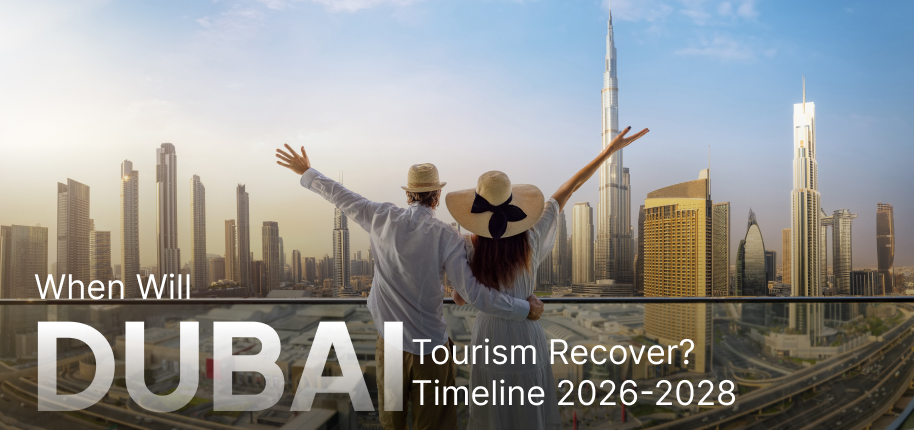
Dubai’s hotels have gone quiet. Beaches that were packed months ago now look like the cover of a crisis report. If you own or operate a hospitality business here, you have been asking the same question every morning: When do tourists come back?
The answer is not “nobody knows.” There is a clear, data-backed pattern to how global tourism hubs recover from regional disruption, and Dubai’s fundamentals give it one of the fastest recovery profiles of any city in the world. The UAE hospitality market has survived shocks before. It absorbed the 2008 financial crisis, the post-Expo demand cliff, and the complete collapse of global travel in 2020. Each time, it came back stronger and with a larger share of the global travel market.
What is different this time is the speed of the initial shock. First-quarter 2026 passenger traffic at Dubai International Airport fell by at least 2.5 million compared to the same period in 2025, with March alone seeing a 66% drop in passenger numbers as travellers avoided the Gulf region. Hotels that were running at 81% occupancy in January and February found themselves at 22% within weeks. That is a sharper drop than the early months of COVID-19.
But the fundamentals that made Dubai a global hospitality powerhouse have not changed. The infrastructure is intact. The brand is intact. The government has resources and the political will to deploy them. And crucially, the demand that existed before the crisis, 19.59 million international overnight visitors annually do not simply disappear. It defers. It builds. And when confidence returns, it releases.
This article gives you a month-by-month timeline from now through 2028: occupancy forecasts, capital strategy by phase, staffing realities, regional recovery patterns, and what business models actually work at each stage of the Dubai tourism recovery.
The Pre-Crisis Baseline: What “Normal” Looked Like
Before mapping the Dubai tourism recovery timeline, you need a precise picture of what you are recovering to and why it is worth fighting for.
In the most recent full operating year, Dubai recorded 19.59 million international overnight visitors, a city that had absorbed 22% growth compared to pre-pandemic 2019 levels. Dubai International Airport handled 95.2 million passengers, making it one of the highest-traffic single international airports on the planet. For context, that is more passengers than London Heathrow and Singapore Changi combined.
The Dubai hotel occupancy rate in 2025 sat at 79–81%, among the highest city-wide averages of any major tourism market in the world. Average daily rates had reached AED 745 at the premium end. RevPAR the composite health signal for any hotel market, was setting records quarter after quarter.
Hotel market in numbers
- 280+ hotels, 100,000+ rooms across all categories
- Peak occupancy: 75–80% city-wide average
- ADR (Average Daily Rate): AED 500–800/night for 4-star properties; AED 700–1,400 for luxury
- RevPAR: Record-breaking levels across all segments
- 12,000+ restaurants and F&B outlets
- 100,000+ direct hospitality jobs, with a further 300,000+ in the hospitality supply chain
Who was filling the rooms?
Guest Segment |
Share of Demand |
|---|---|
| International leisure tourists | 40% |
| Regional GCC travellers | 30% |
| Business travellers & conferences | 20% |
| Domestic staycations | 10% |
The GCC segment deserves special attention. Regional travellers from Saudi Arabia, Kuwait, Bahrain, and Oman represented roughly 30% of total demand, and critically, this segment is the most resilient during a regional disruption. They travel by road, they are familiar with Dubai, and they are largely unaffected by international flight cancellations. This bloc becomes the survival engine during Phase 1 and the growth accelerant in Phase 2.
For a typical 4-star property, the pre-crisis picture meant AED 150–200M in annual revenue, operating margins of 55–65%, and net operating profit of 25–35%. That is the benchmark every recovery phase is measured against. Understanding the gap between current performance and that benchmark is what allows you to plan capital deployment intelligently rather than emotionally.
The UAE tourism forecast heading into 2026 had been uniformly positive before the disruption. Tourism was contributing 13% of the UAE’s GDP, equivalent to AED 257 billion. Investment in the sector had reached AED 32.2 billion in 2024 and was projected to hit AED 35.2 billion in 2025. That investment base does not evaporate it waits.
The Three-Phase Dubai Tourism Recovery
Every major tourism market that has experienced a rapid exogenous shock follows a recovery arc with three identifiable phases. This is not speculation it is the pattern from post-SARS Hong Kong (2003), post-Arab Spring Egypt (2011–2013), post-tsunami Thailand (2004), and post-pandemic global hospitality (2020–2023). Dubai’s recovery will follow the same structure, accelerated by its structural advantages.
The Recovery Thesis
Dubai’s recovery runs in three phases Stabilization (April–December 2026), Rebound (2027), and Normalization (2028). Owners who map their decisions to the right phase will emerge as the dominant players of the next decade. Those who confuse one phase for another, spending in Phase 1, or holding back in Phase 2, will either exhaust cash or cede market share.
Phase 1: Stabilization (April–December 2026)
Months 1–3: Free Fall and Shock (April–June 2026)
This is the hardest stretch. Most operators are living through it right now, and the instinct to panic is understandable. The data is brutal. But it is important to recognize that free fall and shock are not the same as permanent decline. They are the first phase of a defined recovery arc.
Occupancy rates across the city collapsed from 81% in early 2026 to 22–25% within weeks of the disruption. Hotels that had been turning away guests in January were running skeleton crews in March. Airlines cancelled over 30,000 flights touching the Gulf during the first ten days alone, and international travellers, particularly long-haul visitors from Western Europe, East Asia, and North America, moved to a full wait-and-see posture.
What this looks like on the ground:
- City-wide occupancy: 20–35%
- International luxury hotels: 15–25% occupancy
- Luxury resorts (Palm Jumeirah, JBR): 20–30% occupancy
- Extended-stay / serviced apartments: 40–50% (significantly more resilient)
- Budget and midscale hotels: 25–35%
- Revenue decline: 60–70% versus the 2025 equivalent period
Most hotels are in cash preservation mode. Non-essential departments are dark or operating on minimum staffing. This is correct behaviour not weakness. The single most important variable in determining whether a property survives into the rebound phase is how much cash it has when the recovery begins.
What is quietly positive right now
Despite the scale of the shock, several structural signals point toward an earlier-than-feared recovery. The UAE’s Civil Aviation Authority lifted air travel restrictions within weeks of the ceasefire announcement, a move specifically designed to restart connectivity and signal safety to international carriers. Dubai announced an AED 1 billion economic incentive package for the hospitality sector, including a three-month deferral of tourism dirham and sales fee payments. The government’s response speed has been materially faster than comparable disruptions in other markets.
Regional GCC travellers are already returning. Families from Abu Dhabi, Sharjah, and Ras Al Khaimah are driving into Dubai for long weekends. Saudi visitors are making the road trip north. This regional demand is filling leisure and waterfront properties at 50–80% occupancy on weekend nights, numbers that were being completely missed by the crisis forecasts that focused exclusively on international long-haul travel.
The domestic market residents of Dubai and the UAE have remained an anchor. Staycation demand at wellness properties, urban resorts, and extended-stay apartments has held up far better than anyone expected. This matters enormously: it means the base of demand has not collapsed to zero, it has simply rotated from international to regional and domestic.
Owner priority in this window
Preserve cash. Protect your credit rating. Retain your three to five irreplaceable staff members. Everything else is secondary. The properties that survive Phase 1 with liquidity intact will be positioned to take market share from those that did not.
Months 4–6: Bottoming and Stabilization (July–September 2026)
This is the period where the crisis stops worsening, and that shift, subtle as it sounds, represents a genuine inflection point in market psychology.
Flights are returning to 30–50% of normal capacity. Booking cancellations are slowing rather than accelerating. The UAE’s aviation infrastructure has proven more resilient than most crisis models projected, precisely because airlines treat Dubai International as a global transit node rather than a purely leisure destination. Even during the disruption, transit passengers connecting between continents continued to flow through the airport, keeping the passenger ecosystem alive.
The summer period (June–August) is traditionally the soft season for Dubai hotel occupancy anyway, which means the crisis coincides with the time of year when reduced demand is least damaging to annual financial performance. Operators who have managed their costs correctly through April–June will find July and August more survivable than they feared.
Occupancy projections for this period
| Property Type | Occupancy Rate |
|---|---|
| International hotels | 25–35% |
| Regional / mid-market hotels | 35–45% |
| Extended-stay / serviced apartments | 50–60% |
| Budget hotels | 30–40% |
Revenue is still 50–60% down versus 2025, but the trajectory has changed direction. Marginal profitability is emerging for the most efficiently run operators. Weak operators, those who entered the crisis over-leveraged or with bloated cost structures, are beginning to close or enter distress. This is painful at the individual level and healthy at the market level: consolidation now means less competition for the recovery phase.
GITEX Dubai’s flagship technology and innovation conference, consistently one of the largest of its kind in the world, is building momentum for its autumn return. Corporate event calendars are beginning to fill in. Business travel is cautiously resuming for the Gulf region’s most essential sectors: logistics, finance, and real estate.
Owner actions
- Restart selective, targeted marketing with a GCC and regional audience focus
- Rehire key operational staff, the people your property cannot function without
- Begin formal conversations with lenders about covenant modifications and improved terms
- Start structured capital planning: know exactly how much you will need and when for the recovery phase
Months 7–12: Confidence Returns (October–December 2026)
This is the window where the Dubai tourism recovery narrative begins to shift from fear to resilience. Tourist arrivals are rising month-over-month, not dramatically, but consistently. That consistency is what builds travel agent confidence, what gets the travel press writing positive coverage again, and what brings back the leisure traveller who was watching and waiting.
GITEX returns, drawing 150,000+ attendees and injecting a significant pulse of business travel demand into the market. Media and travel influencers who had gone quiet during the crisis begin visiting and publishing again. The global travel industry starts reclassifying Dubai from a “monitor closely” destination to a “cleared for promotion” destination.
The New Year’s Eve period, historically one of Dubai’s biggest demand peaks, with occupancy spiking above 90% citywide, becomes the psychological marker of recovery. Strong bookings for December 31 signal that the market has genuinely turned a corner.
Occupancy projections (October–December 2026)
- International hotels: 35–50%
- Regional hotels: 50–60%
- Extended-stay / serviced apartments: 60–70%
- Budget hotels: 40–50%
Revenue decline narrows to 40–50% versus 2025. Profitable operators are back in the black by Q4. The hotel market enters active consolidation M&A activity picks up as stronger operators acquire distressed properties at below-replacement cost. This is one of the most significant value-creation opportunities in a generation for well-capitalized buyers.
Hospitality staffing normalizes to 70–80% of pre-crisis levels. Bank lending for hospitality assets begins to resume. Real estate interest from both regional and international buyers returns to the market.
Owner actions
Increase marketing spend, particularly in source markets showing the fastest recovery signals. Begin the property improvement projects that will pay dividends when Phase 2 demand arrives. Accelerate hiring and retraining ahead of the rebound.
Phase 2: The Rebound (January–December 2027)
Q1 2027: “Dubai Is Back” Becomes the Global Headline
The start of 2027 represents the first full calendar year of the Dubai tourism recovery. The entire year is structured around recovery, not crisis management. The spring season, March through May, delivers the first genuine proof that the market has turned: Easter holiday bookings, school holiday travel, and corporate travel all converge for the first time since the disruption.
Flight schedules have recovered to 70–80% of normal capacity. Tourism board marketing is running at full intensity across every major source market. International press coverage has shifted decisively: the storyline is no longer “Dubai crisis” but “Dubai comeback.” This narrative shift is not cosmetic it directly influences booking behaviour, travel agent recommendations, and corporate travel policy updates.
Dubai hotel occupancy projections, Q1 2027
- International hotels: 50–65%
- Regional hotels: 60–70%
- Extended-stay / serviced apartments: 70–75%
- Luxury properties: 55–70% (with meaningfully higher pricing power returning)
Revenue is still 30–40% below 2025 levels, but the margin picture is improving sharply. For the most efficiently run operators, profitability is strong. The businesses that preserved cash through 2026 now have the resources to invest in repositioning and marketing while their less-disciplined competitors are still in survival mode.
What is driving the recovery acceleration in 2027
- First full conference and events calendar since the crisis, GITEX, ADIPEC, Art Dubai, and Dubai Airshow all return at full scale
- Corporate travel policies globally are easing, with Gulf travel removed from restricted lists
- GCC leisure travellers joined by returning European and South Asian visitor cohorts
- “Revenge travel” psychology is releasing pent-up demand. Travellers who deferred Dubai trips in 2026 are now booking
- Dubai’s brand resilience is confirmed: the city never stopped being aspirational, and travellers who stayed away know it
Owner actions in Q1–Q2 2027
Major marketing investment across all channels. Technology upgrades, particularly revenue management systems that allow dynamic pricing as demand returns. Room renovations and refresh programs the properties that look tired will lose share to those that invested in their product during the quiet period.
Q2–Q4 2027: The Growth Phase
By the middle of 2027, the UAE hospitality market is in genuine growth mode. Occupancy across most property types has returned to the ranges that deliver real profitability, and the focus of ownership decisions shifts from survival to positioning for the normalization phase.
Dubai hotel occupancy projections, Q2–Q4 2027
- International hotels: 60–75%
- Regional hotels: 70–80%
- Extended-stay / serviced apartments: 75–85%
- Luxury and upper-upscale: 65–80%
Revenue is 15–25% below 2025, close enough to normal that capital is available for meaningful growth investments. Approximately 40–50 hotels have permanently closed across the UAE, leaving a leaner, more concentrated market. Strong operators are expanding. Some are acquiring the closed or distressed properties at attractive entry prices.
The summer slowdown (June–August) follows the completely normal seasonal pattern for Dubai, lower demand due to extreme heat is a feature of this market, not a crisis signal. The fact that the slowdown is happening on schedule, rather than being catastrophically amplified by a crisis overlay, is itself evidence that the market has normalized.
Fall and winter bookings, the backbone of Dubai’s revenue year come in strong. The November through March period, Dubai’s peak tourism season, is fully recovered by late 2027.
Staff levels are fully normalized by Q4 2027. New property development pipelines are reactivated. The conversations that were paused in 2026 about new hotels, new restaurant concepts, and new experiential venues restart with urgency.
Owner actions in 2027
Plan 2028+ expansion actively. If you have capital and identify a well-located distressed asset, this is the window to acquire. Invest seriously in international marketing campaigns targeted at your highest-value source markets. Begin preparing your property for the normalization phase.
Phase 3: Normalization (2028)
H1 2028: The Dubai Tourism Industry Is Fully Recovered
By the first half of 2028, the Dubai tourism recovery will be complete. City-wide occupancy rates return to the 70–80% range that defined pre-crisis performance. Pricing power has returned. ADR is back to, and in some segments above, 2025 levels. RevPAR is growing again on a year-over-year basis.
Dubai hotel occupancy projections, H1 2028
- International hotels: 70–80%
- Luxury / upper-upscale properties: 75–85%
- Budget and midscale properties: 65–75%
- Extended-stay / serviced apartments: 80%+
Revenue is within 5–15% of 2025 levels, essentially normalized, with pricing power firmly restored. The UAE hospitality market is smaller in hotel count (240–250 operating hotels versus the pre-crisis 280+) but structurally more robust. The operators who survived the crisis are leaner, more efficient, and more skilled at managing demand volatility than they were before it happened.
Annual visitor numbers are on track to exceed 2025 by the end of 2028. This is the “revenge travel” effect playing out at the market level: pent-up demand from 2026 deferrals, combined with Dubai’s undiminished global pull as a destination, produces a tourism statistics record. The UAE tourism forecast for 2028 and beyond reflects that these analysts are projecting 20–22 million international overnight visitors to Dubai annually by the end of the decade.
H2 2028: A New Growth Cycle Begins
The second half of 2028 is not just a recovery; it marks the beginning of a new growth cycle for the Dubai hotel occupancy and wider UAE hospitality market. Year-round occupancy stabilizes at 75–80%+. Seasonal patterns normalize. The new hotel development that was paused in 2026 and early 2027 begins to deliver inventory.
What has permanently changed as a result of the crisis
- Operating efficiency is structurally higher when the cost discipline learned during survival mode is retained
- Technology adoption has accelerated across the industry revenue management systems, contactless operations, and digital distribution are now universal rather than optional
- Revenue diversification is deeper operators who survived did so by developing non-tourism revenue streams, and those streams are kept
- Cost structures are leaner across the board, improving long-run margins
- The market is more concentrated, with fewer, stronger players competing for a recovered and growing demand base
The owners who survived 2026 with their cash intact, who positioned aggressively through 2027, now control a more profitable and defensible market position than they held before the crisis began.
Recovery by Business Model: Who Recovers When
This is where the recovery strategy diverges sharply. The Dubai tourism recovery does not happen uniformly across all business types. Your timeline, your capital needs, and your strategic priorities are entirely different depending on what you own and operate.
| Business Model | Break-Even Point | Return to 2025 Profitability | Recovery Duration |
|---|---|---|---|
| International Hotels | Q4 2027 / Q1 2028 | Late 2028 | 18–24 months |
| Extended-Stay / Serviced Apartments | Q3 2026 | Q2 2027 | 12–18 months |
| Wellness / Staycation Concepts | Q2 2026 | Already growing | Counter-cyclical |
Why does extended-stay recovery happen faster
Corporate demand for monthly and long-stay accommodation never fully collapsed. Companies with Dubai operations still needed housing for their teams. Monthly contracts insulate these properties from the price sensitivity and cancellation patterns that devastate transactional hotel stays. Lower operating cost bases mean the break-even occupancy threshold is reachable at 45–50%, which these properties were hitting even during the worst weeks of the crisis. By Q3 2026, well-managed extended-stay assets are approaching breakeven. By Q2 2027, the best-positioned among them have returned to 2025 profitability levels.
Why is wellness largely immune?
Wellness concepts serving the domestic UAE market, such as spa memberships, fitness clubs, mental health retreats, and urban wellness hotels, operate on a fundamentally different demand driver than inbound tourism. Their customers live here. They are not deterred by flight cancellations or regional geopolitical uncertainty. In fact, mental health and wellness spending historically increases during periods of social disruption as residents prioritize their well-being. Premium positioning holds pricing through the crisis. Recurring revenue models, such as memberships, annual contracts, and corporate wellness packages, provide cash flow stability that no transactional hotel model can match during a demand collapse.
International hotels face the longest road
precisely because their demand is structurally dependent on variables that take the most time to normalize: international flight connectivity, global travel confidence, conference calendar recovery, and the return of long-haul source markets from Europe, East Asia, and the Americas. These variables improve progressively throughout 2026 and 2027, but the return to full pre-crisis profitability does not arrive until late 2028. This is not a failure of the Dubai hotel market it is the nature of international tourism recovery, and it is entirely consistent with how comparable markets have recovered from comparable shocks.
Staffing and Labor: The Human Side of Recovery
Crisis Period (April–December 2026)
The UAE hospitality market’s workforce will contract by 30–40% during the acute crisis phase. Expat workers on family visas, particularly those with school-age children, face the most acute pressure to return home when hotel revenue collapses and salary guarantees become uncertain. Visa uncertainty amplifies departures beyond what pure economic pressure alone would produce.
This creates a painful but strategically important dynamic: the hospitality talent pool shrinks, but the quality of candidates who remain those who want to stay in Dubai and build their careers here is actually higher than average. These are committed, motivated professionals who are available at a moment in the market when most operators are too focused on cost-cutting to see the retention opportunity.
The operators who move quickly and decisively on retention, offering visa guarantees, small loyalty bonuses, and transparent communication about recovery timelines, will build the teams that outperform competitors when demand returns. Cross-training essential staff across departments during the quiet period is not just a cost management measure; it builds organizational resilience and creates a more versatile workforce for the recovery phase.
Recovery Period (2027–2028)
The talent tide turns in 2027. Staff who departed to home countries begin returning as Dubai’s recovery trajectory becomes clear. The return happens in waves: roughly 20–30% of departed staff are back by Q2 2027, 50–70% by Q4 2027, and 90%+ by mid-2028. As the Labor market tightens, wage competition resumes. Late 2027 marks the beginning of salary normalization back to pre-crisis levels.
The competitive advantage in this phase goes to the operators who retained their best people through 2026. They are not scrambling to recruit and train from scratch during the busiest growth period. They have experienced, loyal teams ready to deliver the quality that guests expect from Dubai hospitality and quality of experience is what drives repeat visitation and the premium ADR that makes the recovery financially rewarding.
Capital Allocation by Phase
Getting capital allocation right across the recovery arc is the single most consequential set of decisions a hospitality operator will make in this period. The table below is not a set of guidelines it is a framework that reflects how the risk-return profile of capital deployment changes fundamentally at each phase.
2026 Survival Mode (April–September)
The only question in Phase 1 is: Do you still have a business in twelve months? Every capital decision must be filtered through that lens.
Do not invest ahead of demand. Do not aggressively market to audiences that are not traveling. Do not hire beyond what current occupancy levels justify. Do not take on new debt.
- Cash reserves: 50% this is your oxygen; without it, every other decision is irrelevant
- Debt service: 30% protect your credit rating above almost everything else; it is your lifeline to capital when recovery begins
- Operations: 15% essential maintenance and the minimum staffing required to remain operational
- Strategic investment: 5% low-cost, high-impact improvements only; cosmetic upgrades that can be completed quickly and cheaply
Late 2026 Positioning (October–December)
Cash preservation remains the priority, but selective deployment begins. This is the window to ensure your property is visible and attractive to the first wave of returning travellers.
- Cash reserve: 40%
- Debt service: 20%
- Marketing (GCC-targeted, digital-first): 15%
- Operations: 15%
- Room and common area improvements (cosmetic, not structural): 10%
2027 Growth Investment (Q3 2027 Onward)
This is when you spend. Waiting beyond Q3 2027 to begin serious growth investment is not conservatism, it is ceding ground to more decisive competitors.
- Capital improvements (significant room renovations, brand upgrades): 30%
- Operations (expanded staffing, quality investment): 25%
- Growth marketing (international campaigns, channel investment): 20%
- Debt service: 15%
- Cash reserve: 10%
Dubai’s 2026–2028 government budget, totalling AED 302.7 billion, prioritizes infrastructure investment and economic resilience under the D33 growth agenda, with a strategic 5% surplus target. Key allocations directly relevant to hospitality include the Dubai Metro Blue Line (AED 20.5 billion), 11 new road corridors to be completed by 2027, and parks and green space expansion worth AED 18 billion, all of which enhance the visitor experience infrastructure that underpins Dubai’s hospitality demand. This government investment commitment is a material tailwind for capital deployment: the infrastructure will be upgraded and ready when your guests return.
Regional Recovery: Dubai vs. Abu Dhabi vs. Sharjah
Not all emirates recover at the same speed. The Middle East tourism recovery across the UAE follows a tiered pattern, and operators in each market need recovery timelines calibrated to their specific context rather than applying the Dubai model uniformly.
Dubai 18–24 Months to Full Normalization
Dubai leads the UAE tourism recovery for four compounding reasons: the global recognition of the brand, the depth of its aviation infrastructure (direct connections to 260+ destinations), the breadth of its government financial resources, and the sheer diversity of its demand base. Dubai’s tourism is not dependent on any single source market or travel segment it draws from over 200 nationalities, across leisure, business, MICE, transit, and residential staycation demand. This diversification is precisely what makes it resilient.
Occupancy trajectory: crisis 20–35% → stabilization 30–50% → rebound 50–75% → normalization 75–80%+.
Abu Dhabi 20–26 Months to Full Normalization
Abu Dhabi’s hospitality market is more weighted toward government, corporate, and MICE travel than leisure tourism. These segments take longer to resume than leisure travel because corporate travel approvals, conference planning cycles, and government delegation schedules operate on longer lead times. The reactivation of Formula One (Yas Marina Circuit), major exhibitions like IDEX and ADIPEC, and Abu Dhabi’s growing leisure offering provide strong recovery anchors but the timeline is 2–4 months behind Dubai.
Occupancy trajectory: crisis 25–35% → stabilization 35–50% → rebound 50–70% → normalization 70–75%+.
Sharjah and Ajman 22–28 Months to Full Normalization
These markets serve a primarily price-sensitive leisure base that is heavily dependent on regional GCC and South Asian travellers. The recovery is real but slower, limited by lower brand equity in international source markets and a tourism product that competes primarily on value rather than experience. Operators in these markets should apply the most conservative versions of the Phase 1 capital preservation strategy and the most patient timelines for recovery-phase investment.
Occupancy trajectory: crisis 20–30% → stabilization 30–45% → rebound 45–65% → normalization 65–70%+.
Conclusion: Three Phases, Three Strategies, One Market
The Dubai tourism recovery is not a mystery, and it is not dependent on luck. It follows a pattern established by every major tourism hub that has experienced a rapid exogenous shock, a pattern with three distinct phases, each requiring a different strategic posture from hospitality operators.
The complete timeline
- 2026 Stabilization. City-wide Dubai hotel occupancy is 20–50%, rising throughout the year. The job is to survive with cash and credit intact, retain your key people, and begin positioning for the rebound. Operators who spend aggressively in this phase destroy value. Operators who go entirely dark lose market position.
- 2027 Rebound. Occupancy 50–75%. This is the phase where decisive action wins market share. The UAE hospitality market is recovering, and the winners are those who invested in their product, their people, and their marketing, while the cautious held back. Revenue management sophistication becomes a genuine competitive differentiator as ADR recovery begins.
- 2028 Normalization. Occupancy 75–80%+, approaching and then exceeding 2025 benchmarks. The market is smaller, 240–250 hotels rather than 280+, but the operators who remain are stronger, leaner, and hold more concentrated market share than before the crisis. The new growth cycle is underway.
The operators who dominate the Dubai hospitality market in 2029 and 2030 are being determined right now, in 2026, by the quality of their decision-making during the hardest phase of the arc. Cash preservation, selective retention, and disciplined phased investment are not passive strategies. They are the active choices that determine who is still standing and positioned to lead when the market normalizes.
This recovery has a clear trajectory. Every phase is knowable. Every decision point is plannable. The owners who understand the timeline and match their strategy to the phase will own the Dubai hospitality market for the next decade.