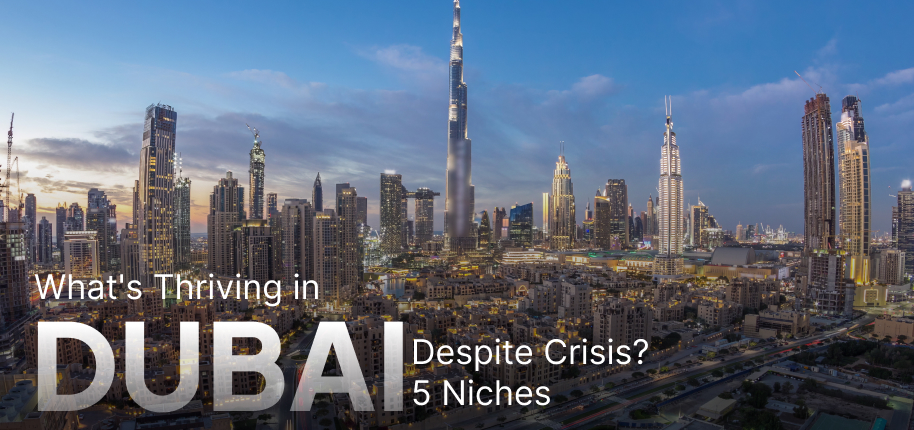
When the rest of the world braces for impact, Dubai tends to lean in.
While geopolitical tensions, rising interest rates, regional conflicts, and global supply-chain disruptions have rattled markets worldwide, Dubai’s economy is forecast to grow by 4.5% in 2026, outpacing the global average of 3.1% and far ahead of most advanced economies, sitting at just 1.6% (Emirates NBD Economic Outlook, 2026).
In a forecast that surprised many international economists, Dubai’s Department of Economy and Tourism projected robust GDP expansion even as regional uncertainty rattled neighboring markets. Bahrain’s economy is expected to contract by 2.3% in 2026. Kuwait is projected to grow by just 0.8%. Even Saudi Arabia has lowered its growth forecast to 2.1%. Dubai, meanwhile, continues to accelerate.
What’s the secret? It’s not luck, and it’s not oil. Dubai deliberately built an economy in which oil accounts for less than 1% of GDP. Trade, technology, financial services, real estate, and tourism carry the weight. And they are doing it exceptionally well.
Over 95% of Dubai’s GDP is non-oil based, demonstrating a highly resilient and diversified economy (Dubai Finance, 2024). This structural reality is why Dubai has earned the title of the most crisis-resistant economy in the Gulf, not through lucky timing, but through decades of deliberate strategy.
This article breaks down the five most crisis-resistant, fast-growing niches in Dubai right now, backed by current data and practical insights for entrepreneurs, founders, and investors who want to act, not just read.
Why Dubai Stays Resilient When Others Don’t
Before diving into the individual niches, it is worth understanding the structural foundations that allow Dubai to grow when others contract. These are not temporary advantages, they are the outcome of decades of intentional nation-building.
The Non-Oil Foundation
Dubai’s emirate-level economy is built on trade and logistics (27% of GDP), financial services (12%), real estate (8%), tourism and hospitality (11%), technology (7%), and manufacturing (9%). This diversification, pursued systematically since the early 2000s under the Dubai Economic Agenda and subsequent strategic plans, has created an economic structure more resilient to regional shocks than any other Gulf economy (digitaldubai.ai, March 2026).
Compare this to Gulf peers where oil still dominates. When prices dip or regional instability disrupts exports, those economies feel it immediately. Dubai feels almost nothing. The economy has been engineered to function without oil, and that engineering is now paying off at exactly the moment the region needs it most.
The Population Engine
Dubai’s rapid population growth is expected to continue by 2025, arriving for employment, lifestyle, and long-term settlement. Since 2014, over 1.35 million people have moved to Dubai, providing a durable demand base that insulates the city from the cyclical nature of any single industry.
The Policy Advantage
Dubai has made business setup structurally easier than most global jurisdictions. Founders retain 100% of personal income with no income tax. Since 2021, most mainland business activities allow full foreign ownership. The UAE’s D33 Agenda has a specific target to scale 30 unicorns and grow 400 SMEs by 2033, goals backed by real funding programs and government co-investment, not just rhetoric.
Free zones contribute 40% of the Dubai economy, employing over 450,000 professionals. Zones like DMCC, JAFZA, and Dubai Silicon Oasis offer specialized infrastructure and incentives tailored to specific industries. Over 200,000 SMEs contribute 45% of Dubai’s GDP, creating diverse investment prospects at every scale. With this foundation in place, here are the five niches dominating growth in 2026.
Niche 1: Technology & AI Services The New Engine of Growth
What’s Happening Right Now
The Dubai tech sector is not just growing; it is becoming a global magnet for companies relocating their regional headquarters, particularly from areas more affected by regional instability.
Dubai Internet City and Dubai Silicon Oasis, the emirate’s two primary technology free zones, reported a combined 340 new company registrations in January and February 2026 alone, up 18% from the same period last year (digitaldubai.ai, March 2026). These are not small operators, many are companies deliberately relocating to take advantage of Dubai’s infrastructure superiority, regulatory clarity, and relative geopolitical stability.
The UAE’s progressive regulatory framework for AI, blockchain, and digital assets continues to attract companies seeking certainty in a region otherwise marked by uncertainty. The UAE was the first country in the world to appoint a Minister of State for AI back in 2017, a signal of long-term commitment that compounds year over year and cannot be easily replicated by a market that starts the journey today.
The AI Campus and Innovation Ecosystem
The DIFC Innovation Hub, the largest innovation community in the MEASA region, is home to more than 1,670 growth-stage tech firms, established innovation companies, digital labs, venture capital firms, regulators, and educational entities (DIFC Innovation Hub). The UAE aims for the digital economy to contribute 20% of non-oil GDP, up from approximately 10% currently. That 10-point gap represents an enormous compounding investment opportunity for founders and operators in the space.
The Dubai AI Campus at DIFC specifically targets the generation of AED 12.9 billion in economic benefits and 25,000 jobs through AI-driven business development, backed by committed government investment rather than aspirational targets alone. The physical infrastructure, regulatory support, and talent concentration at this campus create a compounding advantage that smaller and less developed markets simply cannot replicate.
What’s Thriving Within Tech Right Now
The fastest-growing sub-sectors in Dubai’s tech space in 2026 include:
- Cybersecurity services: demand surging across government, enterprise, and financial services clients
- AI-powered SaaS products: targeting MENA and emerging markets from a Dubai base
- Fintech and digital payment platforms: (overlapping with the financial services niche below)
- Blockchain-based supply chain and trade finance: solutions built for regional and global markets
- IT consulting and digital transformation: for companies entering or expanding in the region
- Cloud services and data center infrastructure: supporting the broader digital ecosystem
Why Tech Is Specifically Crisis-Resistant
Technology businesses in Dubai benefit from a specific structural protection: they do not depend on any single commodity, trade route, or physical infrastructure that can be disrupted by regional events. A cybersecurity company, an AI startup, or a SaaS business serving clients across 50 countries from a Dubai free zone is effectively insulated from the specific risks that affect port operators, hotel chains, or brick-and-mortar retailers. Revenue is global; operations are local; tax is minimal.
Niche 2: Real Estate: Record-Breaking and Still Going
The Numbers Are Historic
If there is one sector that defines Dubai business opportunities on the global stage, it is real estate. And the data in 2026 is not just strong, it is unprecedented.
Dubai’s real estate sector recorded a 31% year-on-year surge in Q1 2026, with total transactions reaching AED 252 billion ($68.6 billion), according to the Dubai Land Department (Gulf News, April 2026). This came after a landmark 2025 where total real estate sales reached AED 682 billion, a 30.6% increase over 2024 and the fifth consecutive year of record-breaking growth.
January 2026 alone recorded AED 72.4 billion in sales, the highest single month in the entire history of Dubai real estate. The average price per square foot rose 12.5% year-on-year in Q1 2026 to AED 1,759. Value growth is now outpacing volume growth, a defining signal of a maturing market driven by price strength rather than speculative volume alone.
The investor base is also expanding sharply. Total investors in Q1 2026 reached 48,448, an 8% increase, including 29,312 new investors up 14%. Foreign investment value rose to AED 148.35 billion, a 26% increase. The leading international markets actively seeking Dubai property are the United Kingdom, Germany, and India. Both India and Germany demonstrated remarkable resilience during the brief regional tensions of early 2026, recording smaller activity decreases than other markets and returning to near-normal levels within weeks.
Three Structural Drivers Behind the Growth
Population growth feeds a supply/demand imbalance
Dubai’s population is growing at 5.4% per year, adding over 200,000 new residents annually. Every new resident needs somewhere to live. The city’s persistent “delivery gap,” where demand consistently outpaces new supply in premium segments, supports values across the cycle and prevents the kind of oversupply correction seen in less managed markets.
Investment-grade yield advantage
Average gross rental yields range from 6% to 9% in Dubai, with mid-market communities like Jumeirah Village Circle achieving up to 8.5% (Edwards & Towers, Q1 2026 Analysis). For comparison, London yields an average 3–4%, Singapore 3–5%, and most European cities 2–4%. Dubai’s yield premium, combined with zero capital gains tax and AED’s USD peg providing currency stability, creates a risk-adjusted return profile that is genuinely difficult to match globally.
Market recovery speed
After brief dips during regional tensions in early 2026, market activity across digital platforms returned to 99% of normal levels within just 51 days. That recovery speed reflects deep structural demand, not speculative froth that evaporates at the first sign of uncertainty.
What’s Thriving Within Real Estate
The sector is broad. Different sub-niches are growing at different rates:
- Luxury residential: investments reached AED 87.71 billion in Q1 2026 alone, a 26% increase
- Off-plan developments: the primary market saw a 90% increase in transaction value in early 2026
- PropTech: platforms like Huspy facilitate over $7 billion in annual transactions and are expanding internationally
- Property management: growing demand from international investors who cannot operate locally
- Short-term rental management: boutique firms managing growing holiday home inventories
- Commercial real estate: demand accelerating as international firms establish or expand Dubai headquarters
| Property Type | Average Gross Yield (2025–2026) | Fastest Growing Segment |
|---|---|---|
| Residential Apartments | 6–8.5% | Off-plan in JVC, Business Bay |
| Luxury Villas | 4–6% | Palm Jumeirah, MBR City |
| Commercial Office | 7–9% | DIFC, Downtown, DWTC |
| Short-Term Rentals | 8–12% | Downtown, JBR, Palm Jumeirah |
| Industrial/Logistics Space | 7–10% | Jebel Ali, Dubai South |
The Golden Visa Accelerant
Dubai’s Golden Visa program is one of the single strongest demand drivers in the premium real estate segment. Property investment above AED 2 million qualifies for a 10-year residence visa. This ties global wealth directly to Dubai real estate in a way that most other markets cannot replicate, turning property into both an asset and a lifestyle gateway. The result is a buyer pool that is structurally different from typical real estate investors, prioritizing access and security over yield alone.
Niche 3: Trade & Logistics: The 27% Backbone That Won’t Break
A Market Built on Infrastructure No One Can Replicate Quickly
Few people outside business circles appreciate just how dominant trade and logistics are in the Dubai economy. At 27% of GDP, it is the single largest contributor, and it rests on infrastructure that took 50 years and hundreds of billions of dollars to build.
Strategic assets like Jebel Ali Port, the largest port in the Middle East, and Dubai International Airport establish the emirate as a prominent global transport nexus. Together, Jebel Ali Port and JAFZA contributed 36% to Dubai’s GDP and supported over 450,000 jobs (JAFZA). JAFZA alone creates an annual trade value of over $169 billion and hosts nearly 10,500 companies.
Even during the regional tensions of early 2026, DP World confirmed Jebel Ali Port remained fully operational. The company reported full-year 2025 revenues growing 22% year-on-year to $24.4 billion, with profit increasing 32% to nearly $2 billion. Jebel Ali itself recorded 9% year-on-year growth in origin and destination volumes in 2025 (AGBI, March 2026). DP World has set its capital expenditure budget at $3 billion for 2026, focused on priority expansion projects, including Jebel Ali itself.
That is the crisis resistance in practice: a brief disruption, and then business at record levels resumes within weeks.
The CEPA Network Creating New Trade Corridors
The UAE’s expanding network of Comprehensive Economic Partnership Agreements (CEPAs) is reshaping the logistics opportunity for businesses in Dubai. Non-oil exports under CEPA agreements registered USD 36.7+ billion, a 42.3% growth rate, and now account for 24% of total non-oil exports (JAFZA, July 2025). CEPA deals with India, Indonesia, Israel, Turkey, Chile, Colombia, South Korea, and Mauritius, which have each opened new trade corridors that run through Dubai. The UAE’s target is to achieve USD 1 trillion in non-oil trade by 2031.
The Gulf logistics sector as a whole is experiencing 12% annual growth, driven by booming Asian trade, expanding e-commerce, and fundamental shifts in global supply chains (Middle East Insider, February 2026). From Dubai, more than two-thirds of the world’s population can be reached within an 8-hour flight a geographic reality no policy decision or infrastructure investment can manufacture from scratch elsewhere.
What’s Thriving Within Logistics Right Now
- Cold chain and pharmaceutical logistics: growing demand linked to UAE medical tourism and regional healthcare expansion
- E-commerce fulfillment and last-mile delivery: the UAE e-commerce market is projected at $17 billion, requiring extensive local distribution infrastructure
- Freight forwarding and customs brokerage: accelerating as CEPA deals reduce tariff barriers and increase bilateral trade volumes
- Supply chain technology: track-and-trace, warehouse automation, and AI-driven route optimization
- Automated port operations: DP World’s $8 billion five-year investment plan includes fully automated container terminals
- Humanitarian and relief logistics: Dubai has emerged as a pivotal global hub for relief supply chains, enhancing its infrastructure and reputation
The Al Maktoum Airport Multiplier
Plans are underway for a massive expansion of Al Maktoum International Airport in Dubai South to eventually become the world’s largest airport by capacity. When complete, this will not only cement Dubai’s aviation supremacy but will create an enormous new logistics corridor and free zone ecosystem around the airport. Companies establishing logistics operations in Dubai South now are positioning themselves ahead of a structural infrastructure shift that will redefine global air freight flows for the next two decades.
Niche 4: Financial Services & Fintech: DIFC’s Compounding Ecosystem
A Hub That Has Outgrown “Regional” Status
Dubai’s financial services sector has moved well past regional ambition. It is now a genuine global force in fintech, Islamic finance, wealth management, and digital assets, competing directly with Singapore, London, and New York for category leadership.
By 2026, DIFC hosts over 1,500 fintech and innovation firms, which have collectively raised $4.2 billion in funding (ainvest.com, December 2025). The broader DIFC ecosystem supports over 4,500 registered companies. The UAE’s fintech market is projected to grow from $3.56 billion in 2025 to $6.43 billion by 2030, at a 12.56% annual growth rate (FinTech News UAE, October 2025). This is not speculative it is backed by $678 million in UAE startup funding raised in Q1 2025 alone, with AI and fintech accounting for approximately half of that total.
The Dubai FinTech Summit, now in its fourth edition in 2026, convenes C-suite leaders, decision-makers, regulators, innovators, and market pioneers from finance, policy, and technology to shape the standards and innovations defining the next chapter of global finance. More than 20 MoUs were signed on day one of the 2026 summit, reflecting the speed at which deals and partnerships are forming in this ecosystem.
Why Founders and Investors Are Moving Here
Traditional financial centres like London, New York, and Frankfurt are increasingly facing regulatory saturation, lengthy approval processes, high compliance costs, and rigid frameworks that make it difficult for innovation-driven financial businesses to scale. Dubai has stepped into that gap deliberately.
DIFC operates under an independent common law legal framework, a rarity in the Middle East, which has enhanced its appeal to international investors, legal institutions, and fintech companies seeking predictability. The DFSA (Dubai Financial Services Authority) has operated a fintech regulatory sandbox since 2017, allowing companies to test new products before full licensing, a pathway that has attracted hundreds of startups and is now used by companies from 80+ countries.
The D33 Agenda specifically targets placing Dubai among the top four global financial hubs by 2033. Supporting that goal are dedicated funding programs: the $100 million DIFC Fintech Fund, the $250 million Hub71 tech investment fund, the $270 million Startupbootcamp fintech accelerator, and the $2 billion Mohammed Bin Rashid Innovation Fund with Emirates Development Bank.
What’s Thriving in Financial Services Right Now
The UAE captures 39% of fintech investment in the MENA region (FinTech News UAE, 2026). Over 60% of UAE consumers now use at least one digital banking or payment app. The cashless economy momentum is accelerating through the CBUAE’s FinTech Strategy 2026 and the rollout of Digital Dirham infrastructure. The fastest-growing sub-sectors include:
- Digital payments and buy-now-pay-later (BNPL): the largest fintech segment, growing rapidly
- Islamic finance and Shariah-compliant platforms: growing across retail and institutional segments globally
- Wealth management for HNWIs: demand driven by the influx of high-net-worth individuals relocating to Dubai
- Digital assets and cryptocurrency custody: Dubai’s VARA provides one of the clearest regulatory frameworks globally for virtual asset businesses
- Embedded finance and B2B payment infrastructure: companies like Alaan and Bayzat are demonstrating the ecosystem’s commercial maturity
- Insurtech and regtech: regulatory sandbox support accelerating adoption across underserved regional segments
Notable startups illustrating ecosystem depth: Stake (real estate investment platform, raised $58M including an oversubscribed $31M Series B in February 2026), Huspy (mortgage and homebuying platform, facilitates over $7B in annual transactions in Europe and the Middle East), Bayzat (HR and payroll platform for 4,000+ business customers, raised over $60M), and Alaan (corporate spend management, 3,000+ business customers across real estate, aviation, logistics, and retail).
| Fintech Sub-Sector | Key Demand Driver | 2026 Market Signal |
|---|---|---|
| Digital Payments | Cashless economy push, CBUAE Strategy 2026 | Largest segment; fastest growing |
| Digital Assets / Crypto | VARA regulatory clarity | Strong institutional adoption |
| Islamic Finance | Regional demand + 1.8B global Muslim market | Expanding product innovation |
| Wealth Management | HNWIs relocating to Dubai | DIFC Family Wealth Centre growth |
| Insurtech | Underserved regional market | Active accelerator pipeline |
The Islamic Finance Advantage That Most People Miss
One dimension of Dubai’s financial services sector that sets it apart globally is Islamic finance. Dubai is establishing itself as the global capital for Islamic finance, a $3+ trillion market requiring specialized structuring, compliance, and distribution expertise. For fintech companies that understand Shariah-compliant product design, Dubai is not just a regional opportunity. It is the gateway to a global market of 1.8 billion potential customers that is currently underserved by digital-first financial products.
Niche 5: Health & Wellness: A $27 Billion Market in Motion
The Most Underestimated Fast-Growing Industry in Dubai
Health and wellness sits at the intersection of several powerful trends simultaneously: medical tourism, a growing affluent population, preventative health consciousness, post-pandemic behavioral shifts, and strong government capital investment. Few industries have this many structural tailwinds pulling in the same direction at the same time.
The health and wellness market in the UAE is projected to reach $27 billion, fueled by demand for fitness programs, organic foods, holistic treatments, and advanced medical services. Government spending on healthcare is rising and expected to reach 5% of GDP by 2029, supporting both supply-side expansion and demand-side innovation simultaneously.
In 2026, healthcare will see continued expansion of hospitals, clinics, and specialized medical facilities with the dual goal of serving a growing and increasingly diverse resident population and establishing the UAE as a premier medical tourism hub for overseas patients from South Asia, Africa, East Asia, and Europe.
Medical Tourism: The New Demand Engine
Medical tourism has emerged as a particularly significant growth driver, supported by a formal agreement between the Dubai Health Authority (DHA) and the Department of Economy and Tourism to promote health-related travel through a coordinated marketing and regulatory strategy.
The results are already tangible: this segment contributed to a 20% year-on-year increase in GDP for human health and social work activities during the first half of 2025 (Gulf News, December 2025). The UAE’s strategy is to explicitly transform from a regional healthcare player to a global medical destination. Hospital-hotel partnerships, specialized medical centers at Dubai Healthcare City, and a streamlined medical visa process for international patients are creating a new category of visitor: the medical tourist who also becomes a real estate investor or long-term resident.
The government’s broader tourism strategy aims for US$122 billion in tourism GDP by 2031, nearly double current levels, by attracting 40 million hotel guests annually. Health and medical tourism will be a growing component of that target.
What’s Thriving Within Health & Wellness
The breadth of opportunity in this niche is unusual. It spans clinical, consumer, digital, and real estate dimensions simultaneously, meaning that entrepreneurs from very different backgrounds can find an entry point that fits their expertise:
- Telehealth and digital health platforms: rapid license uptake post-pandemic, now mainstream among residents and increasingly used for international consultations
- Fitness franchises and boutique studios: a high-income expatriate population with strong spending power and an embedded fitness culture
- Medical aesthetics and anti-aging clinics: premium segment with strong demand from both residents and wellness tourists
- Mental health services: growing corporate and individual demand; HAAD licensing reforms in 2025–2026 are supporting the expansion of credentialed providers
- Nutritional supplements, organic food, and functional food retail: wellness-conscious population driving premiumization across retail categories
- Healthcare IT and hospital management systems: digital transformation of the UAE’s clinical infrastructure, creating B2B opportunity
- Corporate wellness programs: large multinationals with Dubai headquarters mandating structured employee wellness benefits as part of talent retention strategies
The Demographics Supporting Long-Term Growth
Dubai’s population of 4 million residents includes a high proportion of young, high-income professionals who prioritize health, fitness, and preventative care. These residents are active consumers of wellness services, not occasional ones. The emirate’s tourism base, on track for 17+ million visitors in 2026, includes a growing share of wellness-focused travelers who come specifically for medical treatments, wellness retreats, and health screenings.
Combine a young, affluent, health-conscious resident base with a growing stream of international medical tourists, and the structural demand case for health and wellness businesses in Dubai becomes one of the clearest in any market globally.
| Wellness Sub-Niche | Key Demand Driver | Growth Signal |
|---|---|---|
| Medical Tourism | DHA + DET formal partnership | +20% GDP contribution YoY in H1 2025 |
| Telehealth | Post-pandemic adoption, mobile penetration | Rapid free zone license uptake |
| Mental Health | Corporate demand + destigmatization | HAAD regulatory reforms 2025–2026 |
| Fitness & Studios | Affluent expat base (4M+ residents) | Major franchise expansions ongoing |
| Medical Aesthetics | High disposable income + wellness tourism | Premium clinic cluster growth |
Dubai’s Business Infrastructure: Why These Niches Scale Faster Here Than Anywhere Else
Understanding why these five niches grow faster in Dubai than almost anywhere else requires looking at the structural advantages that compound over time. These are not talking points, they are operational realities that change the economics of building a business.
Zero Income Tax and Full Profit Repatriation
Founders retain 100% of personal income. Companies in free zones pay zero corporate tax on most activities and enjoy full repatriation of profits. This changes the unit economics of every business, at every stage of growth. A fintech startup that would retain 65% of profits in London retains effectively 100% in DIFC. A real estate investor who would pay 28% capital gains tax in the UK pays zero in Dubai. That compound advantage over five or ten years is genuinely transformative for wealth creation and reinvestment capacity.
100% Foreign Ownership No Local Partner Required
Since 2021, most mainland business activities in Dubai allow full foreign ownership, removing one of the most cited friction points for international entrepreneurs. All free zone businesses have always permitted 100% foreign ownership. Combined, this makes the UAE one of the most ownership-friendly jurisdictions globally and significantly simpler to operate than markets like Saudi Arabia, India, or Indonesia for international founders.
World-Class Free Zones Aligned to Each Niche
Dubai has built purpose-specific free zones for almost every major industry. Each zone offers sector-specific licensing, talent pipelines, networking ecosystems, co-working infrastructure, and regulatory clarity:
- Dubai Internet City / Dubai Silicon Oasis → Technology and IT
- DIFC / FinTech Hive → Financial services and fintech
- JAFZA / Dubai South → Trade, logistics, and manufacturing
- Dubai Healthcare City (DHCC) → Healthcare, wellness, and medical services
- Dubai Land Department / RERA → Real estate operations and investment
The Talent Advantage
Dubai attracts professionals from over 200 nationalities. The combination of zero income tax, world-class infrastructure, a safe environment, and a cosmopolitan lifestyle creates a talent magnet that few cities globally can rival. For businesses that need to hire quickly, at competitive costs, across diverse skill sets, this depth of local talent is a practical operational advantage not just an aspirational quality-of-life story.
Sector Snapshot: Dubai’s 5 Thriving Niches at a Glance
| Niche | GDP Contribution | Key 2026 Data Point | Best Setup Entry Points |
|---|---|---|---|
| Technology & AI | 7% of GDP | 340 new tech firms registered Jan–Feb 2026 (+18% YoY) | Dubai Internet City, DSO |
| Real Estate | 8% of GDP | AED 252B in Q1 2026 transactions (+31% YoY) | Mainland + RERA license |
| Trade & Logistics | 27% of GDP | Jebel Ali 9% volume growth; DP World $3B capex 2026 | JAFZA, Dubai South |
| Financial Services | 12% of GDP | DIFC hosts 1,500+ fintech firms, $4.2B raised | DIFC, ADGM |
| Health & Wellness | Fast-growing | +20% GDP contribution health sector H1 2025 | DHCC, DHA license |
How to Choose the Right Niche for Your Situation
Not every niche is right for every founder or investor. Here is a practical matching framework:
- If you have a technology background and want to build or scale a product business, the tech and fintech niches offer the most structurally supportive ecosystems. DIFC FinTech Hive, Dubai Internet City, and the AI Campus provide licensing, co-working, mentorship, and access to institutional capital in ways most markets cannot.
- If you have capital to deploy and want reliable returns with low operational complexity, real estate remains the most straightforward entry point. Rental yields of 6–9%, strong capital appreciation, zero capital gains tax, and AED’s USD peg providing currency stability create a risk-adjusted return profile that is difficult to match globally.
- If you are already in trade, supply chain, or manufacturing, Dubai’s logistics infrastructure is your competitive multiplier. CEPA deals, Jebel Ali Port, and JAFZA’s ecosystem mean that companies headquartered here access the world’s best-connected logistics platform at costs that remain competitive against Singaporean and European hubs.
- If you are in professional services, advisory, or consulting, the financial services sector creates consistent demand for legal, compliance, tax, and operational expertise. DIFC’s common-law framework specifically attracts international firms that need advisors familiar with both UAE regulation and global standards.
- If you are in healthcare, fitness, or wellness, Dubai’s combination of medical tourism growth, high-income residents, and government investment in health infrastructure creates a market that is both large and willing to pay premium prices for credentialed services. Entry via DHCC provides regulatory credibility and proximity to the core ecosystem.
Final Thoughts: Crisis Reveals Character. Dubai’s Is Clear
Not every market deserves your capital or your time. But Dubai has spent decades earning the right to be taken seriously, and the 2026 data across every niche covered in this article confirms it is still delivering.
What stands out is not just the headline GDP growth rate. It is the specific mechanisms at work: population growth creating durable demand, government policy creating structural investment tailwinds, world-class infrastructure creating real competitive moats, and a regulatory environment that has consistently moved toward openness rather than restriction.
The five niches covered here, technology, real estate, trade and logistics, financial services, and health and wellness, are not speculative bets on a single favorable trend. They are each structurally supported by policy, infrastructure, demographics, and global demand simultaneously. They have demonstrated the ability to grow through uncertainty, not just during calm periods.
As Sheikh Mohammed bin Rashid Al Maktoum noted in the statement accompanying Dubai’s 2026 economic report: “We did not build Dubai for the easy times. We built it to endure, to adapt, and to thrive in any condition.” The five niches in this article are the ones doing exactly that in measurable, data-backed ways that give investors and founders a genuine basis for confidence.
The question for any entrepreneur or investor is no longer whether Dubai business opportunities exist in 2026. It is which one fits your resources, timeline, risk profile, and ambitions and whether you have the right setup and structure in place to actually capture it.