
The UAE EdTech market is growing 15–20% annually and Dubai sits at the centre of it. If you are a teacher, trainer, or entrepreneur who has been running courses informally, 2026 is the year to make it official. The global online learning market has crossed $200 billion (source – HolonIQ), and the UAE government’s D33 economic agenda names digital education as a strategic priority. The window to build a serious EdTech company in Dubai has never been wider. But here is where most people get stuck – they do not know which business model fits their goals, which license to apply for, or how long it will all take. This guide answers all of that, clearly.
EdTech Business Models – Which One Fits You?
You do not have to pick between passion and profitability. The right model is the one that matches how you want to teach and how quickly you want to scale.
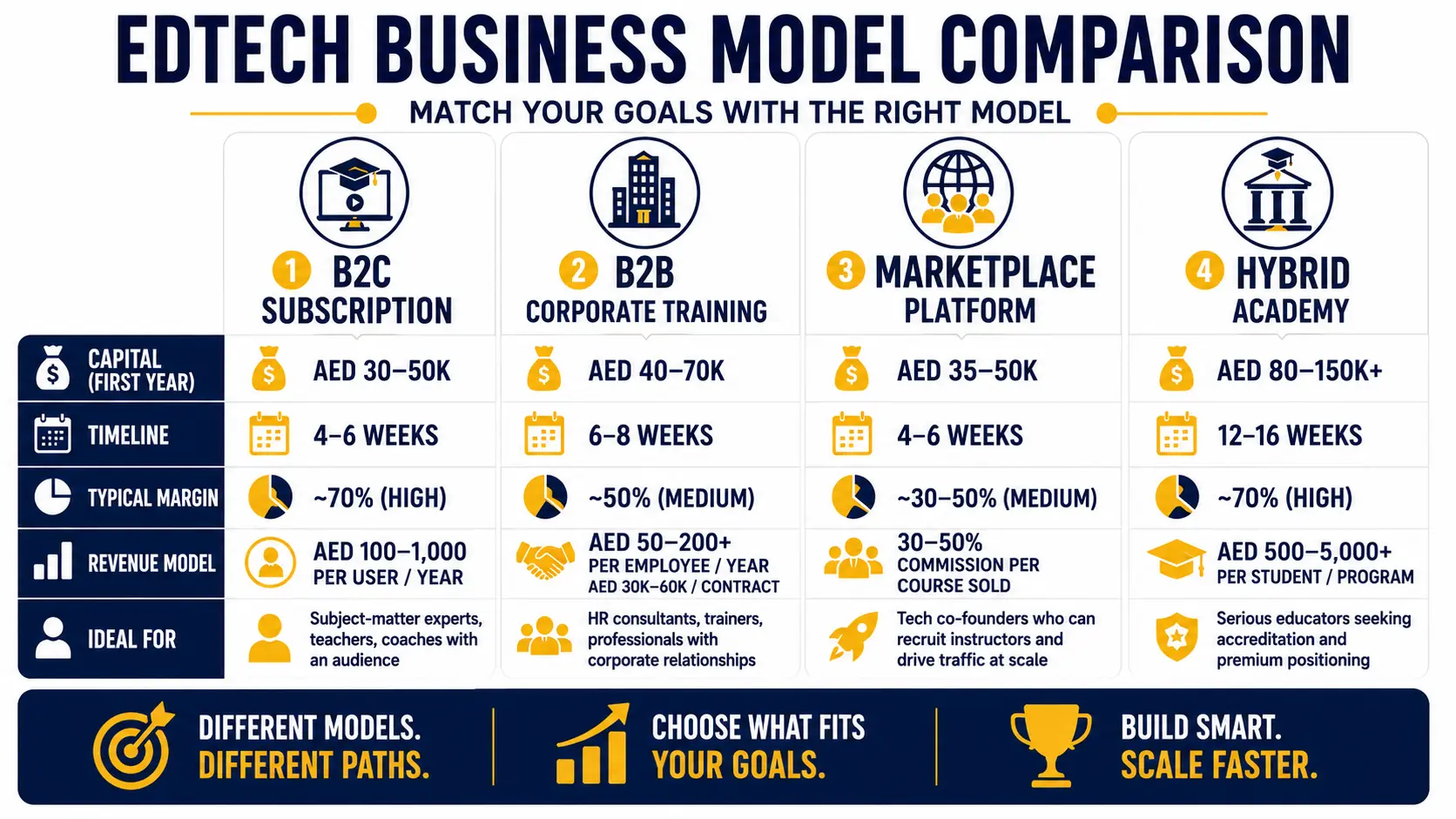
Model 1 – B2C Subscription Platform
Think Teachable or Udemy. Students pay you directly monthly, annually, or per course. You own the audience and the revenue.
- How it works – You create content (video, PDFs, live sessions), host it on a platform, and charge subscribers.
- Best platforms – Teachable, Thinkific, Podia, or a custom LMS built on Moodle.
- Licensing needed – Tech Company License (simplest, fastest).
- Startup cost – AED 30–50k first year.
- Revenue model – AED 100–1,000 per user per year.
- Typical margin – ~70% (low overhead once content is created).
Ideal for – Subject-matter experts, teachers, and coaches who already have an audience or email list.
Model 2 – B2B Corporate Training
You sell reskilling or professional development programs directly to companies. Contracts are larger but sales cycles are longer.
- How it works – You pitch HR teams and L&D managers, deliver custom training programs, and invoice per employee or per project.
- Licensing needed – Professional Training License.
- Startup cost – AED 40–70k first year.
- Revenue model – AED 50–200+ per employee per year; AED 30k–60k per corporate contract.
- Typical margin – ~50%.
Ideal for – HR consultants, trainers, and professionals with existing corporate relationships.
Model 3 – Marketplace Model
You build the platform. Independent instructors create and sell courses. You take a commission (typically 30–50%).
- How it works – Think Udemy or Coursera you are the infrastructure, not the content creator.
- Licensing needed – Tech Company License.
- Startup cost – AED 35–50k first year (requires custom development or white-label tech).
- Revenue model – 30–50% commission on every course sold.
- Key challenge – You need critical mass of both instructors and students to generate meaningful revenue.
Ideal for – Tech co-founders with the ability to recruit instructors and drive traffic at scale.
Model 4 – Hybrid Academy
Structured diploma programs, bootcamps, or certificate courses with defined curricula. This is the most credible model and the most capital-intensive.
- How it works – You design a formal curriculum, hire qualified instructors, and offer programs that may be KHDA-accredited.
- Licensing needed – Education Institution License (most complex).
- Startup cost – AED 80–150k first year.
- Revenue model – AED 500–5,000+ per student per program.
- Typical margin – ~70% at scale.
Ideal for – Serious educators who want government credibility, accreditation, and premium pricing.
Business Model Comparison
Use this table to match your goals with the right model –
| Model | Capital | Timeline | Margin | Complexity |
| B2C Subscription | AED 30–50k | 4–6 weeks | High (70%) | Medium |
| B2B Training | AED 40–70k | 6–8 weeks | Medium (50%) | Medium |
| Marketplace | AED 35–50k | 4–6 weeks | Medium (30–50%) | Medium |
| Academy | AED 80–150k | 12–16 weeks | High (70%) | High |
Licensing & Compliance – Choosing the Right Path
Licensing is not the hard part. Choosing the right license, one that matches your business model, is what matters. Pick the wrong one, and you will face delays, rejections, or restrictions on what activities you can legally operate.
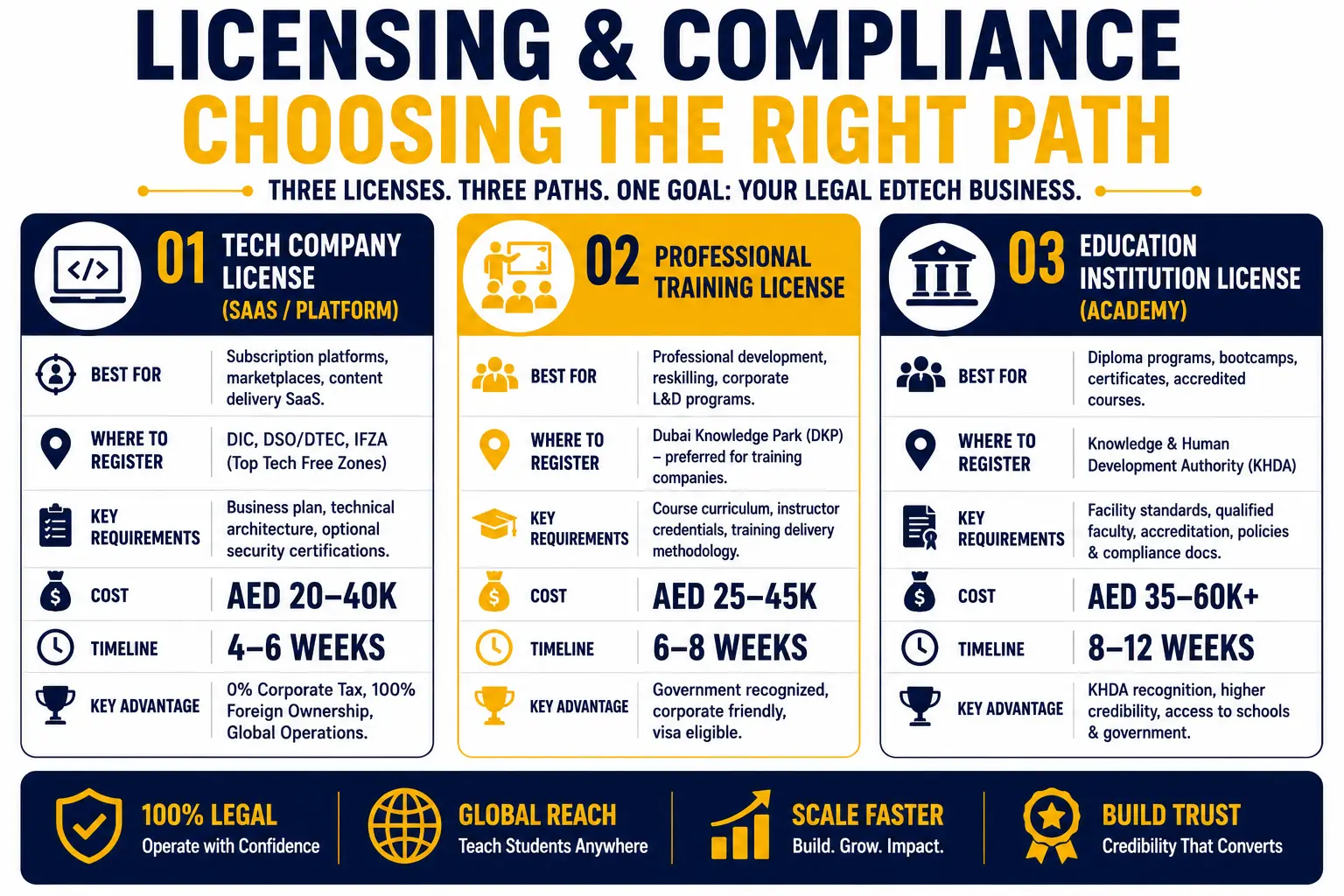
Option 1 – Tech Company License (SaaS / Platform)
This is the fastest and most cost-effective option for online-first EdTech businesses.
- When to choose this – You are building a subscription platform, marketplace, or content delivery SaaS.
- Where to register – Dubai Internet City (DIC), Dubai Silicon Oasis (DSO/DTEC), or IFZA are popular free zones.
- Key requirements – Business plan, technical architecture documentation, optional security certifications.
- Cost – AED 20–40k.
- Timeline – 4–6 weeks.
- Key advantage – 0% corporate tax in most free zones, 100% foreign ownership, global operations permitted.
Note on free zones – DTEC (Dubai Silicon Oasis) is specifically designed for tech startups including EdTech, with networking, mentorship, and startup ecosystem benefits. Learn more about starting a business in Dubai Silicon Oasis
Option 2 – Professional Training License
The middle ground more regulated than a tech license, far simpler than a full education institution license.
- When to choose this – You offer professional development, reskilling, or corporate L&D programs.
- Where to register – Dubai Knowledge Park (DKP) is the preferred free zone for training companies.
- Key requirements – Course curriculum, instructor credentials, training delivery methodology.
- Cost – AED 35–60k.
- Timeline – 6–8 weeks.
- Key advantage – Balanced credibility without the heavy compliance burden of an education license.
Note on Dubai Knowledge Park – DKP is UAE’s dedicated hub for human capital management and training businesses. It provides access to 500+ training and education companies.
Option 3 – Education Institution License
The most complex path but also the most credible. Required if you want to offer accredited diplomas, degrees, or formal bootcamps.
- When to choose this – Structured diploma programs, bootcamps seeking KHDA accreditation.
- Regulatory body – KHDA (Knowledge and Human Development Authority) in Dubai.
- Key requirements – Detailed curriculum documentation, qualified faculty credentials, facilities inspection.
- Cost – AED 60–120k.
- Timeline – 8–12 weeks (can extend to 16 weeks for accreditation).
- Ongoing compliance – Annual KHDA inspections, curriculum updates, student outcome reporting.
Decision Tree – Which License Do You Need?
Step 1 – Are you primarily building a software/SaaS platform? → YES – Apply for a Tech Company License (fastest, lowest cost). → NO – Continue to Step 2.
Step 2 – Do you offer formal diploma or degree-level programs? → YES – You need an Education Institution License (KHDA regulated). → NO – A Professional Training License is your best fit.
Licensing Comparison at a Glance
| License Type | Cost | Timeline | Complexity | Best For |
| Tech Company License | AED 20–40k | 4–6 weeks | Simplest, fastest | Subscription, Marketplace |
| Professional Training | AED 35–60k | 6–8 weeks | Balanced | Corporate Training, L&D |
| Education Institution | AED 60–120k | 8–12 weeks | Most complex | Formal academies, bootcamps |
Cost Breakdown – What to Budget
Transparency matters. Here is a realistic breakdown of what it costs to launch each model in Dubai in 2026. These figures include licensing, setup, basic tech, and a 3-month operations runway.
| Cost Item | B2C / Marketplace | B2B Training | Academy |
| Licensing & Registration | AED 20–40k | AED 35–60k | AED 60–120k |
| Platform / Development | AED 5–10k | AED 5–10k | AED 20–40k |
| Virtual/Physical Office | AED 3–5k | AED 8–15k | AED 15–30k |
| Marketing Launch | AED 5–10k | AED 5–10k | AED 10–20k |
| Operations (3 months) | AED 5–8k | AED 8–15k | AED 15–30k |
| Total (First Year) | AED 38–73k | AED 61–110k | AED 120–240k |
Note – Costs above are indicative. Free zone fees vary. Virtual office packages (AED 3–8k/year) are available at most free zones and are sufficient for online-only EdTech businesses.
Real-World Examples – Three Paths to Launch
Case Study 1 – The Solopreneur Fatima’s Arabic Language Platform
Profile – Fatima, Arabic language teacher, age 45
Model – B2C Subscription (live classes + recorded content)
Platform – Teachable
Startup cost – AED 35,000 (tech license, virtual office, content production, marketing)
Timeline to first student – 8 weeks after license approval
Year 1 revenue – AED 180,000 (300 students × AED 600/year)
Profitability – Break-even at month 9.
Key success factor – Built a 2,000-person email list before launching the platform. “I took my classroom students online. The demand was already there, I just needed to formalise it.”
Fatima’s key lesson – Build your audience before you build your product. She grew her email list for six months through social media and a free mini-course before spending a single dirham on licensing.
Case Study 2 – The Corporate Trainer Ahmed’s B2B Training Firm
Profile – Ahmed, HR consultant, age 38
Model – B2B Corporate Training (professional reskilling)
Clients – Corporate organisations across Dubai and Abu Dhabi
Startup cost – AED 55,000 (professional training license, office, team, marketing)
Timeline to first contract – 12 weeks
Year 1 revenue – AED 150,000 (3 contracts at AED 50k average)
Profitability – Break-even at month 14
Key success factor – Existing corporate relationships from 10+ years in HR consulting “My corporate network was the biggest asset. People already knew I could deliver results.”
Ahmed’s key lesson – In B2B, your reputation precedes the platform. He closed his first three contracts through direct conversations no marketing spend required.
Case Study 3 – The Platform Builder Layla & Omar’s Marketplace
Profile – Layla & Omar, tech co-founders, ages 32 and 34
Model – Instructor Marketplace (40% commission)
Startup cost – AED 50,000 (tech license, MVP development, instructor recruitment, marketing)
Timeline to MVP launch – 6 weeks (with 10 seed instructors)
Timeline to profitability – 12–18 months (needed 100+ courses and consistent traffic)
Year 1 revenue – ~AED 200,000 (300 students × AED 600 avg course × 40% commission)
Key success factor – Seeded the marketplace with committed instructors before public launch “The hard part is not building the platform it is getting critical mass of instructors and students at the same time.”
Layla & Omar’s key lesson – Launch with supply before marketing demand. They recruited and onboarded 10 instructors in stealth before opening public registration, ensuring the platform had content on day one.
Market Opportunity & Funding Options Why Dubai in 2026?
Three structural forces are converging to make this the best time to launch an EdTech company in Dubai –
- UAE EdTech market growing 15–20% annually (source – Technavio research cited by multiple UAE government publications).
- D33 Agenda – Dubai’s economic blueprint targets doubling the economy by 2033, with education technology named a strategic growth sector.
- Post-pandemic normalisation – Online and hybrid learning is no longer a novelty it is expected. Learner adoption barriers have effectively disappeared.
- Diverse, multilingual learner base – 200+ nationalities in the UAE create demand for content in Arabic, English, Hindi, Tagalog, and beyond.
Funding Options
1. Bootstrapping
The most common path for B2C subscription and marketplace models. Starting costs are low enough (AED 35–50k) that many solopreneurs self-fund. Your first revenue from pre-selling courses or consulting contracts can cover licensing fees.
2. Government Grants
- UAE startup grants – Up to AED 100k available through programmes such as the Mohammed Bin Rashid Innovation Fund.
- Dubai SME (part of Dubai Economy) offers grants and subsidised services for eligible startups.
- Timeline – 2–4 months for application and approval.
- Best for – Early-stage startups with validated product-market fit.
3. Angel Investment
- Typical check size – AED 100k–500k.
- Best for – Established educators or trainers launching their first scaled platform.
- Key UAE angel networks – Dubai Angel Investors, Wamda, 500 Global MENA.
- Timeline to close – 2–4 months.
4. Venture Capital
- Typical check size – AED 500k–2M+ (Series A and beyond).
- Best for – Marketplace or SaaS models with demonstrated growth metrics.
- Key UAE VC firms – BECO Capital, Wamda Capital, Global Ventures.
- Timeline to close – 4–9 months.
Realistic advice – Most EdTech founders in the UAE bootstrap through their first AED 150k–200k revenue, then approach angels with a proven product. Raising before you have paying students is significantly harder.
Compliance & Ongoing Requirements
For Tech Company License Holders
- Annual license renewal (typically AED 8–12k/year depending on free zone).
- Financial reporting if required by the free zone authority.
- VAT registration mandatory if annual revenue exceeds AED 375,000.
- Corporate tax – 0% on the first AED 375k of profit; 9% on profit above that threshold.
For Education Institution License Holders
- Annual KHDA inspection of curriculum, facilities, and student outcomes.
- Mandatory curriculum review and updates when academic content changes.
- Staff credential verification all instructors must meet KHDA qualification standards.
- Student outcome reporting submitted to KHDA annually.
Tax Implications (2026)
The UAE introduced corporate tax in June 2023. Key facts for EdTech businesses –
- 0% tax on annual taxable profit up to AED 375,000.
- 9% tax on profit above AED 375,000.
- Free zone entities with qualifying income may still benefit from 0% rates confirm eligibility with a UAE tax advisor.
- VAT at 5% applies to most services if turnover exceeds AED 375,000 annually.
Go-to-Market Strategy – Getting Your First 100 Customers
Who Are Your First 100?
Before you worry about scaling, nail your first 100 paying students or clients. Your target differs by model –
- B2C Subscription – Former students, social media followers, email subscribers who already know you.
- B2B Training – Past colleagues, HR contacts, LinkedIn connections at companies in your niche.
- Marketplace – 10–20 instructors from your professional network who can seed content on day one.
Marketing Strategy That Works for EdTech
- Content marketing – Publish free educational content (YouTube, LinkedIn, blog) to demonstrate your expertise. Search Engine Journal notes that content authority is the strongest long-term SEO signal.
- Email list first – Build a list of 1,000+ subscribers before launching. This is the single biggest predictor of successful course launches.
- Partnerships – Partner with UAE universities, professional associations, and corporate HR departments for co-marketing.
- Social proof – Student success stories and testimonials are more persuasive than any paid ad.
Pricing Strategy
- Free trial or freemium – Effective for subscription models. Reduce friction for the first conversion.
- Preselling – Sell before you build. If 50 people pay for a course that does not yet exist, you have validated demand and funded production simultaneously.
- Anchored pricing – Always show a higher original price alongside your launch price to frame value.
Time to First Revenue
- B2C Subscription – 3–6 months from company formation to first paid student.
- B2B Training – 2–4 months from company formation to first signed contract.
- Marketplace – 6–12 months to meaningful revenue (critical mass takes time).
- Academy – 4–8 months (approval process is longest but contracts are largest).
EdTech Launch Checklist
Phase 1 – Before You Apply for a License
- Define your target learner clearly (who, what problem, what outcome).
- Validate demand – survey potential students or pre-sell a pilot cohort.
- Choose your business model (B2C, B2B, marketplace, or academy).
- Build at least 500 email subscribers or social followers before launch.
- Choose your free zone – DIC, DSO/DTEC, DKP, or IFZA.
Phase 2 – Licensing & Setup
- Submit the company name reservation.
- Prepare business plan and relevant documentation.
- Apply for the correct license type (tech, professional training, or education institution).
- Set up a virtual or physical office address.
- Open a UAE business bank account (Emirates NBD, Mashreq, or ADIB are popular for startups).
- Register for VAT if projecting revenue above AED 375k in year one.
Phase 3 – Pre-Launch
- Build or configure your LMS platform (Teachable, Moodle, custom).
- Produce at least 3–5 hours of high-quality course content.
- Set up payment processing (Stripe, PayTabs, or Telr for UAE).
- Create your course landing page with clear outcome statements.
- Run a beta cohort of 10–20 students at a discount for testimonials.
Phase 4 – Growth
- Publish weekly content (YouTube, LinkedIn, blog) to build authority.
- Set up affiliate or referral programme for students.
- Target one corporate client for B2B revenue alongside B2C.
- Review unit economics after first 3 months and adjust pricing if needed.
- Explore government grants once you have 6 months of revenue data.
Conclusion & Your Next Steps
Starting an EdTech platform in Dubai in 2026 is genuinely achievable but it requires making the right decisions early. Choose the wrong license and you will face delays and unexpected costs. Launch without an audience and you will be paying for an empty platform. contact our team for guidance on choosing the right setup for your EdTech business. Here is the simple version of everything above
- Choose your model first (B2C, B2B, marketplace, or academy).
- Match it to the right license (tech, professional training, or education institution).
- Build your audience in parallel with your licensing process.
- Aim for first revenue within 90 days of license approval.
The UAE’s regulatory environment is genuinely supportive of EdTech. Free zones offer 100% foreign ownership, 0% personal income tax, and streamlined setup processes. The infrastructure is here. The demand is here. The question is whether your content is ready for it.
Your First Month Action Plan
Week 1 – Define your model and research free zone costs.
Week 2 – Build a simple landing page and begin collecting email subscribers.
Week 3 – Engage a UAE business setup consultant to confirm license type and submit the application.
Week 4 – Begin producing your first course module while the application processes.