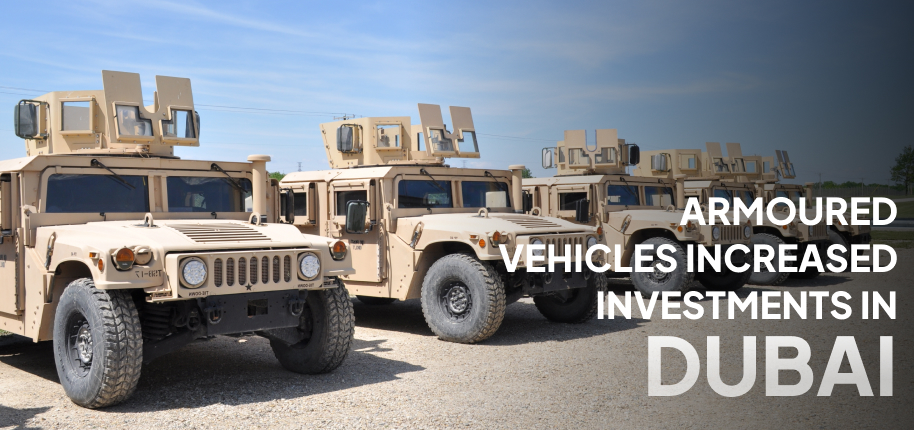
Dubai has developed into an important regional centre for advanced manufacturing, vehicle trading, logistics, and specialised automotive industries. Armoured vehicles form a highly specialised part of this ecosystem, with UAE-based manufacturers serving government, institutional, commercial, and international customers. Investment interest is supported by Dubai’s industrial infrastructure, export connectivity, specialist facilities, and proximity to major markets across the Middle East, Africa, and Asia.
Why Dubai Attracts Specialised Vehicle Investment
Dubai’s advantage begins with infrastructure. Vehicle manufacturers and traders can access industrial facilities, warehousing, major road networks, Jebel Ali Port, and international airports. These connections are particularly valuable for businesses importing base vehicles or components and exporting finished vehicles to international customers.
The wider investment environment also remains active. DP World reported AED 854 million in investment commitments in JAFZA during the first four months of 2026, covering manufacturing, logistics, finished-vehicle handling, heavy equipment, healthcare, and other activities. While this figure should not be interpreted as investment specifically in armoured vehicles, it demonstrates continued investment in the industrial, automotive, and logistics ecosystem that supports specialised vehicle businesses.
Entrepreneurs considering opportunities in this environment can explore setting up a business in Dubai and determine which structure is appropriate for their intended operations.
UAE Armoured-Vehicle Manufacturing Has Developed Significantly
Armoured-vehicle manufacturing is not new to the UAE. Research by the International Institute for Strategic Studies identified several manufacturers operating in the country, including NIMR, INKAS Armored Vehicles, International Armored Group, STREIT Group, Calidus, Isotrex, and TAC Armored Vehicles. It also noted that several manufacturers had expanded production capacity over time.
Dubai itself has a history in this industry. Dubai Investments Park previously attracted several armoured-vehicle manufacturers because of its logistics, manufacturing, storage facilities, and proximity to Jebel Ali Port and Al Maktoum International Airport. This established industrial base remains relevant when assessing why Dubai can support specialised automotive manufacturing and export operations.
What Is Driving the Sector?
Demand for specialist protected vehicles can originate from several legitimate customer groups and applications. These include government agencies, diplomatic organisations, corporate security requirements, secure transportation providers, and organisations operating in higher-risk markets.
From an investment perspective, Dubai offers several commercial advantages
- Strategic location between major international markets
- Established automotive trading sector
- Manufacturing and industrial facilities
- Access to skilled technical professionals
- International shipping connectivity
- Vehicle handling and warehousing infrastructure
- Strong re-export capabilities
- Access to specialist suppliers and professional services
The UAE’s position as an international trading hub can therefore be as important as domestic demand.
Dubai as an Export and Re-Export Base
Armoured vehicles are specialised products with international customers, making logistics a major part of the business model. Dubai’s location provides relatively convenient access to markets across the GCC, Africa, South Asia, and other regions.
Jebel Ali is particularly important to the wider vehicle ecosystem. JAFZA supports vehicle handling, heavy equipment, manufacturing, warehousing, and international distribution. Dubai Customs has also invested in advanced vehicle and equipment inspection infrastructure at Jebel Ali to support trade flows.
This infrastructure can make Dubai attractive not only for manufacturing but also for regional headquarters, vehicle trading, parts distribution, engineering services, and export management.
Business Opportunities Around Armoured Vehicles
Investment opportunities are not limited to companies manufacturing complete vehicles. A broader supporting ecosystem can develop around specialised automotive operations.
Potential business areas include
- Specialist vehicle manufacturing
- Approved vehicle conversion activities
- Vehicle and component trading
- Automotive engineering
- Replacement parts and components
- Vehicle maintenance
- Fleet management
- Automotive technology
- International distribution
- Logistics and warehousing
- Testing and certification support
- Professional B2B services
The appropriate activity must be selected carefully because a vehicle trader, manufacturer, maintenance provider, and security-service operator can face very different licensing and regulatory requirements.
Manufacturing vs Trading – Choosing the Right Model
Investors should first establish whether their company will manufacture or modify vehicles, trade finished vehicles, distribute parts, or provide supporting services.
| Business Model | Main Requirement |
|---|---|
| Vehicle manufacturing | Industrial facilities and relevant approvals |
| Vehicle trading | Appropriate commercial trading activity |
| Parts distribution | Trading, storage and logistics |
| Vehicle maintenance | Suitable premises and technical approvals |
| Export business | Customs and international trade processes |
| Support services | Licence matching the exact service |
Manufacturing will generally require more infrastructure, capital, technical resources, and approvals than a straightforward commercial trading operation. Investors should therefore define the business model before choosing a jurisdiction.
Why Industrial Location Matters
An armoured-vehicle business can require considerably more physical infrastructure than an ordinary consultancy or digital company. Manufacturing or conversion businesses may need industrial premises, vehicle access, loading areas, storage, specialist equipment, and suitable logistics connections.
Location decisions should consider
- Factory or workshop requirements
- Warehouse capacity
- Port and airport access
- Vehicle transportation
- Customs requirements
- Staff accessibility
- Utility requirements
- Expansion capacity
This is why an industrial or logistics-focused location can sometimes be more important than selecting the least expensive company formation package.
How to Establish a Specialised Vehicle Business in Dubai
Setting up a specialised automotive business requires careful planning because the licensing route depends on exactly what the company intends to do.
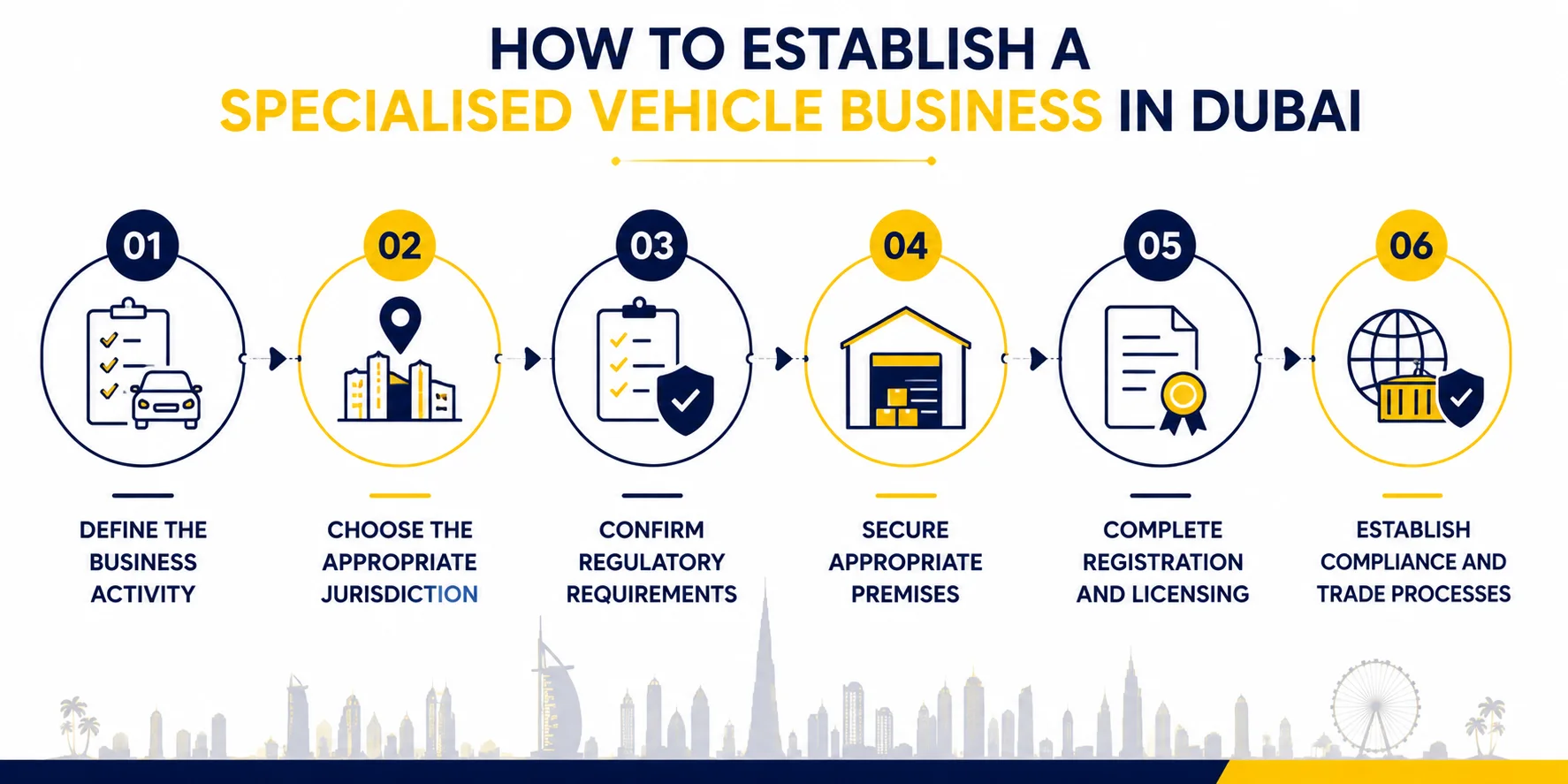
Step 1 – Define the Business Activity
Establish whether the company will manufacture, modify, trade, maintain, distribute, or export vehicles or components.
Step 2 – Choose the Appropriate Jurisdiction
Determine whether a mainland or suitable economic-zone structure best supports the intended customers, premises, imports, exports, and operations.
Step 3 – Confirm Regulatory Requirements
Identify all approvals applicable to the specific activity, products, facilities, and markets before committing to significant investment.
Step 4 – Secure Appropriate Premises
Manufacturing and technical operations may require industrial facilities rather than standard office accommodation.
Step 5 – Complete Registration and Licensing
Register the trade name, submit incorporation documents, obtain the relevant licence, and complete applicable external approvals.
Step 6 – Establish Compliance and Trade Processes
Businesses involved in international vehicle trade should establish appropriate customs, tax, accounting, banking, certification, and export-control processes before transactions begin.
For investors deciding between different Dubai structures, choosing correctly at this stage can reduce future restructuring and operational restrictions.
Also read – Mainland vs Free Zone vs Offshore
Mainland or Free Zone for a Vehicle Business?
There is no single structure that suits every specialised automotive company. The correct option depends on where the business will operate, where customers are located, whether manufacturing is involved, and how vehicles or components will enter and leave the UAE.
Businesses intending to operate directly within Dubai may consider Dubai mainland company formation, subject to the requirements applying to their particular automotive or industrial activity. Export-focused operations may also evaluate suitable economic or industrial zones based on facilities, customs arrangements, and logistics requirements.
Regulation and Compliance Matter
Armoured vehicles are not ordinary consumer products. Depending on the exact vehicle, specifications, transaction, destination, end user, and business activity, additional regulatory, customs, technical, security, trade, or export requirements may apply.
Businesses should therefore avoid assuming that an ordinary automotive trading licence covers every activity associated with protected vehicles. Before importing, modifying, manufacturing, selling, or exporting specialised vehicles, investors should verify the current requirements with the relevant UAE authorities and obtain specialist legal or regulatory advice where necessary.
Why Dubai Remains Attractive for Specialist Manufacturing
Dubai’s wider industrial strategy strengthens the case for sophisticated manufacturing businesses. Investors gain access to international logistics, modern infrastructure, economic zones, professional services, and a large trading ecosystem.
The latest JAFZA investment figures reinforce that industrial and logistics businesses continue committing capital to Dubai in 2026. At the same time, the broader UAE already has an established armoured-vehicle manufacturing base, giving specialist automotive businesses access to an ecosystem that has developed over many years.
Conclusion
Increased investment across Dubai’s manufacturing, logistics, vehicle-handling, and heavy-equipment sectors demonstrates continued confidence in the emirate as an industrial and international trading base. Combined with the UAE’s established armoured-vehicle manufacturing capabilities, this creates a strong environment for legitimate specialist automotive investment. However, success depends on choosing the correct activity, premises, jurisdiction, and regulatory pathway rather than treating armoured vehicles as ordinary automotive trading.
If you are considering establishing a specialised automotive, manufacturing, or vehicle-trading company, contact our Dubai company formation experts to discuss the appropriate business structure and licensing route for your proposed operations.