Dubai’s rise as a global hub for business, talent, investment, and innovation is no longer simply an ambition. The emirate has developed into an international commercial centre attracting entrepreneurs, skilled professionals, multinational companies, investors, and families from around the world. Its combination of global connectivity, modern infrastructure, economic opportunity, lifestyle, and long-term development continues to strengthen its international appeal in 2026.
Earlier international studies already highlighted Dubai’s attractiveness compared with established global cities. Since then, the emirate has expanded its digital economy, introduced new residency pathways, developed specialised business ecosystems, and launched ambitious economic programmes designed to make Dubai an even more competitive destination for international business and talent.
From Regional Business Centre to Global Economic Hub
Dubai’s economic strength comes largely from diversification. Rather than relying on a single industry, the emirate has developed interconnected sectors that attract different types of businesses and investment.
Major growth sectors include
- Technology and artificial intelligence
- Financial services and fintech
- Logistics and international trade
- Tourism and hospitality
- Real estate and construction
- Media and creative industries
- E-commerce and digital services
- Professional and business services
The Dubai Economic Agenda D33 aims to double the size of Dubai’s economy over the decade to 2033 and consolidate its position among the world’s top three global cities. It also targets AED650 billion in foreign direct investment over the decade and significant growth in foreign trade and digital transformation.
For entrepreneurs attracted by this expanding economy, setting up a business in Dubai provides access to a market positioned between Europe, Asia, Africa, and the wider Middle East.
Why Global Talent Continues to Choose Dubai
Dubai combines professional opportunity with an international lifestyle. Executives can manage regional operations, founders can access new markets, and skilled professionals can develop careers within industries ranging from finance and technology to hospitality and logistics.
Some of Dubai’s strongest attractions include
- International business connectivity
- Modern transport and digital infrastructure
- Diverse employment and entrepreneurial opportunities
- A multicultural workforce
- High standards of services and amenities
- Strong focus on safety and quality of life
- Long-term residence options for eligible applicants
- Access to regional and global markets
The D33 strategy specifically identifies skilled talent, multinational companies, SMEs, innovation, digital transformation, and quality of life among Dubai’s priorities for the coming decade.
Long-Term Residency Is Strengthening Dubai’s Appeal
One of the biggest changes in the UAE’s talent strategy has been the expansion of longer-term residence options. The Golden Visa provides eligible investors, entrepreneurs, exceptional talents, scientists, executives, specialists, and other qualifying individuals with renewable residence of five or ten years, depending on the category.
The Green Visa also provides eligible skilled workers, freelancers, self-employed professionals, investors, and business partners with a renewable five-year residence route without requiring a traditional sponsor. These options give some globally mobile professionals greater certainty when considering the UAE as a long-term base.
Dubai Offers a Strong Environment for Entrepreneurs
Entrepreneurs are an important part of Dubai’s growth strategy. The city offers mainland and free zone structures, specialist business ecosystems, access to investors, international banking and professional services, and a large regional consumer market.
Key advantages for entrepreneurs include
- 100% foreign ownership across many activities
- Multiple company formation structures
- Specialised industry free zones
- Access to international talent
- Advanced digital government services
- Strong transport and logistics connections
- Proximity to fast-growing regional markets
Businesses can explore company formation services in Dubai to compare mainland, free zone, and offshore structures according to their activity, customers, location requirements, and expansion strategy.
Mainland vs Free Zone – Which Structure Works Best?
Choosing the correct jurisdiction is one of the most important decisions when establishing a Dubai business.
| Factor | Mainland | Free Zone |
|---|---|---|
| UAE market access | Broad access subject to activity rules | Depends on licence and applicable regulations |
| Foreign ownership | 100% for many activities | Generally 100% |
| Business ecosystem | Broad UAE economy | Often industry-specific |
| Office options | Depends on activity/licence | Flexible options in many zones |
| Best suited for | UAE-facing operations | International or specialised businesses |
A Dubai mainland company can be suitable for businesses targeting customers throughout the UAE, while Dubai free zone company formation may suit companies seeking specialised ecosystems or internationally focused operations.
Technology and Innovation Are Reshaping Dubai
Dubai is investing heavily in artificial intelligence, digital services, fintech, advanced technology, and innovation-led industries. D33 targets an average annual contribution of AED100 billion from digital transformation and seeks to increase economic productivity through innovation and digital solutions.
This creates opportunities for businesses operating in
- Artificial intelligence
- Fintech
- Software development
- E-commerce
- Cybersecurity
- Digital payments
- Blockchain and Web3
- Gaming
- Data and cloud services
Dubai is also pursuing sector-specific initiatives. The Dubai Program for Gaming 2033, for example, aims to place the emirate among the world’s top ten gaming cities and create 30,000 jobs in the sector by 2033.
Strategic Location and Global Connectivity
Dubai’s location remains one of its strongest commercial advantages. Businesses can use the emirate as a base for serving customers throughout the GCC, Middle East, Africa, South Asia, Europe, and other international markets.
Its aviation, ports, logistics networks, free zones, and international trade infrastructure are particularly valuable for companies involved in trading, e-commerce, logistics, professional services, technology, and regional headquarters operations.
This connectivity helps explain why companies can use Dubai not simply as a UAE market entry point but as a base for wider international expansion.
Quality of Life Supports Talent Retention
Attracting talented people is only part of the challenge for global cities – retaining them matters just as much. Dubai combines business opportunity with infrastructure and lifestyle services designed for an international population.
Residents have access to
- International schools and universities
- Private and public healthcare
- Modern residential communities
- Beaches, parks, sports, and entertainment
- Extensive dining and retail
- International air connectivity
- Modern roads and public transportation
- A multicultural social environment
This combination allows companies to recruit international professionals while giving employees and their families reasons to establish longer-term lives in the emirate.
Dubai’s Free Zones Support International Companies
Free zones remain an important part of Dubai’s international business strategy. They provide specialised environments across industries such as commodities, finance, logistics, technology, media, healthcare, and professional services.
Dubai’s Free Zones Council has highlighted their role in attracting foreign investment and supporting economic diversification, while the evolving Free Zones 2030 model is intended to increase their contribution to D33 objectives.
For entrepreneurs comparing jurisdictions, understanding the difference between available structures before incorporating can prevent unnecessary licensing or operational restrictions.
Also read – Mainland vs Free Zone vs Offshore
How to Establish Your Business in Dubai
Starting a Dubai company can be relatively straightforward when the correct activity and jurisdiction are selected from the beginning.
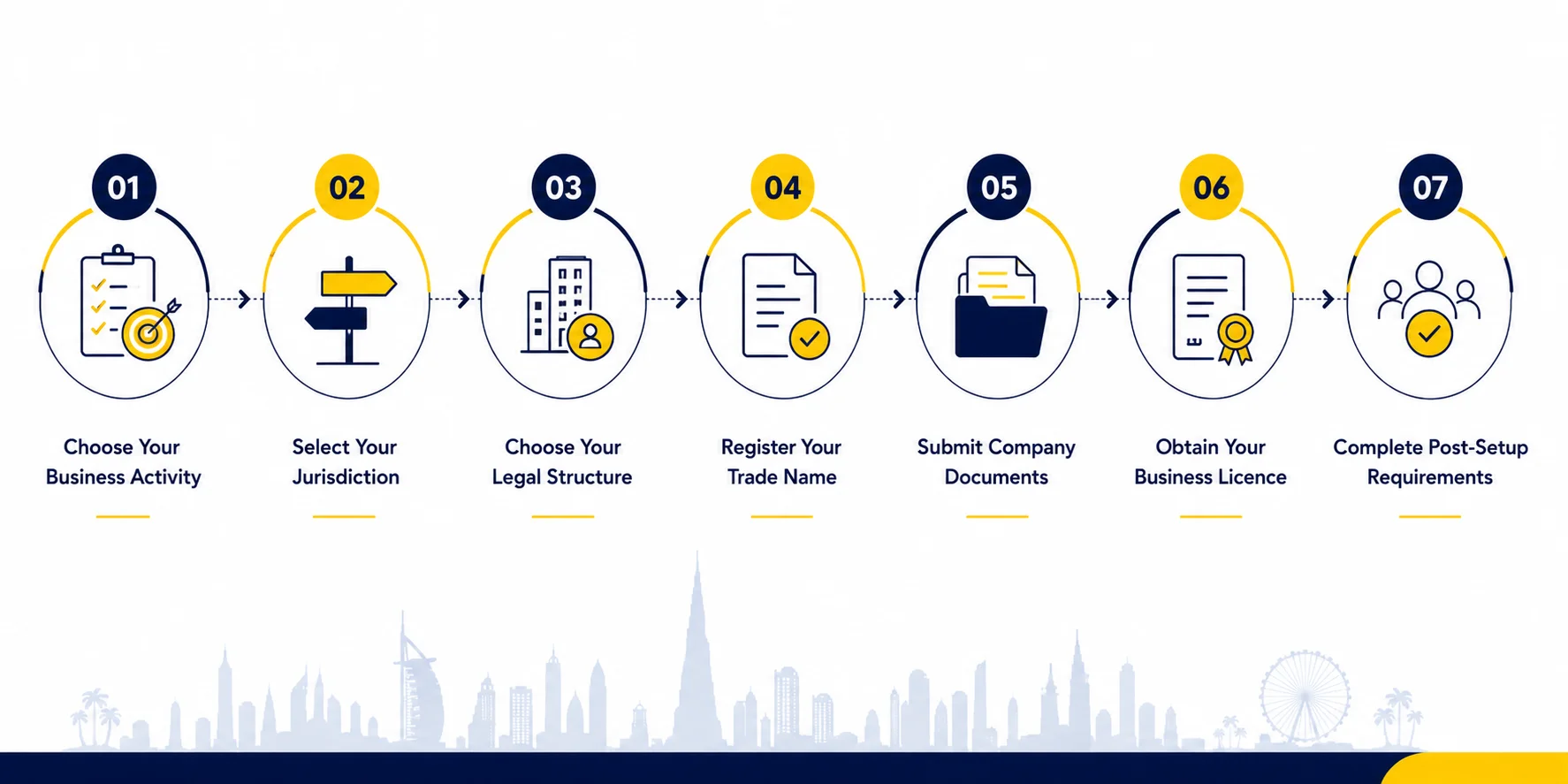
Step 1 – Choose Your Business Activity
Identify exactly what your company will do and whether additional regulatory approval is required.
Step 2 – Select Your Jurisdiction
Compare mainland and free zone options according to customers, activity, location, costs, and expansion plans.
Step 3 – Choose Your Legal Structure
Select an appropriate corporate form based on ownership and operational requirements.
Step 4 – Register the Trade Name
Choose a compliant business name and obtain the required initial approvals.
Step 5 – Submit Company Documents
Provide shareholder documentation and other incorporation paperwork required by the relevant authority.
Step 6 – Obtain Your Licence
Secure the appropriate commercial, professional, industrial, or other business licence.
Step 7 – Complete Post-Setup Requirements
Depending on the business, this can include visas, banking, tax registration, accounting, office arrangements, and additional regulatory approvals.
Why Dubai Remains Attractive in 2026
Dubai’s advantage comes from combining several qualities that businesses often have to find across multiple locations – international connectivity, economic ambition, infrastructure, talent, technology, lifestyle, and government-led long-term planning.
D33 also continues to shape this direction. In 2026, Dubai approved a unified Investor Register designed to reduce operational burdens and allow companies and investors to operate across multiple zones without repeated registration, supporting the broader target of AED650 billion in FDI by 2033.
For businesses, these reforms demonstrate that Dubai is continuing to evolve rather than relying solely on advantages established in previous decades.
Conclusion
Dubai’s transformation into a leading international destination for business, talent, and investment reflects decades of infrastructure development, economic diversification, and forward-looking policy. In 2026, its appeal is strengthened by the D33 economic agenda, expanding digital industries, international connectivity, specialised business jurisdictions, and residence options designed to attract investors and skilled professionals.
For entrepreneurs, the opportunity is not simply to relocate to Dubai but to use the city as a platform for regional and international growth. If you are considering establishing or expanding your business in the UAE, contact our Dubai company formation experts to identify the right jurisdiction, licence, and company structure for your plans.