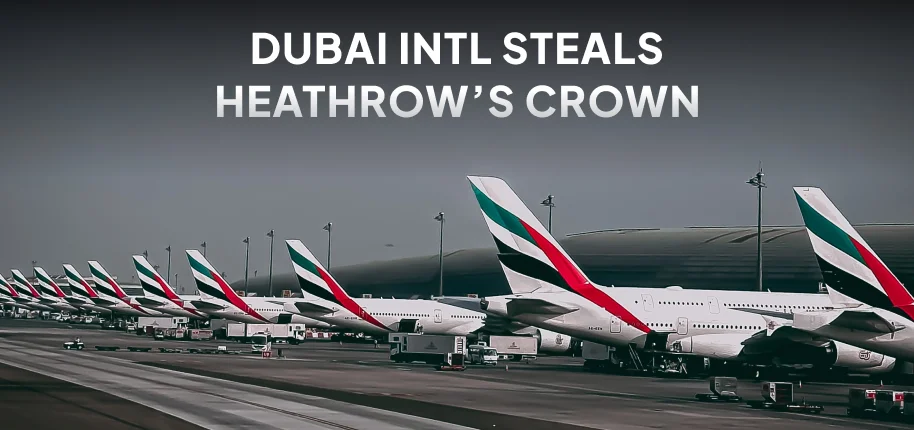
Dubai International Airport – DXB – has transformed the global aviation hierarchy, moving ahead of London Heathrow as the world’s leading airport for international passenger traffic and developing that early breakthrough into more than a decade of international leadership. Its success is closely connected to Dubai’s strategic location, Emirates’ extensive global network, continued investment in aviation infrastructure, strong tourism growth, and the emirate’s expanding position as an international business and investment centre. Although exceptional regional disruption has affected passenger numbers in 2026, DXB’s long-term performance demonstrates how aviation has become one of the foundations of Dubai’s global economic strategy.
How Dubai Took Heathrow’s International Aviation Crown
For decades, London Heathrow represented one of the most important gateways for international aviation. Dubai’s rapid emergence changed that competitive landscape.
DXB initially overtook Heathrow in international passenger traffic more than a decade ago and subsequently established itself at the top of the international rankings. By 2025, Airports Council International data showed DXB handling 95,192,160 international passengers, compared with 79,874,784 at Heathrow.
That represents a difference of more than 15 million international passengers.
The comparison is particularly important because overall airport rankings and international passenger rankings measure different things. Atlanta remained the world’s busiest airport by total passenger traffic in 2025, while Dubai ranked second overall. When only international passengers are considered, however, DXB ranked first globally.
Dubai’s rise as an aviation hub also reflects the emirate’s broader transformation into an international destination for tourism, investment, trade, employment, and entrepreneurship. Businesses considering the opportunities created by this growth can explore setting up a business in Dubai and the different structures available to international entrepreneurs.
DXB Reached a Historic 95.2 Million Passengers
The scale of DXB’s current position becomes clearer when looking at its latest full-year performance.
Dubai International welcomed a record 95.2 million guests during 2025, an increase of approximately 3.1% compared with 2024. It was the highest annual traffic figure in the airport’s history and the highest number of international passengers handled by any airport in a single year.
The result also placed DXB second globally when domestic and international passenger traffic were combined.
| 2025 Measure | Dubai International – DXB | London Heathrow – LHR |
|---|---|---|
| Total passengers | 95.2 million | 84.5 million |
| International passengers | 95.2 million | 79.9 million |
| International ranking | No. 1 | No. 2 |
| Primary role | Global international hub | Major international hub |
DXB’s international nature is a major reason the airport occupies such a distinctive position in global aviation.
Why Dubai Became Such a Powerful Aviation Hub
Dubai’s success cannot be explained by airport infrastructure alone. Several economic and geographical advantages have worked together.
Strategic Global Location
Dubai sits between Europe, Asia, and Africa, allowing airlines to connect major population and business centres through a single international hub.
This geographical advantage is particularly valuable for long-haul connections between markets such as Europe and Asia, as well as travel between Africa, the Middle East, South Asia, and other international regions.
Emirates’ Global Network
Emirates has been fundamental to DXB’s development as an international transfer hub.
Its long-haul network enables passengers to travel between numerous international markets through Dubai rather than relying entirely on traditional European or Asian connecting airports.
Tourism Growth
Dubai is no longer primarily a transfer point.
The emirate welcomed approximately 19.6 million international overnight visitors in 2025, reinforcing demand for flights while generating activity across hospitality, retail, entertainment, transport, property, and professional services.
International Business
Dubai has also developed into an important base for multinational companies, entrepreneurs, investors, and regional headquarters.
The combination of aviation connectivity and a business-friendly commercial environment allows companies to manage customers, suppliers, employees, and operations across multiple international markets.
Airport Connectivity Creates Business Opportunities
An airport handling tens of millions of international passengers creates economic opportunities far beyond airlines.
Aviation supports a wider ecosystem that can include –
- Freight and logistics
- Aircraft services
- Tourism
- Hotels and hospitality
- Business travel
- Retail
- Food and beverage
- Technology
- Professional services
- E-commerce
- Import and export
- Warehousing
- Transport
- Events and exhibitions
For businesses that depend heavily on international connectivity, locating close to DXB can provide operational advantages.
Dubai Airport Freezone is one of the specialised business environments positioned close to the airport and supports companies across sectors including trading, logistics, technology, professional services, and other approved activities.
Dubai Airport Freezone Benefits From DXB’s Position
DAFZ was established close to Dubai International Airport specifically to provide businesses with access to a highly connected commercial location.
For businesses handling time-sensitive products, international clients, frequent executive travel, or air freight, proximity to a major international airport can be particularly valuable.
Companies considering DAFZ still need to assess their actual business activities, facility requirements, licence, workforce, visa needs, and regulatory obligations rather than choosing the jurisdiction based solely on location.
The overall cost can also differ substantially according to the type of company being established.
Also read – DAFZA Company Setup Costs
DXB’s Network Extends Across the World
Connectivity is one of Dubai International’s greatest competitive advantages.
During its record 2025 performance, Dubai Airports reported that DXB connected passengers through more than 100 international airlines to hundreds of destinations.
India remained one of DXB’s largest country markets, while Saudi Arabia and the United Kingdom also generated substantial passenger traffic.
This broad network helps Dubai connect both established economies and rapidly developing markets.
For businesses, that connectivity can make Dubai particularly attractive as a base for managing operations across multiple regions.
Aviation Supports Dubai’s Wider Economy
The importance of DXB goes beyond passenger numbers.
Every additional international route can potentially improve access to customers, investors, tourists, professionals, suppliers, and new markets.
This creates a relationship between aviation growth and sectors such as –
- Tourism and hospitality
- International trade
- Financial services
- Real estate
- Professional services
- Technology
- Logistics
- Events
- Retail
- Foreign investment
Dubai’s airport strategy therefore forms part of a wider economic development model rather than operating as an isolated transport project.
What Is Happening at DXB in 2026?
The 2026 picture requires some context.
DXB’s first-half traffic was significantly affected by regional airspace constraints and an unusually challenging operating environment. Dubai Airports reported 31.5 million passengers during H1 2026, representing a 31.3% decline compared with the same period of 2025.
However, traffic progressively strengthened during the second quarter as capacity returned. Passenger volumes increased from approximately 3.5 million in April to 4.5 million in May and 5 million in June.
By the end of H1, DXB was connected to 217 destinations across 99 countries, with airline capacity continuing to recover.
The decline should therefore be understood in the context of exceptional regional disruption rather than interpreted as evidence that Dubai’s long-term aviation model has fundamentally weakened.
Heathrow Remains a Major Global Competitor
DXB’s leadership should not be interpreted as diminishing Heathrow’s importance.
Heathrow remains one of the world’s largest and most important international airports. It served approximately 84.5 million passengers in 2025, another extremely strong annual performance.
Its position as London’s principal international gateway gives it access to one of the world’s largest business, financial, tourism, and aviation markets.
The difference is that DXB’s operating model is exceptionally concentrated around international traffic and global connections.
This makes Dubai particularly powerful when airports are ranked specifically by international passenger volumes.
Dubai Is Already Preparing for the Next Aviation Era
The most important part of Dubai’s aviation story may not be DXB itself.
Dubai is making an enormous long-term investment in Dubai World Central – Al Maktoum International Airport – DWC.
Dubai Airports states that approximately US$35 billion is being invested in DWC’s expansion.
The long-term vision is substantial.
DWC is planned to eventually accommodate up to –
- 260 million passengers annually
- 12 million tonnes of cargo
Capacity is expected to reach approximately 150 million passengers annually during an earlier stage of its development.
The project is designed to provide Dubai with the aviation capacity required for future decades as DXB approaches the practical limits of its existing location.
What Does Airport Growth Mean for Entrepreneurs?
Dubai’s aviation expansion creates opportunities for companies that either directly participate in aviation or benefit from increased international connectivity.
Potential areas include –
- Logistics and freight forwarding
- Import and export
- E-commerce fulfilment
- Tourism services
- Hospitality
- Aviation technology
- Business consultancy
- Events and exhibitions
- Corporate travel services
- Warehousing and distribution
- Professional services
- Digital businesses serving international markets
Not every company needs to operate directly within an airport-related free zone.
A business should choose its jurisdiction according to its actual commercial activity, customers, physical-space requirements, regulatory obligations, and long-term expansion strategy.
Why International Connectivity Matters for New Businesses
For an international entrepreneur, connectivity can influence much more than travel convenience.
It can affect how easily executives reach customers, how efficiently products move between markets, how quickly specialist employees can travel, and how effectively a Dubai company can coordinate regional operations.
This is one reason Dubai continues attracting companies looking for a base between Europe, Asia, Africa, and the wider Middle East.
DXB’s development demonstrates how infrastructure and business policy can work together. The airport brings international markets physically closer to Dubai, while the emirate’s company formation ecosystem gives businesses multiple options for establishing operations around those opportunities.
DXB’s Crown Represents More Than Passenger Numbers
The competition between DXB and Heathrow attracts attention because rankings are easy to understand, but Dubai’s achievement has wider significance.
Becoming the world’s busiest international airport reflects decades of investment in aviation, airlines, tourism, infrastructure, trade, and the wider business environment.
DXB has helped make Dubai accessible to millions of visitors while giving companies based in the emirate connections to markets across the world.
The next stage – particularly the expansion of DWC – could extend that strategy considerably further.
Conclusion
Dubai International’s rise above Heathrow in international passenger traffic was not a temporary achievement. DXB developed its early lead into more than a decade of global international aviation leadership, culminating in a record 95.2 million passengers in 2025. Its position reflects Dubai’s location, Emirates’ international network, tourism growth, investment, infrastructure, and expanding role as a global business centre.
While exceptional regional disruption has affected traffic during 2026, Dubai continues investing for the long term, particularly through the enormous expansion planned for Al Maktoum International Airport. For entrepreneurs, that aviation strategy means continued access to international customers, markets, talent, logistics networks, and investment opportunities. If you are considering establishing a company within this globally connected economy, contact our Dubai company formation specialists to discuss the right structure and jurisdiction for your business.