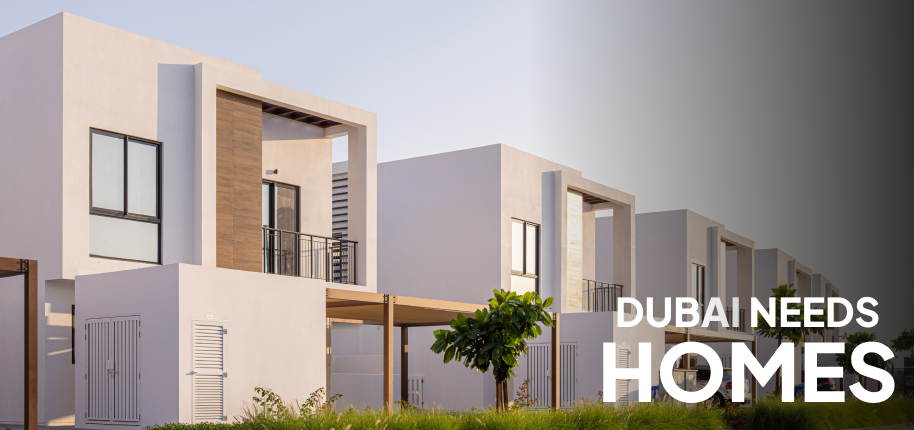
Dubai’s rapid transformation into a global destination for business, investment, tourism, and employment is creating a fundamental requirement more homes for a growing population. As more professionals, entrepreneurs, families, and investors choose the emirate, demand is evolving across apartments, villas, family communities, affordable housing, and premium residences.
Why Does Dubai Need More Homes?
Dubai’s population reached approximately 4.58 million by the end of 2025, increasing by around 332,000 people, or 7.5%, during the year. This continued expansion has important implications for housing, infrastructure, transportation, schools, healthcare, retail, and other services. For entrepreneurs looking to set up a business in Dubai, the city’s residential expansion also creates opportunities across construction, property services, technology, maintenance, design, and related industries.
Population growth is one of the clearest drivers. Dubai continues attracting international professionals and businesses while developing new economic districts and residential communities. The Dubai 2040 Urban Master Plan was designed around long-term population growth, with the city’s resident population projected to reach 5.8 million by 2040.
Housing demand is also becoming increasingly diverse. Dubai does not simply need more luxury towers; its expanding population requires different types of accommodation, including:
- Apartments for professionals and young families
- Villas and townhouses for larger households
- Affordable and mid-market housing
- Premium and luxury residences
- Communities close to employment centres
- Housing connected to public transport
- Integrated family-oriented developments
This creates opportunities for both property developers and businesses supporting the wider residential ecosystem.
Dubai’s Residential Market Continues to Expand
| Housing Segment | Main Demand Drivers |
|---|---|
| Apartments | Professionals, couples, investors and smaller families |
| Villas & Townhouses | Families seeking space and community living |
| Affordable Housing | Workforce and cost-conscious residents |
| Premium Homes | Executives and international investors |
| Luxury Property | HNWIs and global wealth |
| Transit-Oriented Housing | Residents prioritising accessibility |
Dubai’s property sector entered 2026 following record residential sales activity in 2025. According to Knight Frank, approximately 205,400 residential transactions were recorded during 2025, representing an 18% year-on-year increase, while their total value reached AED 544.2 billion.
However, more homes are also entering the market. CBRE reported in Q2 2026 that new residential supply was helping ease pricing pressures as market activity moderated. This is important: Dubai’s housing story is increasingly about ensuring the right homes are delivered in the right locations and price segments, rather than simply adding units.
Construction Is Responding to Demand
Development activity remains substantial. Dubai Municipality issued 10,776 building permits in Q1 2026, 12% more than during the same period in 2025. The total permitted built-up area was close to 3.9 million square metres.
Developers are expanding established communities while creating new residential districts. This construction activity supports not only housing supply but also numerous business sectors, including:
- Construction and contracting
- Architecture and engineering
- Interior design
- Property management
- Facilities management
- Landscaping
- Building technology
- Real estate services
- Furniture and home products
Entrepreneurs interested in participating in Dubai’s expanding economy can explore company formation services in Dubai to determine the appropriate structure for their proposed activity.
Population Growth Is Changing Dubai’s Communities
As Dubai grows, residential development is increasingly focused on complete communities rather than isolated buildings. Residents expect convenient access to workplaces, schools, healthcare, supermarkets, parks, entertainment, and transport.
The Dubai 2040 Urban Master Plan reflects this direction by focusing on integrated urban centres and improving quality of life. The plan also seeks to increase green and recreational spaces while creating communities where essential services are more accessible.
What Do Modern Dubai Communities Need?
Successful residential areas increasingly combine housing with:
- Schools and nurseries
- Healthcare facilities
- Retail centres
- Restaurants and cafés
- Parks and recreational areas
- Public transportation
- Fitness and wellness facilities
- Offices and flexible workspaces
This creates a multiplier effect: every new residential community can generate opportunities for dozens of supporting businesses.
Affordable Housing Is Becoming More Important
Dubai’s housing requirements are not limited to high-end developments. A growing international workforce requires a broader range of housing at different price levels.
Dubai has consequently taken steps toward expanding affordable housing. In 2025, the RTA, Dubai Municipality and Wasl Group signed an agreement to implement affordable housing projects as part of Dubai’s wider urban planning objectives.
Affordable and mid-market housing can play an important role in attracting and retaining talent while ensuring workers can live within practical distances of employment centres.
Luxury Housing Remains a Major Market
At the other end of the market, Dubai remains one of the world’s strongest destinations for luxury residential property. Knight Frank reported 296 sales of homes valued above US$10 million during the first half of 2026, with transactions in this segment worth US$5.1 billion.
Dubai attracts international wealth through a combination of lifestyle, connectivity, security, modern infrastructure, business opportunities, and premium residential developments. Luxury property therefore remains an important part of the market even as the city develops more housing for its wider population.
Business Opportunities Created by Dubai’s Housing Growth
A growing residential market creates opportunities well beyond buying and selling property. Entrepreneurs can build businesses that serve developers, landlords, homeowners, tenants, and residential communities.
Promising areas include:
- Property and facilities management
- Interior design and fit-out
- Cleaning and maintenance services
- Smart-home technology
- Property technology platforms
- Furniture and furnishing
- Landscaping
- Moving and relocation services
- Building materials
- Energy-efficiency solutions
- Security services
- Professional property consultancy
Dubai’s expanding technology ecosystem also provides opportunities to develop PropTech solutions for property searches, digital transactions, building management, maintenance, tenant communication, and investment analysis.
How to Start a Property-Related Business in Dubai
Entrepreneurs seeking to benefit from Dubai’s residential growth should first identify exactly where their business fits within the property ecosystem.
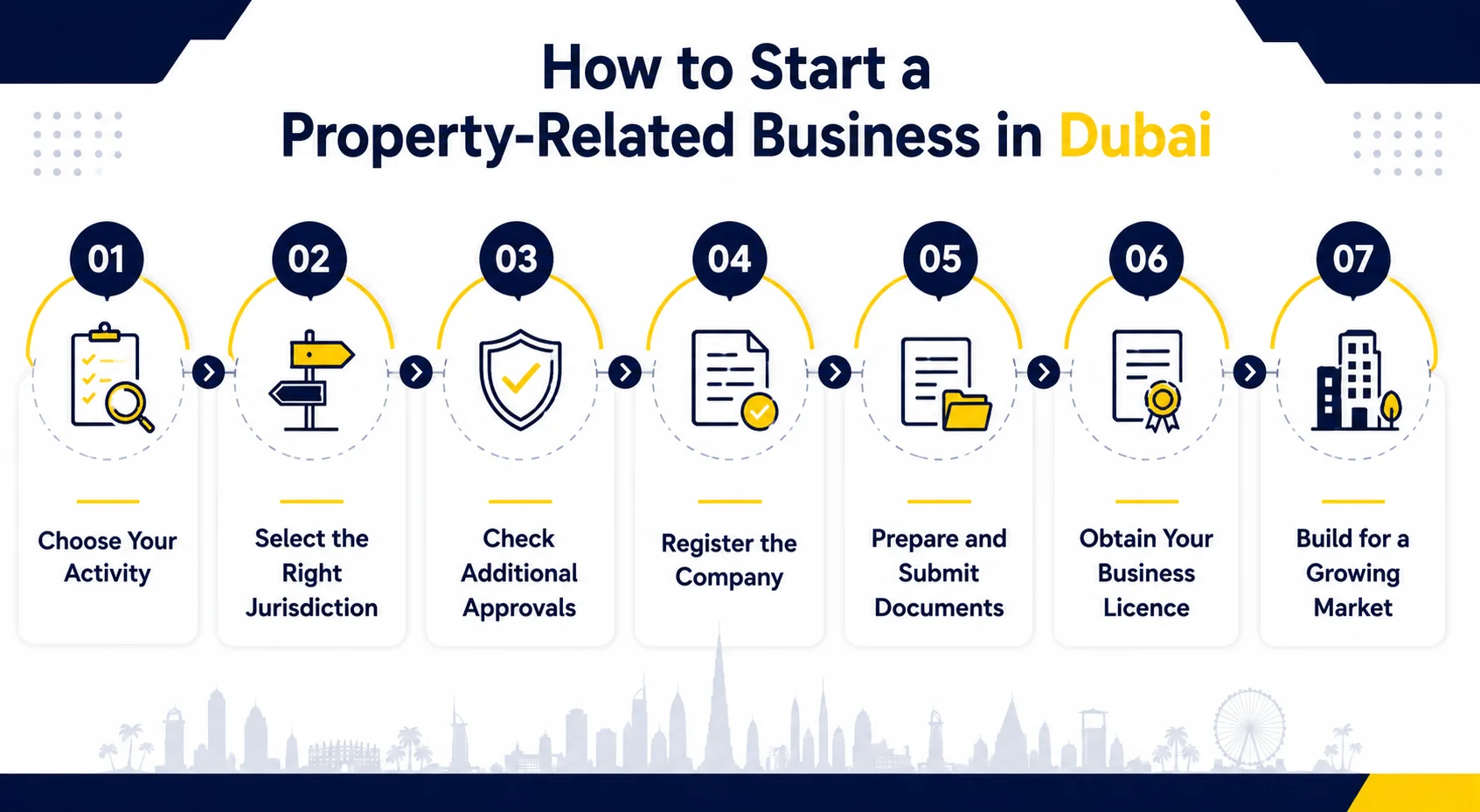
Step 1 – Choose Your Activity
Determine whether your company will provide construction, maintenance, technology, design, consultancy, property management, trading, or another service.
Step 2 – Select the Right Jurisdiction
Compare Dubai mainland company formation with available free zones based on where and how you intend to operate.
Step 3 – Check Additional Approvals
Property, construction, engineering, and other regulated activities may require approvals beyond a standard business licence.
Step 4 – Register the Company
Complete trade-name registration, initial approvals, documentation, licensing, and any office requirements applicable to your activity.
Step 5 – Build for a Growing Market
Focus your services on genuine needs emerging from Dubai’s expanding communities rather than relying purely on short-term property-market trends.
Housing and Dubai’s Wider Economic Growth
Residential development and economic expansion reinforce each other. New companies bring employees and entrepreneurs to Dubai, while good housing, infrastructure, schools, transport, and lifestyle amenities help the emirate retain those residents.
This relationship is one reason property remains closely connected to Dubai’s broader economic strategy. If you’re considering entering the market as an entrepreneur, also read Thriving Businesses in Dubai for a wider look at business opportunities across the emirate.
What Does the Future Hold?
Dubai’s housing market is likely to keep evolving as population growth, new supply, affordability, infrastructure, and changing lifestyle preferences reshape demand. The Dubai 2040 Urban Master Plan provides a long-term framework for balancing residential expansion with transportation, green space, services, and economic development.
The key challenge is therefore not simply to build more. Dubai needs a diverse residential market capable of serving different income groups, household sizes, lifestyles, and locations while maintaining the quality of life that helps attract people to the city.
Conclusion
Dubai needs homes because Dubai continues to grow. More residents mean greater demand not only for apartments and villas but also for schools, shops, healthcare, transport, maintenance, technology, and thousands of other services that support everyday life.
For entrepreneurs, this expansion can create opportunities throughout the residential and property ecosystem. If you are considering launching a business to serve Dubai’s growing communities, contact our Dubai company formation experts to discuss your proposed activity, licensing requirements, and suitable company structure.