
Opening a business bank account in Dubai takes between 2 and 4 weeks for most companies. You need a valid trade licence, proof of business activity, passport copies of all shareholders, and a minimum deposit that varies by bank. UAE banks are thorough. They run KYC and AML checks on every application. But once your account is open, you gain access to one of the world’s most efficient business banking systems, including multi-currency accounts, instant international transfers, and fully digital banking services.
This guide covers everything – the required documents, the best UAE banks for business accounts, costs, timelines, common rejection reasons, and real case examples from companies that have been through the process.
Why You Need a Business Bank Account in Dubai
Many entrepreneurs arriving in Dubai try to run business transactions through a personal account. UAE banks flag this quickly. Most corporate clients and government entities will not transfer money to a personal account. VAT registration with the Federal Tax Authority (FTA) also requires a registered business account.
Beyond compliance, a dedicated business bank account gives you
- Clear financial separation between personal and business funds
- Access to trade finance, letters of credit, and overdraft facilities
- Merchant payment terminals and payment gateway integrations
- Online banking dashboards for payroll, supplier payments, and reporting
- Multi-currency accounts to receive and hold USD, EUR, GBP, and other currencies
The UAE has no personal income tax. But corporate tax of 9% now applies to profits above AED 375,000, introduced in June 2023. Accurate business banking records are essential for tax filings and audits.
Understanding the UAE Banking System
The UAE has over 50 licensed banks, regulated by the Central Bank of the UAE (CBUAE). The system is divided into three main categories.
Local Banks
Local UAE banks dominate business banking. Emirates NBD is the largest bank in the Middle East by total assets. Abu Dhabi Commercial Bank (ADCB) is the second largest and has a strong SME proposition. Dubai Islamic Bank (DIB) is the country’s leading Islamic bank.
International Banks
HSBC, Standard Chartered, and Citibank serve multinationals and businesses with significant cross-border activity. Their account packages typically require higher minimum balances but offer more sophisticated international banking services.
Islamic Banks
Abu Dhabi Islamic Bank (ADIB), Dubai Islamic Bank (DIB), and Emirates Islamic operate under Sharia principles. They offer profit-sharing accounts instead of interest-bearing ones. These are increasingly popular with businesses from Muslim-majority markets.
The Regulatory Framework
The Central Bank of the UAE sets licensing requirements and compliance standards for all banks. The UAE follows strict Anti-Money Laundering (AML) and Counter-Terrorism Financing (CTF) rules, aligned with FATF (Financial Action Task Force) standards. Every business applying for a bank account goes through mandatory Know Your Customer (KYC) checks. This is not negotiable. Banks that fail compliance standards face heavy penalties.
Eligibility Requirements – Who Can Open a Business Bank Account
Eligibility requirements vary by bank, but all UAE banks apply the same core criteria.
Company Registration
Your company must be legally registered in the UAE. This applies to Mainland companies, Free Zone companies, and Offshore companies. Offshore companies face the most scrutiny. Some banks refuse to open accounts for offshore entities entirely. Others require extensive documentation about the ultimate beneficial owner (UBO) and the nature of business activity.
- Mainland companies licensed by the Department of Economic Development (DED) or equivalent emirate authority
- Free zone companies registered in zones such as DMCC, JAFZA, IFZA, RAKEZ, or any of the UAE’s 40+ free zones
- Offshore companies registered in RAKICC, JAFZA Offshore, or similar jurisdictions
Offshore companies face the most scrutiny. Some banks refuse to open accounts for offshore entities entirely. Others require extensive documentation about the ultimate beneficial owner (UBO) and the nature of business activity.
Residency Status
You do not need to be a UAE resident to open a business bank account in Dubai. However, non-residents face additional due diligence. Banks will want to understand why a non-resident is operating a business in the UAE, the source of funds, and the expected volume of transactions. Non-residents typically need to visit the UAE in person for at least the initial account meeting.
If you hold a UAE residence visa, the process is significantly smoother. You can also complete more steps through the bank’s digital portal or mobile app.
Minimum Deposit and Balance Requirements
Most UAE banks require a minimum opening deposit and charge fees if the average monthly balance falls below a threshold. These numbers vary significantly
|
Bank |
Minimum Opening Deposit |
Monthly Minimum Balance |
Account Package |
|
Emirates NBD |
AED 50,000 |
AED 50,000 |
Business Current Account |
|
ADCB |
AED 25,000 |
AED 25,000 |
Business Plus Account |
|
RAKBANK |
AED 10,000 |
AED 10,000 |
Business One |
|
Mashreq |
AED 25,000 |
AED 25,000 |
Business Account |
|
Dubai Islamic Bank |
AED 10,000 |
AED 10,000 |
Business Current Account |
|
ADIB |
AED 15,000 |
AED 15,000 |
Business Account |
|
HSBC |
AED 100,000+ |
AED 100,000+ |
Business Banking |
Note – These figures are indicative and subject to change. Always confirm directly with your chosen bank. Some banks offer promotional account packages with reduced minimums for the first 6 to 12 months.
Required Documents for Opening a Business Bank Account in Dubai
Incomplete documentation is the single biggest reason applications are delayed or rejected. Prepare all of the following before you approach a bank.
Standard Documents for All Company Types
- Valid trade licence (not expired, must cover your actual business activity)
- Certificate of incorporation
- Memorandum and Articles of Association (MOA and AOA)
- Board resolution authorising the account opening and designating signatories
- Passport copies of all shareholders, directors, and authorised signatories
- UAE residence visa copies (if applicable)
- Emirates ID copies (for UAE residents)
- Proof of business address (Ejari contract, utility bill, or tenancy agreement)
- Proof of business activity (contracts, invoices, website, company profile)
Additional Documents Banks May Request
- Business plan with projected revenue and transaction volumes
- Source of funds declaration (especially for initial capital deposits)
- Bank statements from your home country (for non-residents)
- Corporate structure chart showing all beneficial owners
- Details of key customers and suppliers
- Tax registration certificate (if applicable in your home country)
If any shareholder or director holds more than 25% of the company, the bank will require full KYC on that individual. Banks may also conduct online searches and request explanations for any adverse media.
Document Tips
- All documents should be in English or officially translated and attested
- Ensure your trade licence shows the correct business activity matching your actual operations
- Prepare a one-page company profile – what you do, who your clients are, where funds come from
- If your company is less than 6 months old, have a clear business plan ready
Choosing the Right Bank – Top UAE Banks for Business Accounts
The right bank depends on your business size, transaction volume, industry, and whether you need international banking services. Here is a detailed breakdown.
Emirates NBD
Emirates NBD is the UAE’s largest bank and a first choice for many established businesses. Their business banking services include trade finance, letters of credit, payroll management, and a comprehensive digital banking platform. The eBusiness Banking portal allows you to manage all transactions online with strong security features.
Best for – Larger SMEs and corporates, businesses needing trade finance, companies requiring premium relationship management.
Abu Dhabi Commercial Bank (ADCB)
ADCB has invested heavily in its SME banking services. The Business Banking Online platform is rated highly for ease of use. ADCB also offers working capital loans, business credit cards, and a dedicated SME advisory team in both Dubai and Abu Dhabi.
Best for – SMEs looking for comprehensive account packages with credit facilities.
RAKBANK
RAKBANK (National Bank of Ras Al Khaimah) has built a reputation as the go-to bank for startups and early-stage businesses. The minimum balance requirement is lower than most competitors, and account approval tends to be faster, often within 48 hours to one week. Their RAKStarter and Business One packages are well suited to new companies with lean operations.
Best for – Startups, new UAE companies, and businesses with lower transaction volumes.
Mashreq
Mashreq is known for its digital-first approach. Their NeoBiz platform is one of the most advanced business banking apps in the UAE, allowing you to open an account online and manage everything from your phone. Mashreq is particularly strong for e-commerce businesses and companies that need fast, seamless international transfers.
Best for – Tech-enabled businesses, e-commerce companies, businesses prioritising digital banking services.
Dubai Islamic Bank (DIB)
DIB is the first Islamic bank in the UAE and offers a full range of Sharia-compliant business banking products. Their corporate business accounts include profit-sharing investment options, trade finance solutions, and multi-currency accounts.
Best for – Businesses seeking Islamic banking solutions, companies from Muslim-majority markets.
HSBC UAE
HSBC is the bank of choice for businesses with significant international operations. Their global network and multi-currency account capabilities are unmatched among UAE banks. However, HSBC requires substantially higher minimum balances and has rigorous account opening standards.
Best for – Multinationals, businesses with heavy cross-border trading, companies needing international banking relationships.
Step-by-Step Process – How to Open a Business Bank Account in Dubai
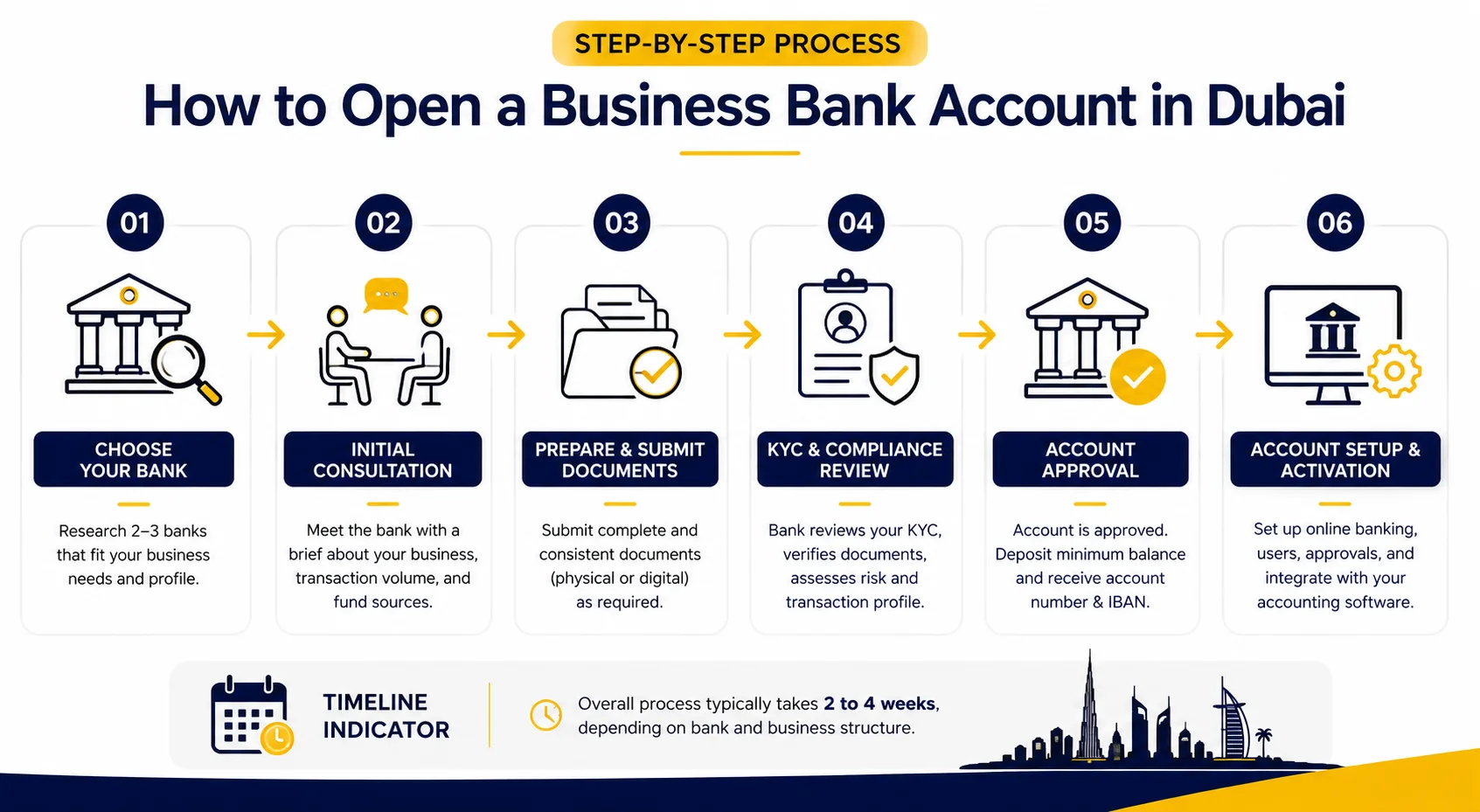
Follow these steps in order. Skipping steps or arriving unprepared extends your timeline significantly.
Step 1 – Choose Your Bank
Do not approach every bank at once. Research two or three banks that match your profile, then approach them in priority order. Consider –
- Do they bank companies in your industry?
- Do they have branches or relationship managers familiar with your business type?
- Do their minimum balance requirements match your expected cash flow?
- Do they offer the international banking services you need?
Step 2 – Initial Consultation
Call or email the bank’s business banking team to request an initial meeting. Bring a brief company overview – what your business does, your expected monthly transaction volume, and where funds will come from. This pre-meeting helps the relationship manager understand whether your application is a good fit.
Step 3 – Prepare and Submit Documents
Compile your full document set before submission. Provide physical originals where required and certified copies where accepted. Upload digital copies to any online portal the bank provides. Ensure your company name, licence number, and shareholder details are consistent across all documents.
Step 4 – KYC and Compliance Review
The bank’s compliance team will conduct a full KYC review. They verify the identity of all shareholders, check sanctions lists, review the nature of your business activity, and assess the expected transaction profile. This step typically takes 1 to 2 weeks. Banks may come back with additional document requests during this stage.
Step 5 – Account Approval
Once compliance is satisfied, the bank approves the account. You deposit the minimum opening balance and receive your account number, IBAN, and online banking access. Most banks issue a debit card within 5 to 7 business days.
Step 6 – Account Setup and Activation
Set up your online banking portal, configure payment approvals, add authorised users, and link your account to any accounting software you use (Xero, QuickBooks, Zoho Books, etc.). Most UAE banks have API integrations or direct bank feed connections with major accounting platforms.
Typical Timeline
Here is a realistic timeline breakdown
|
Stage |
Typical Duration |
Notes |
|
Bank selection and initial meeting |
2 to 5 days |
Faster if you have a referral or prior relationship |
|
Document preparation and submission |
3 to 7 days |
Depends on your readiness |
|
KYC and compliance review |
7 to 14 days |
Can be longer for offshore companies or complex structures |
|
Account approval notification |
1 to 2 days |
After compliance sign-off |
|
Account activation and card issuance |
5 to 7 days |
Online access usually within 48 hours of approval |
|
Total estimated timeline |
2 to 4 weeks |
RAKBANK and Mashreq tend to be faster |
Business Banking for Free Zone vs Mainland Companies
Your company’s registration type affects which banks will work with you and how smoothly the process runs.
Mainland Companies
Mainland companies (licensed by DED or equivalent emirate authorities) are the easiest category for business banking. All UAE banks accept applications from mainland companies. Relationship managers at most banks are well-versed in processing mainland applications quickly.
Free Zone Companies
Free zone companies can bank with any UAE bank. However, some free zones have preferred banking partners. DMCC, for example, has a close relationship with Emirates NBD. IFZA has partnerships with several local banks. Ask your free zone authority which banks are most familiar with their licence types, as this can speed up your application.
Offshore Companies
Offshore companies (RAKICC, JAFZA Offshore) face the greatest difficulty opening UAE business bank accounts. Most major UAE banks do not offer current accounts to offshore entities. Some niche banks and international banks will, but with significantly higher minimum deposits and more extensive due diligence. If you need banking for an offshore company, work with a specialist corporate services provider to identify which banks are currently accepting offshore applications.
Non-Residents Opening a Business Bank Account in Dubai
You do not need to be a resident to open a business bank account in Dubai. However, non-residents should expect –
- Mandatory in-person visit to the UAE for at least the initial meeting
- Additional documentation including overseas bank statements and source of funds evidence
- Longer processing times due to enhanced due diligence requirements
- Higher minimum balance requirements at some banks
Some banks, including Mashreq, offer digital account opening processes that reduce the need for physical presence. Check with your chosen bank whether any steps can be completed remotely.
Multi-Currency Accounts and International Banking
If your business trades internationally, a multi-currency account is essential. UAE banks are well positioned for international banking, given Dubai’s role as a global trade hub.
What a Multi-Currency Account Gives You
- Hold balances in USD, EUR, GBP, AED, and other major currencies
- Receive payments from international clients without conversion losses
- Pay overseas suppliers directly in their local currency
- Manage foreign exchange exposure more cost effectively
Emirates NBD, HSBC, Standard Chartered, and FAB (First Abu Dhabi Bank) all offer robust multi-currency account packages. FAB is particularly strong for USD-denominated business given Abu Dhabi’s oil and trade flows.
SWIFT and International Transfers
All major UAE banks are SWIFT members. International wire transfers typically clear within 48 hours for major currencies. UAE banks also participate in the Arab Regional Switch (AFAQ) for transfers within Gulf Cooperation Council (GCC) countries. Real-time international transfers are increasingly available through platforms like Mashreq NeoBiz.
Common Challenges and How to Overcome Them
The UAE’s strict AML and compliance environment means business banking applications get rejected more often than entrepreneurs expect. Understanding the common failure points helps you prepare better.
Incomplete or Inconsistent Documents
The most common cause of delays and rejections. Ensure every document uses the same company name, same shareholder names, and same registered address. Even a minor inconsistency between your trade licence and your MOA will trigger a request for clarification.
Unclear Business Activity
Banks want to understand exactly what your business does. A vague trade licence category like ‘general trading’ is a red flag. The more specific and explainable your business activity, the better. Prepare a one-page business overview that describes your products or services, your customers, and how money flows into and out of the company.
High-Risk Business Categories
Some business activities face heightened scrutiny or outright refusal. These include –
- Cryptocurrency and virtual asset services
- Money exchange and remittance businesses
- Precious metals and gemstones trading
- Real estate brokerage
- Cash-intensive businesses
If your business falls into one of these categories, consider working with a corporate services provider who has established relationships with banks that are open to these sectors.
Offshore Company Structures
As noted above, offshore companies face significantly more scrutiny. If your business is structured with an offshore holding company and a UAE operating entity, banks will want to understand the full corporate structure and the purpose of the offshore element.
Long Processing Times
If your application has been with a bank for more than 4 weeks without a decision, follow up with your relationship manager. Ask specifically whether the compliance team has any outstanding queries. Do not submit multiple applications to different banks simultaneously without disclosing this, as banks share information and simultaneous applications can look suspicious.
Case Studies – Real Businesses Opening Dubai Bank Accounts
Case Study 1 – E-Commerce Startup, Free Zone Company
A UK-based founder set up an e-commerce company in IFZA (International Free Zone Authority) in early 2025. She was not a UAE resident. She approached Emirates NBD first, which declined due to no UAE residency and the company being less than 6 months old.
She then approached Mashreq through a referral from her free zone business centre. With a clear business plan, sample customer contracts, and an explanation of her payment processing setup, Mashreq approved her account in 12 days. She now operates a multi-currency account holding AED, GBP, and USD balances.
Key lesson – A referral from a trusted source, a clear business narrative, and the right bank for your profile makes a significant difference.
Case Study 2 – Consulting Firm, Mainland Company, UAE Resident
A management consultancy registered on the Dubai mainland in Q1 2026. The founder held a UAE residence visa. He submitted a complete document pack to ADCB including his business plan, sample client contracts, and a corporate profile. ADCB approved the account in 9 business days. The firm now uses ADCB’s online platform for payroll processing and invoice payments to international clients.
Key lesson – Residency, a complete document pack, and a clear business purpose lead to fast approvals.
Case Study 3 – Trading Company with Offshore Structure
A commodities trading business with a RAKICC offshore holding structure and a JAFZA free zone operating entity spent 3 months trying to open a bank account in 2024. Most banks declined due to the offshore holding layer and the high-value commodity trade transactions involved. Working with a corporate services provider, they ultimately opened an account with a specialist bank with experience in commodity trading structures. They also had to provide detailed documentation on all beneficial owners and evidence of trading contracts.
Key lesson – Offshore and complex structures take longer and require specialist advice. Start the banking process early, ideally before your company is fully operational.
Banking Costs – Fees and Charges to Expect
Business banking in the UAE is not free. Understanding the fee structure helps you choose the right account package and avoid unnecessary charges.
|
Fee Type |
Typical Range |
Notes |
|
Monthly account maintenance |
AED 0 to AED 500 |
Often waived if minimum balance is maintained |
|
International wire transfer (outbound) |
AED 25 to AED 150 per transfer |
Varies by destination and currency |
|
International wire transfer (inbound) |
AED 0 to AED 50 |
Most banks charge a small receipt fee |
|
Cheque book |
AED 25 to AED 100 |
Per book; cheques still widely used in UAE |
|
Debit card |
AED 0 to AED 150 per year |
Often free with standard business accounts |
|
Online banking setup |
AED 0 |
Standard with all business accounts |
|
Below minimum balance penalty |
AED 100 to AED 500/month |
Avoid by maintaining minimum balance |
|
Account closure fee |
AED 0 to AED 500 |
Check before you open; varies by bank |
Some banks offer promotional account packages for new businesses. RAKBANK’s Business One package, for example, offers a reduced minimum balance for the first year. Always request a full fee schedule from your chosen bank before signing up.
Best Practices for Managing Your Dubai Business Bank Account
Opening the account is the beginning. Managing it well ensures you avoid compliance issues and maintain a good banking relationship.
- Keep your KYC documents updated. If your trade licence is renewed, notify your bank. If your shareholders or directors change, update your bank immediately.
- Maintain your minimum balance. Falling below the threshold generates fees and can flag your account.
- Avoid unusual transaction patterns. Sudden large deposits or transfers with no explanation trigger AML alerts.
- Respond to bank queries quickly. If your compliance team requests additional information, provide it promptly.
- Use the online banking portal for all regular transactions. This creates a clear audit trail.
- Reconcile your accounts monthly. Connect your bank account to accounting software for automated reconciliation.
- Separate personal and business funds strictly. UAE banks take co-mingling of funds seriously.
Final Thoughts
Opening a business bank account in Dubai is one of the most important steps in establishing your UAE company. The process is thorough because UAE banks maintain high compliance standards. But with the right preparation, the right bank, and a clear business narrative, most applications succeed within two to four weeks. Contact our team for guidance with your UAE business setup.
The key factors that determine your success are –
- A valid trade licence with a clearly defined business activity
- Complete, consistent, and up-to-date documentation
- A clear explanation of your business model, clients, and funding sources
- Choosing a bank whose account packages match your company profile
- Working with experienced advisors if your structure is complex
Dubai’s business banking infrastructure is world-class. Multi-currency accounts, real-time international transfers, and digital banking tools give UAE-based businesses a genuine competitive edge. Once your account is open and operating well, it becomes a core asset of your Dubai business.