Dubai has developed into a major destination for healthcare investment, attracting medical professionals, healthcare groups, wellness providers and international investors seeking access to the UAE and wider Middle Eastern market. For businesses that want to operate within a specialised healthcare environment, Dubai Healthcare City – commonly known as DHCC – provides an established free zone ecosystem designed around healthcare, medical services, wellness, education and related activities.
However, establishing a healthcare business involves more than obtaining a standard commercial licence. Clinical facilities may need facility approvals, appropriately designed premises, licensed healthcare professionals and regulatory assessments before they can begin treating patients. Understanding these requirements from the beginning can help investors create a realistic setup plan and avoid unnecessary licensing or operational delays.
What Is Dubai Healthcare City?
Dubai Healthcare City is a specialised free zone and healthcare ecosystem in Dubai. It was established to support healthcare delivery while creating opportunities for healthcare providers, investors, medical professionals and businesses connected with the sector.
Unlike a general-purpose free zone, DHCC provides an environment in which healthcare facilities can operate alongside related businesses and services. DHCC currently encourages investment across healthcare, wellness, education, hospitality and retail, with options including leasing, freehold land and joint-venture models.
Businesses considering DHCC should therefore determine whether they will operate as a clinical healthcare provider or as a non-clinical company serving the healthcare ecosystem.
Investors who want broader assistance with establishing operations in the UAE can learn more about company formation in Dubai before deciding which jurisdiction and structure are appropriate for their activities.
Why Set Up a Healthcare Business in DHCC?
For healthcare entrepreneurs, choosing a specialised location can provide practical advantages beyond basic company registration.
100% Foreign Ownership
As a free zone, DHCC permits full foreign ownership of businesses, including eligible clinical and non-clinical operations. This can make the jurisdiction particularly relevant to international healthcare groups and entrepreneurs establishing a UAE presence.
Specialised Healthcare Environment
DHCC is specifically structured around healthcare and associated sectors. Businesses can operate in an ecosystem where healthcare providers, professionals and supporting organisations are concentrated within the same community.
This environment can be particularly useful for businesses that depend on referrals, partnerships, specialised employees or relationships with other healthcare organisations.
Strategic Dubai Location
Location is another important consideration. DHCC provides access to Dubai’s transport and commercial infrastructure and is served by the Dubai Healthcare City Metro station. DHCC also highlights its proximity to Dubai International Airport as an advantage for partners and their clients.
For businesses targeting international patients or professionals travelling to Dubai, accessibility can be particularly valuable.
Established Regulatory Framework
Healthcare businesses operate in a highly regulated environment because patient safety, professional competence and quality of care must be protected.
DHCA – Regulations is responsible for licensing healthcare providers and professionals within DHCC and maintaining regulatory requirements for healthcare delivery.
Rather than treating these requirements simply as administrative obstacles, investors should incorporate regulatory compliance into their business plan from the beginning.
What Types of Healthcare Businesses Can Be Established?
The appropriate activity and approval requirements depend heavily on the type of operation being established.
Potential healthcare-related operations may include activities associated with
- Hospitals
- Medical clinics
- Dental clinics
- Specialist healthcare centres
- Diagnostic services
- Allied healthcare services
- Complementary and alternative medicine
- Wellness services
- Healthcare consultancy
- Medical education and training
- Healthcare support businesses
- Other approved clinical and non-clinical activities
The exact permitted activity should always be confirmed before incorporation because commercial registration alone does not automatically authorise a business to perform every healthcare service.
This distinction becomes especially important where a company intends to provide clinical treatment directly to patients.
Clinical vs Non-Clinical Businesses in DHCC
One of the first decisions investors need to make is whether their proposed company is clinical or non-clinical.
| Area | Clinical Business | Non-Clinical Business |
|---|---|---|
| Main purpose | Provides healthcare or clinical services | Provides supporting or other approved services |
| Healthcare professionals | Usually required | Depends on the activity |
| Professional licensing | Required for applicable clinical professionals | Generally activity dependent |
| Facility requirements | May require healthcare-specific facility standards | Depends on business and premises |
| Pre-operational assessment | Applicable to healthcare operators before clinical operation | Depends on the approved activity |
| Regulatory complexity | Generally higher | Usually lower, depending on activity |
Clinical facilities face additional requirements because they are responsible for patient treatment and clinical care. DHCC states that healthcare operators must complete a pre-operational assessment covering areas such as patient safety, clinical planning, facility operations and administration before obtaining a clinical operating licence.
Steps to Set Up a Healthcare Business in Dubai Healthcare City
Healthcare company formation should be approached systematically. Although DHCC provides online services through its MASAAR platform, a clinical operation may involve additional stages beyond ordinary company registration.
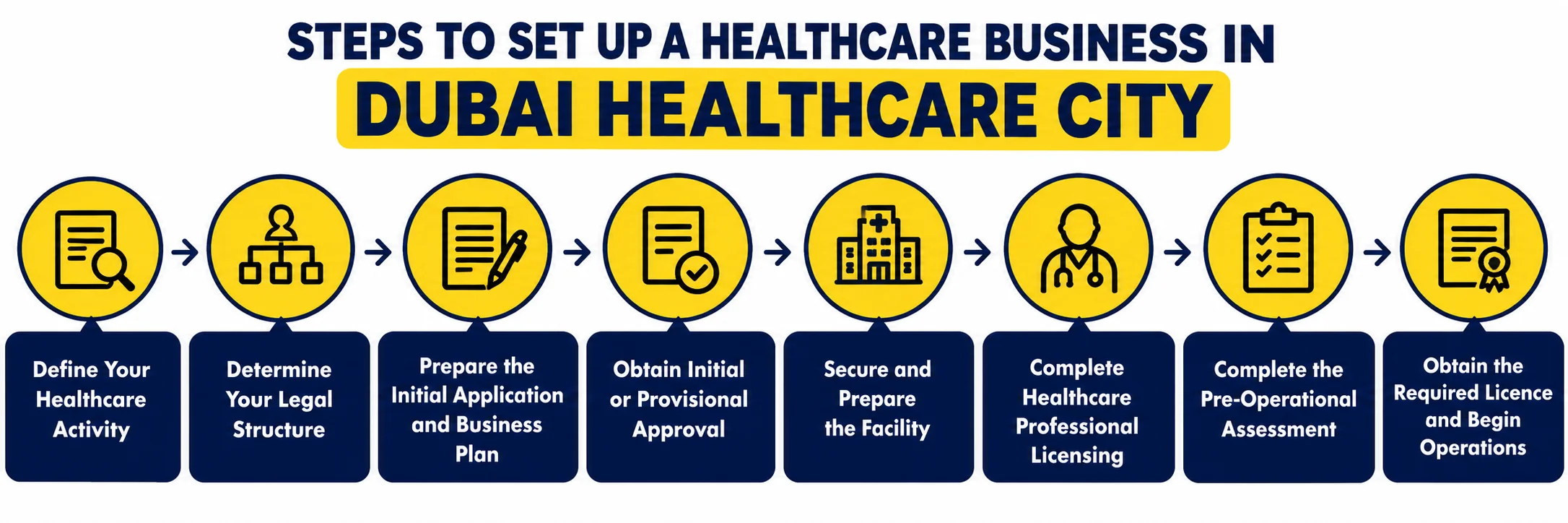
1. Define Your Healthcare Activity
Start by defining exactly what your company will do.
For example, establishing a dental clinic requires a different regulatory approach from operating a healthcare consultancy or administrative support company.
Your proposed services influence your
- Commercial activity
- Facility requirements
- Professional licensing
- Staffing
- Regulatory approvals
- Equipment requirements
- Overall setup cost
Selecting an incorrect or overly broad activity at the beginning can create problems later when applying for facility or professional approvals.
2. Determine Your Legal Structure
Investors must select a legal structure compatible with their proposed operation and ownership arrangement.
The appropriate option can depend on whether the business is being established as a new entity or as an extension of an existing organisation. DHCC’s licensing services also provide for matters such as company share transfers and conversion from a branch to an FZ-LLC.
Professional advice at this stage can help ensure that the structure supports future ownership, investment and expansion plans.
For wider assistance with choosing a free-zone structure and completing the formation process, investors can review our Dubai free zone company formation services.
3. Prepare the Initial Application and Business Plan
For healthcare operators, DHCC identifies an initial application and business plan among the requirements at the beginning of the process.
Supporting documents can include passports and CVs for shareholders, directors and managers. Where an existing company is establishing a branch, corporate documents such as a commercial licence or certificate of incorporation may also be required.
Your business plan should clearly explain the proposed healthcare operation, services, management structure and operational model.
4. Obtain Initial or Provisional Approval
The Facility Licensing Department reviews healthcare operator applications and can refer them to the relevant Facility Committee.
Following a successful review, a provisional approval letter may be issued specifying the approved services and applicable conditions or restrictions.
Importantly, provisional approval does not mean that a clinical facility can immediately begin treating patients. An operating licence must still be obtained.
5. Secure and Prepare the Facility
Clinical premises must be appropriate for the healthcare services being provided.
Healthcare operators may need to build or fit out their allocated premises according to applicable healthcare standards. DHCC states that facility design and construction are reviewed for conformity with Facility Guidelines Institute requirements, while medical equipment must also meet applicable standards.
This stage can significantly affect both the budget and timeline of a healthcare project.
Investors should therefore avoid committing to an unsuitable facility before confirming the technical requirements associated with their intended healthcare activity.
6. Complete Healthcare Professional Licensing
Company licensing and professional licensing are separate considerations.
Healthcare professionals working within DHCC must obtain the appropriate DHCA professional licence. DHCA assesses professional qualifications and uses Primary Source Verification to verify credentials with their issuers.
Professional categories include areas such as
- Medical and dental professionals
- Nurses
- Allied health professionals
- Pharmacists and pharmacy technicians
- Complementary and alternative medicine professionals
- Trainees
Depending on the professional category and credentials, additional assessment or an examination may apply.
Businesses should check professional eligibility early rather than waiting until the facility is almost ready to open.
7. Complete the Pre-Operational Assessment
Before a clinical healthcare facility becomes operational, DHCA – Regulations conducts a pre-operational assessment.
The assessment considers areas including
- Quality and patient safety
- Clinical planning
- Facility operations
- Administrative requirements
Successful completion of the required pre-operational assessment is a prerequisite for obtaining the clinical operating licence.
8. Obtain the Required Licence and Begin Operations
Once the applicable company registration, facility, professional and regulatory requirements have been completed, the business can obtain the licences and approvals required to commence its approved activities.
Investors should ensure that the services actually delivered match those authorised under their licence and facility approvals.
Also read 5 Thriving Business Niches in Dubai Despite Global Crisis.
Documents You May Need
Required documents vary according to the activity, ownership structure and whether the applicant is establishing a new company or branch.
Typical documents can include
- Passport copies of shareholders
- Passport copies of directors and managers
- CVs
- Business plan
- Initial application documents
- Existing company incorporation documents for branch applications
- Professional qualifications for healthcare staff
- Employment and experience certificates where applicable
- Good standing documentation where required
- Facility plans and technical documentation
- Additional regulatory documentation applicable to the proposed healthcare activity
Healthcare professionals can also be required to provide supporting credentials during the professional licensing process.
The final document list should always be confirmed for the specific activity before submission.
How Much Does It Cost to Set Up a Healthcare Business in DHCC?
There is no single cost that applies to every healthcare company.
The total investment can depend on
- Business activity
- Company structure
- Commercial licence
- Facility type and size
- Lease or property arrangement
- Fit-out requirements
- Medical equipment
- Professional licensing
- Employee visas
- Number of healthcare professionals
- Regulatory assessments
- Additional approvals and services
A small non-clinical healthcare consultancy, for example, may have substantially different setup requirements from a specialist medical centre containing treatment rooms and medical equipment.
Investors should therefore request a tailored estimate rather than relying on a generic advertised licence price.
How to Prepare for a Successful DHCC Setup
Before submitting an application, investors should develop a clear operational plan.
Start by confirming the exact services your business will provide. Then determine the appropriate company structure, identify which employees require professional licensing, understand your facility specifications and calculate the complete cost of becoming operational.
It is also advisable to consider future expansion. If you expect to introduce additional specialties, increase staff or expand the facility, your initial structure and premises should provide sufficient flexibility where possible.
Healthcare businesses should also establish internal systems for patient safety, record management, staffing, insurance, administrative compliance and licence renewals as applicable.
How Open a Dubai Company Can Help
Healthcare company formation can involve multiple interconnected requirements. A mistake at the activity-selection or facility-planning stage can affect later licensing and potentially delay the launch.
Open a Dubai Company can support investors through the company formation process by helping identify the appropriate jurisdiction and business activity, preparing formation documentation and coordinating the steps required to establish the company.
For healthcare businesses, early planning is particularly important because commercial registration, premises, healthcare professional licensing and regulatory approvals must work together.
Conclusion
Setting up a healthcare business in Dubai Healthcare City can provide international entrepreneurs, healthcare groups and medical professionals with access to a specialised healthcare ecosystem in one of Dubai’s established free zones. DHCC combines full foreign ownership with sector-specific infrastructure and a regulatory framework designed around healthcare quality and patient safety.
The key is to approach formation as an operational project rather than simply a licence application. Your healthcare activity, company structure, premises, staff qualifications, facility approvals and regulatory obligations should all be considered before making major commitments. If you are planning to establish a clinic, medical centre, wellness operation or healthcare-related company in Dubai, Contact Us to discuss the appropriate setup route for your business.