Dubai Airport Freezone – commonly known as DAFZ or DAFZA – is one of Dubai’s established free zones for companies that value international connectivity, airport access and modern business infrastructure. Located beside Dubai International Airport, DAFZA is particularly relevant to trading, logistics, aviation, pharmaceutical, technology and professional service businesses. Setting up successfully requires more than selecting the free zone – investors need to choose the correct activity, licence, legal structure and facility while considering visas, external approvals, banking and UAE tax obligations from the beginning.
What Is DAFZA?
Dubai Airport Freezone was established in 1996 and has developed into a major business hub next to Dubai International Airport. DAFZ currently states that its community includes more than 3,400 registered businesses from over 20 sectors and more than 20,000 professionals.
Its location makes it especially attractive to businesses for which international movement, air freight, rapid cargo clearance or access to overseas markets is commercially important. Companies can also benefit from 100% foreign ownership and the ability to repatriate earnings, subject to applicable UAE laws and regulations.
Entrepreneurs assessing their wider options for business setup in Dubai should consider DAFZA alongside other free zones and mainland structures rather than choosing solely because of its location.
Why Set Up a Company in DAFZA?
DAFZA’s strongest advantage is its strategic position next to Dubai International Airport. For businesses handling high-value, time-sensitive or internationally traded goods, this can create significant operational advantages.
The free zone can be particularly suitable for
- International trading companies
- Logistics and distribution businesses
- Aviation-related companies
- Pharmaceutical and healthcare businesses
- Technology companies
- E-commerce businesses
- Professional and consultancy services
- Light manufacturing and assembly businesses
The best choice still depends on the company’s customers, activities, cargo requirements, office needs and long-term expansion plans.
DAFZA Licence Types
Selecting the correct licence is one of the most important decisions during incorporation because the licence determines what the company is legally authorised to conduct.
DAFZ currently identifies several licence categories.
Trade Licence
A Trade Licence allows approved trading activities involving specified products. According to DAFZ, this can include import, export, re-export, distribution and storage.
This can be suitable for businesses dealing in products such as electronics, equipment, components and other approved goods.
Service Licence
A Service Licence is intended for businesses providing approved professional or commercial services.
This may be appropriate for consultants, technology service providers and other service-oriented businesses depending on the exact activity selected.
Industrial Licence
An Industrial Licence supports approved light industrial operations such as manufacturing, packaging and assembly.
Businesses requiring significant manufacturing operations should confirm whether their proposed activities and facility requirements are suitable for DAFZA before incorporation.
General Trading Licence
The General Trading Licence provides a broader trading scope and allows approved general trading activities involving import, export, re-export, storage and distribution.
Other Licence Options
DAFZ also lists specialised options including e-commerce, Single-Family Office, Multi-Family Office, Talent Pass and a Dual Licence with Dubai’s Department of Economy and Tourism. Eligibility and operating conditions differ between these licences.
DAFZA Company Structures
After selecting the business activity and licence, investors need to choose the appropriate legal structure.
According to DAFZ’s current setup information, three principal structures are available.
| Structure | Key Characteristics | Suitable For |
|---|---|---|
| Freezone Company | 1 to 50 shareholders and minimum stated share capital of AED 1 | Startups, SMEs, investors and international groups establishing a separate UAE entity |
| Branch | Extension of an existing foreign company with no stated share capital requirement | Existing international businesses expanding into Dubai |
| Public Limited Company | Limited liability structure with no stated limit on shareholders | Companies considering wider share ownership or capital-market objectives |
The correct structure should be selected according to ownership, liability, governance, banking, tax and expansion requirements rather than simply choosing the cheapest incorporation option.
Step-by-Step Process for Setting Up a Company in DAFZA
DAFZ officially presents company formation around three core decisions – choosing the licence, company type and space. In practice, investors should approach the process through the following stages.
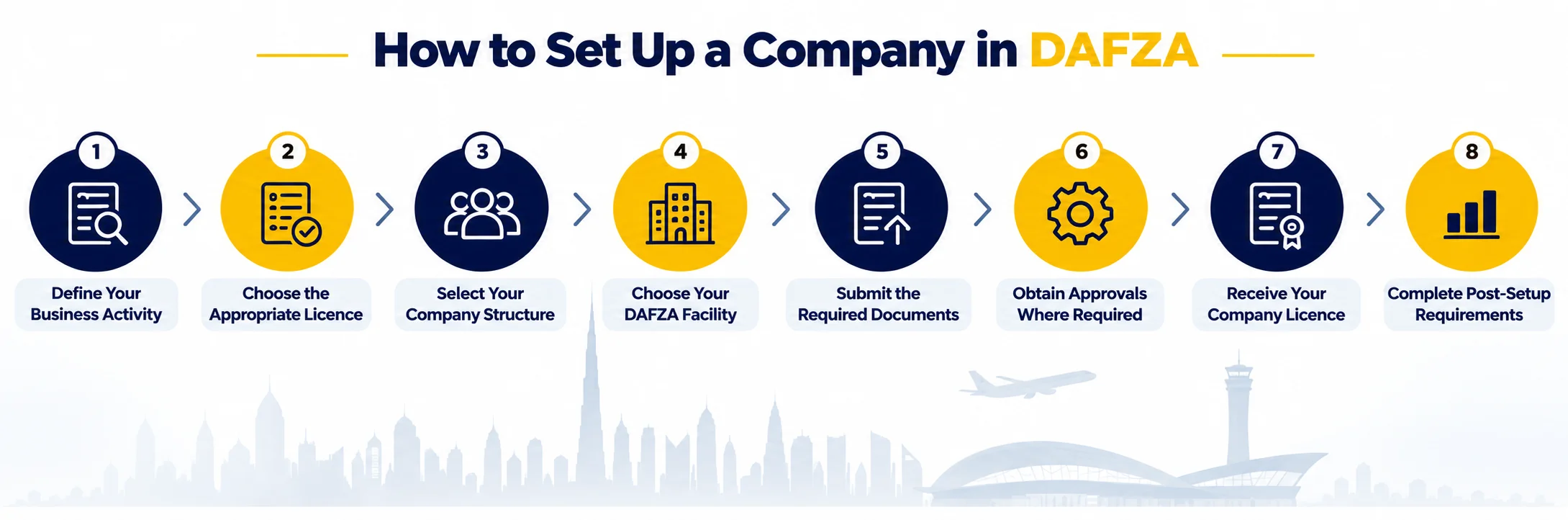
Step 1 – Define Your Business Activity
Start by identifying exactly what the company will do.
A business described simply as “trading” may actually require specific activities covering particular products. Similarly, logistics, aviation, pharmaceutical and industrial operations may require more specialised licensing or external approvals.
Your activity affects the licence, approvals, facility requirements and potentially your tax treatment, so it should be confirmed before proceeding.
Step 2 – Choose the Appropriate Licence
Match the proposed activities with the correct DAFZA licence.
A consultancy will generally have different licensing requirements from an importer, distributor or light manufacturing business. Companies conducting multiple activities should confirm whether they can be combined under the selected licence.
Step 3 – Select Your Company Structure
Determine whether the business should operate as a Freezone Company, branch or another available structure.
For many new investors, establishing a separate Freezone Company provides a straightforward structure. Existing overseas companies may consider establishing a branch where that structure better fits their objectives.
Step 4 – Choose Your DAFZA Facility
DAFZ currently offers office space, warehouse and industrial space, and cold-storage facilities.
The appropriate facility depends on factors including
- Business activity
- Number of employees
- Storage requirements
- Visa requirements
- Cargo volume
- Operational needs
- Future expansion
A professional services company may need an office, whereas a pharmaceutical distributor or logistics company could require specialised warehousing or cold storage.
Step 5 – Prepare and Submit the Required Documents
Documentation depends on whether shareholders are individuals or corporate entities and on the proposed business activity.
Applicants should generally be prepared to provide identification and corporate information relating to shareholders, directors or managers, together with application and supporting documents required for the particular structure.
Corporate shareholders may need additional corporate documentation, while certain regulated activities can require further approvals.
Requirements should always be confirmed for the individual application rather than relying on a generic document checklist.
Step 6 – Obtain Approvals Where Required
Not every business requires an external approval.
However, DAFZ specifically notes that depending on the company’s activity, an NOC from an external government entity may be required.
This is particularly important for regulated sectors. Identifying these requirements before incorporation can help prevent delays after the initial application has already been submitted.
Step 7 – Finalise the Lease and Make Payment
Once the appropriate facility has been confirmed, the lease agreement can be issued for signing by the authorised manager.
DAFZ states that after signing and confirmation of payment according to the agreed payment plan, the business can proceed with collection of the office keys and finalisation of the relevant legal documentation.
Step 8 – Obtain Your Company Licence
After the required documentation, approvals, lease arrangements and payments have been completed, the company can proceed towards final registration and licence issuance.
At this stage, carefully check that the licence accurately reflects the activities the business intends to conduct.
Step 9 – Complete Visas, Banking and Post-Setup Requirements
Receiving the company licence is an important milestone, but it does not complete every operational requirement.
Depending on the business, post-incorporation work may include
- Immigration and establishment procedures
- Investor or employee visa applications
- Emirates ID and medical procedures where applicable
- Corporate bank account application
- Corporate Tax registration
- VAT registration where applicable
- Customs-related registrations where required
- Accounting and record-keeping systems
- Industry-specific compliance
Bank account approval remains subject to the individual bank’s KYC, compliance and commercial assessment.
Documents Required for DAFZA Company Formation
There is no single document list that applies identically to every DAFZA application.
Requirements can change depending on whether the shareholder is an individual or company, whether a branch is being established and whether the activity requires regulatory approval.
Common categories of information can include
- Passport and identification details
- Shareholder information
- Manager or authorised signatory details
- Application documentation
- Proposed company and activity information
- Corporate documents for corporate shareholders
- Parent-company documents for branch applications
- Business information or supporting documents where requested
- Regulatory approvals where applicable
Documents issued outside the UAE may require additional authentication or legalisation depending on their type and the applicable requirements.
For professional support throughout the process, OADC’s DAFZA company formation service can help businesses assess their activities, structure and setup requirements.
How Much Does It Cost to Set Up in DAFZA?
There is no single DAFZA company formation price that applies to every investor.
The total first-year and recurring costs can depend on
- Licence type
- Number and type of activities
- Legal structure
- Office or warehouse selection
- Facility size
- Visa requirements
- External approvals
- Immigration requirements
- Additional operational registrations
This is why comparing only the headline licence fee can give an inaccurate picture of the actual cost of establishing the business.
A company requiring a warehouse and several employee visas will naturally have a different cost structure from a small service company requiring office space and limited immigration support.
For a more detailed cost breakdown,
Also read – DAFZA Company Setup Costs, Fees & Facility Options (2026).
DAFZA Office, Warehouse and Cold-Storage Options
Choosing suitable premises is especially important in DAFZA because many businesses select the free zone specifically for operational and logistics reasons.
DAFZ currently lists office space, warehouse or industrial space and cold storage among its available facility categories.
For example, an international consultancy may mainly need an office and meeting facilities. An importer could require warehouse capacity, while a pharmaceutical or temperature-sensitive goods business may need cold-storage infrastructure alongside applicable regulatory approvals.
Facility selection should therefore be incorporated into the initial business plan rather than considered only after the licence has been chosen.
DAFZA Corporate Tax Considerations
The UAE’s Free Zone Corporate Tax rules are frequently misunderstood.
Being incorporated in DAFZA does not mean that every company automatically pays 0% Corporate Tax on all profits.
A Qualifying Free Zone Person can benefit from a 0% Corporate Tax rate on Qualifying Income, while taxable income that does not meet the Qualifying Income definition is subject to 9%.
To qualify for the Free Zone regime, relevant conditions must be satisfied. The Federal Tax Authority identifies requirements including maintaining adequate substance in the UAE, deriving Qualifying Income, complying with transfer pricing requirements and not electing to be subject to Corporate Tax under the standard regime.
The FTA also identifies logistics services and distribution of goods or materials in or from a Designated Zone among the listed Qualifying Activities, subject to the detailed statutory conditions.
Businesses should therefore review their activities, customers, transactions and operating structure rather than treating “free zone” and “0% tax” as interchangeable concepts.
Corporate Tax Registration and Ongoing Compliance
Tax planning should form part of company setup rather than being addressed only after the business begins generating revenue.
The FTA states that taxable persons are required to register for Corporate Tax and obtain a Corporate Tax Registration Number in accordance with the applicable legislation.
Once operational, a DAFZA company may also need to manage
- Accounting records
- Corporate Tax returns
- Transfer pricing requirements where applicable
- VAT obligations where applicable
- Licence renewals
- Facility renewals
- Visa and immigration renewals
- Regulatory approvals
- Beneficial ownership and other applicable company compliance requirements
The exact obligations depend on the business and should be reviewed individually.
Is DAFZA the Right Free Zone for Your Company?
DAFZA is particularly compelling when proximity to Dubai International Airport provides a genuine operational advantage.
It can be a strong choice for aviation, logistics, trading, pharmaceuticals, technology and international businesses, but it is not automatically the best free zone for every company.
Before choosing DAFZA, consider
- Where your customers are located
- Whether you depend primarily on air or sea freight
- What products or services you will offer
- Whether external approvals are required
- How much physical space you need
- How many visas will be required
- Whether you need warehousing or cold storage
- How the UAE Corporate Tax rules affect your activities
- Your first-year and recurring operating costs
- Your expected growth over the next several years
A business primarily dependent on large-volume sea freight, for example, may also want to compare port-oriented jurisdictions. A purely digital startup may find that airport proximity provides less operational value than it does for an aviation or logistics company.
The right jurisdiction is the one that supports the actual business model.
Conclusion
Setting up a company in DAFZA gives investors access to one of Dubai’s established international business environments, with a strategic airport location and options covering offices, warehouses, industrial facilities and cold storage. The official process begins with three fundamental choices – licence, company type and space – but successful incorporation also requires careful attention to documentation, external approvals, visas, banking, tax and ongoing compliance.
The most important decision is not simply whether to establish in DAFZA, but whether DAFZA’s location, licensing framework and facilities match the company’s actual commercial requirements. If you are planning to establish or expand your business in Dubai Airport Freezone, contact us for guidance on the appropriate setup for your business.