Dubai is one of the world’s leading hubs for aviation, trade, and logistics, supported by major airports, Jebel Ali Port, modern transport infrastructure, and specialist free zones. For logistics and aviation companies, choosing the right free zone can directly affect cargo movement, warehousing, operational efficiency, and long-term expansion.
DAFZA, DMCC, and JAFZA are three of Dubai’s most prominent options. DAFZA is best known for airport connectivity and air-freight-focused businesses, JAFZA is closely linked to port-based logistics and large-scale warehousing, while DMCC offers a strong international trading and corporate ecosystem. The right choice depends on your transport model, space requirements, customers, and future growth plans.
DAFZA – Best Positioned for Aviation and Air Freight
Dubai Airport Freezone is strategically located next to Dubai International Airport. DAFZA says its business community includes more than 3,400 registered companies across over 20 sectors, supported by cargo-handling facilities and rapid access to the airport.
This positioning makes DAFZA particularly compelling for businesses where speed between aircraft, warehouse and customer is critical. Its Industrial Park is around 5 km from Dubai International Airport and includes bonded warehouses, cold-storage-enabled facilities and dedicated loading and unloading areas.
Businesses considering these opportunities can start by reviewing the different options for setting up a business in Dubai.
DAFZA Can Be Suitable For
- Air cargo businesses
- Aviation-related trading
- Time-sensitive distribution
- High-value goods
- Electronics and technology products
- Pharmaceutical and temperature-sensitive supply chains
- Import and re-export operations
- Freight and logistics support businesses
DAFZA also offers offices, warehouses, industrial space and cold storage. Its published setup process involves choosing the licence, company type and space, although external approvals may be required depending on the business activity.
For a closer look at the jurisdiction, businesses can – Dubai Airport Freezone company formation.
JAFZA – Built Around Large-Scale Logistics and Trade
JAFZA has a different advantage – integration with the Jebel Ali trade ecosystem. It is DP World’s flagship free zone and describes itself as the largest customs-bonded zone in the Middle East. Logistics is one of its established core industries.
Its location close to Jebel Ali Port and Al Maktoum International Airport gives businesses access to a multimodal environment combining sea, road and air connectivity. JAFZA specifically offers trading, service, industrial and logistics licences, making its logistics proposition especially direct.
JAFZA Can Be Suitable For
- Freight forwarding
- Third-party logistics – 3PL
- Sea freight
- Regional distribution centres
- Import and re-export
- Large warehouses
- E-commerce fulfilment
- Automotive logistics
- Industrial businesses
- FMCG distribution
- Healthcare distribution
- Machinery and equipment supply chains
The scale is a major differentiator. JAFZA says its property portfolio includes 4.2 million square metres of leasable logistics space, alongside offices, plots, warehouses, showrooms and customised developments.
Its logistics ecosystem also continues to attract new investment. In May 2026, Gallega Global Logistics opened a 215,000-square-foot multi-user 3PL hub in JAFZA designed to support fulfilment, storage and regional distribution.
DMCC – Strong for Trading, Headquarters and Flexible Logistics Models
DMCC is not positioned in the same way as an airport logistics zone or a port-integrated industrial free zone. Its strength lies in being a major international business and commodities-trading district in Jumeirah Lakes Towers and Uptown Dubai.
DMCC has built ecosystems spanning commodities, professional services, finance and technology. It had surpassed 24,000 member companies by the end of 2023, demonstrating the scale and diversity of its business community.
For logistics businesses, DMCC can work particularly well when the company needs
- A central Dubai corporate base
- Trading and distribution activities
- Client-facing offices
- Regional headquarters functions
- Shipping and logistics services
- Access to professional and financial services
- A combination of trading operations and outsourced warehousing
DMCC also launched its Maritime Centre in April 2026, building on a community of more than 150 maritime-related companies across shipping, logistics, marine services and trade support.
Businesses considering this option can review DMCC company formation before comparing its operational model with DAFZA and JAFZA.
DAFZA vs DMCC vs JAFZA – Quick Comparison
| Factor | DAFZA | DMCC | JAFZA |
|---|---|---|---|
| Best For | Aviation & air freight | Trading & headquarters | Logistics & distribution |
| Key Advantage | Airport connectivity | Central business ecosystem | Port connectivity |
| Warehousing | Strong | Limited / external options | Extensive |
| Transport Focus | Air | Mixed | Sea, road & multimodal |
| Ideal Business | Aviation & urgent cargo | Traders & service firms | 3PL, freight & large distribution |
This comparison should be treated as a strategic guide rather than a substitute for checking the exact permitted activity, facility and external approvals required for a particular company.
Also read – How to Choose the Right Free Zone in Dubai.
Which Free Zone Is Best for Aviation?
DAFZA is generally the most natural starting point among these three for aviation and air-cargo-focused businesses.
Its location beside Dubai International Airport is the key reason. Companies handling high-value, urgent or time-sensitive cargo can benefit from reducing the distance between their business facilities and one of Dubai’s principal aviation gateways. DAFZA also specifically highlights rapid cargo clearance and extensive cargo-handling facilities as competitive advantages.
Businesses that may favour DAFZA include
- Aircraft-related trading companies
- Aviation support businesses
- Air-freight operators
- Express distribution companies
- High-value cargo traders
- Time-sensitive spare-parts distributors
- Pharmaceutical logistics businesses
However, an important distinction is necessary – forming a free zone company does not automatically authorise every aviation activity. Activities involving aircraft operations, maintenance, regulated aviation services or other specialised functions may require additional approvals from the relevant aviation authorities.
Which Free Zone Is Best for Logistics?
For a business whose core requirement is large-scale physical logistics, JAFZA is generally the strongest choice among the three.
JAFZA combines warehousing, plots, logistics licences and close integration with Jebel Ali Port. Its logistics industry page describes millions of square metres of combined facilities and positions the zone as a hub serving global markets through the UAE’s multimodal infrastructure.
JAFZA is especially compelling when the business model involves
- Containers arriving through Jebel Ali Port
- Large inventory volumes
- Regional warehousing
- 3PL services
- Re-export operations
- Industrial supply chains
- Distribution across the GCC
- Sea-to-air or sea-to-road logistics
The ability to scale from office space into warehouses, plots and customised facilities can also matter for companies planning substantial long-term expansion.
When Does DMCC Make More Sense?
DMCC becomes particularly attractive when the company is fundamentally a trader, commercial headquarters or service provider rather than a warehouse-heavy logistics operator.
A shipping consultancy, commodity trader, supply-chain technology company or regional trading headquarters may value DMCC’s central business environment more than being physically located beside an airport or port.
There is also an important crossover with JAFZA. DMCC and DP World established an arrangement allowing eligible DMCC member companies with trade licences to access JAFZA warehousing. DMCC currently advertises warehouses of up to 700 square metres under the arrangement, together with freight forwarding, clearing, handling and customs-related services.
This can create a useful hybrid model – corporate and trading operations in DMCC with physical warehousing in JAFZA.
What About Corporate Tax?
Free zone should not automatically be interpreted as meaning every company pays zero corporate tax.
Under the UAE corporate tax framework, a Qualifying Free Zone Person can potentially benefit from a 0% rate on qualifying income when the applicable statutory requirements are satisfied. Other taxable income can be subject to the general corporate tax rules.
This is particularly relevant to this comparison because current rules identify activities including logistics services, distribution from a designated zone and financing and leasing of aircraft among qualifying activities, subject to the detailed conditions. DMCC itself highlights these categories in its corporate tax guidance.
Companies should therefore evaluate tax treatment based on their actual transactions and activities rather than choosing a free zone solely because of a “0% tax” marketing claim.
How to Choose Between DAFZA, DMCC and JAFZA
The best decision begins with the supply chain rather than the licence price.
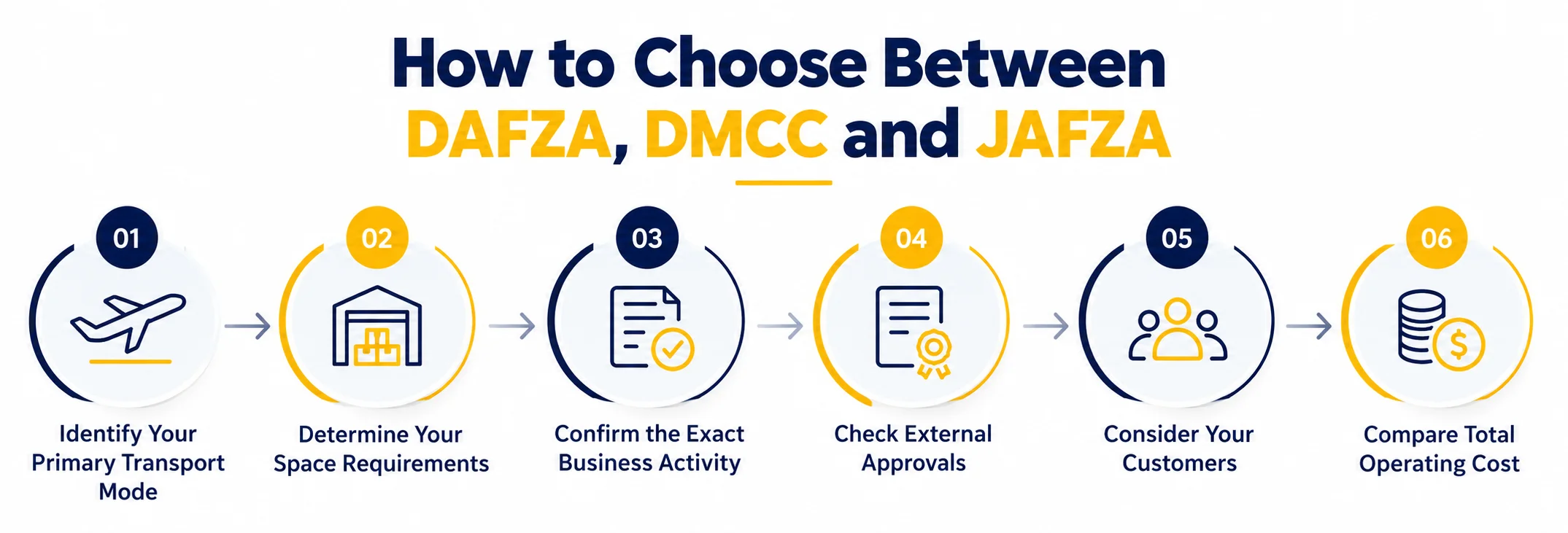
Step 1 – Identify Your Primary Transport Mode
Choose whether most cargo will move by
- Air
- Sea
- Road
- A combination of all three
Air-heavy businesses should examine DAFZA closely, while sea-heavy and large-scale multimodal logistics businesses should start with JAFZA.
Step 2 – Determine Your Space Requirements
Consider whether you require
- Office only
- Small warehouse
- Cold storage
- Large distribution centre
- Industrial unit
- Open land
- Custom-built facility
JAFZA has a particularly broad physical logistics offering, while DAFZA combines airport-oriented warehousing with office and industrial facilities.
Step 3 – Confirm the Exact Business Activity
A trading company and a freight-forwarding business do not necessarily require the same licence. Confirm permitted activities before incorporation.
Step 4 – Check External Approvals
Aviation, customs, transportation and other regulated activities may require approvals from authorities outside the free zone.
Step 5 – Consider Your Customers
A company serving airlines and air cargo may prioritise airport access. A distributor receiving containers may prioritise Jebel Ali. A trading headquarters meeting clients throughout Dubai may prefer DMCC.
Step 6 – Compare Total Operating Cost
Do not compare licence fees alone. Calculate
- Licence
- Registration
- Office
- Warehouse
- Visas
- Customs
- Logistics
- Staff
- External approvals
- Renewals
- Corporate tax and compliance costs
This produces a much more realistic comparison.
DAFZA vs DMCC vs JAFZA – Which One Should You Choose?
There is no universal winner because these free zones solve different business problems.
Choose DAFZA when your competitive advantage depends heavily on Dubai International Airport, rapid air cargo movements or airport-oriented distribution.
Choose JAFZA when your business requires substantial warehousing, port connectivity, 3PL operations, regional distribution or industrial-scale logistics.
Choose DMCC when you want a prestigious central business environment for trading, headquarters, shipping or logistics-related services and do not necessarily need your principal office inside a large industrial logistics zone.
For companies that remain uncertain about whether a specialist free zone or another Dubai jurisdiction is more appropriate,
Why Dubai Works for Aviation and Logistics Companies
The larger advantage shared by all three zones is Dubai itself. The emirate combines major aviation infrastructure, Jebel Ali Port, highways, customs systems, free zones and a strategic location between major global markets.
That ecosystem allows companies to design supply chains around different combinations of air, sea and road transport. DAFZA, DMCC and JAFZA should therefore not simply be viewed as competitors – in some business models they can form different parts of the same Dubai trade network. The DMCC-JAFZA warehousing partnership is a practical example of this integration.
Conclusion
DAFZA, DMCC and JAFZA are all established Dubai business jurisdictions, but each has a different strategic advantage. DAFZA stands out for airport-oriented aviation and air-freight businesses. JAFZA is generally the strongest option for port-based, warehouse-intensive and large-scale logistics operations. DMCC is particularly attractive for international trading, headquarters and service-led companies that value a central Dubai business ecosystem.
The right choice depends on much more than incorporation cost. Cargo flows, warehouse requirements, customs arrangements, licences, regulatory approvals, customers and long-term expansion should all influence the decision. If you are deciding between these jurisdictions, contact our Dubai company formation experts for guidance on selecting the free zone and company structure that best fits your operations.