Dubai Logistics City, now part of the wider Dubai South logistics ecosystem, is one of Dubai’s key locations for businesses involved in logistics, freight forwarding, warehousing, distribution, e-commerce and international trade. Its position close to Al Maktoum International Airport and Jebel Ali Port gives companies access to air, sea and road networks from a single strategic location. For entrepreneurs and established logistics operators looking to serve the UAE, GCC and international markets, setting up in Dubai Logistics City can provide the infrastructure, facilities and connectivity needed to build scalable supply-chain operations.
What Is Dubai Logistics City?
Dubai Logistics City was developed as a specialised business destination for logistics and supply-chain activities and today sits within Dubai South’s broader Logistics District ecosystem.
The district is designed to connect businesses with major air, sea and land transportation infrastructure. Dubai South describes its Logistics District as supporting warehousing, distribution and logistics operations, with direct access to cargo terminals at Al Maktoum International Airport and connectivity to Jebel Ali Port through a bonded logistics corridor.
Businesses considering the location can work with Open a Dubai Company to assess the appropriate company structure, licence and operational requirements before starting the incorporation process.
Why Set Up a Business in Dubai Logistics City?
Strategic Position for International Trade
Location is one of the biggest advantages for logistics companies. Dubai South places businesses close to Al Maktoum International Airport while providing convenient access to Jebel Ali Port and Dubai’s major road network.
This multimodal connectivity can be particularly valuable for businesses whose supply chains depend on combining air freight, sea freight and road transportation.
Access to Al Maktoum International Airport
Companies handling time-sensitive, high-value or internationally transported cargo can benefit from proximity to Al Maktoum International Airport.
Dubai South’s Logistics District includes zones with direct access to the airport’s cargo terminals, strengthening its suitability for freight and supply-chain companies.
Connection to Jebel Ali Port
Dubai South also provides access to Jebel Ali Port, giving logistics businesses the ability to integrate sea freight into their operations.
The combination of airport and seaport connectivity is particularly relevant to freight forwarders, distributors, import-export companies and third-party logistics providers managing regional and international cargo.
Who Should Consider Dubai Logistics City?
Dubai Logistics City can suit businesses whose operations depend heavily on the movement, storage or distribution of goods.
Examples include
- Freight forwarding companies
- Third-party logistics providers
- Warehousing businesses
- Distribution companies
- Import and export businesses
- E-commerce fulfilment operators
- Supply-chain management companies
- Transportation-related businesses
- International trading companies
- Cargo handling businesses
The exact activities permitted under a licence should always be confirmed before incorporation. Some specialised activities or regulated goods can require additional approvals.
Business Structures Available in Dubai Logistics City
Investors have several possible structures when establishing a business.
| Business Structure | Generally Suitable For |
|---|---|
| Free Zone Establishment – FZE | Businesses with a single shareholder |
| Free Zone Company – FZC | Businesses with multiple shareholders |
| Branch of a Foreign Company | Overseas companies expanding operations into Dubai |
| Branch of a Local Company | UAE businesses establishing operations within the zone |
The right structure depends on ownership, existing corporate arrangements, planned activities and long-term expansion requirements.
Our dedicated Dubai Logistics City company formation service can help investors assess the structure and setup requirements relevant to their intended operation.
Facilities Available for Logistics Businesses
One important distinction between a logistics business and many service companies is the need for appropriate physical infrastructure.
Dubai South’s Logistics District provides different facility options designed for logistics, warehousing and trade.
Warehouses
Warehouse requirements can vary substantially according to inventory volume, cargo type and operational model.
Dubai South has introduced flexible multiuser logistics facilities with combinable units. Its published specifications include warehouse areas starting from approximately 190 square metres, with options for combining units as requirements expand.
Office Space
Companies may also require administrative offices for management, documentation, customer service, finance and operational teams.
The appropriate combination of office and warehouse space should be determined according to the licence, visa requirements and operational model.
Specialised Logistics Facilities
Larger operators may require purpose-built facilities for activities such as 3PL, fulfilment, cargo consolidation, temperature-controlled storage or specialist goods handling.
Dubai South continues to expand this part of its ecosystem. Recent facilities in the district have been developed for major logistics operators and include warehousing, fulfilment, inventory management, transportation management and other value-added logistics services.
Step-by-Step Process to Set Up in Dubai Logistics City
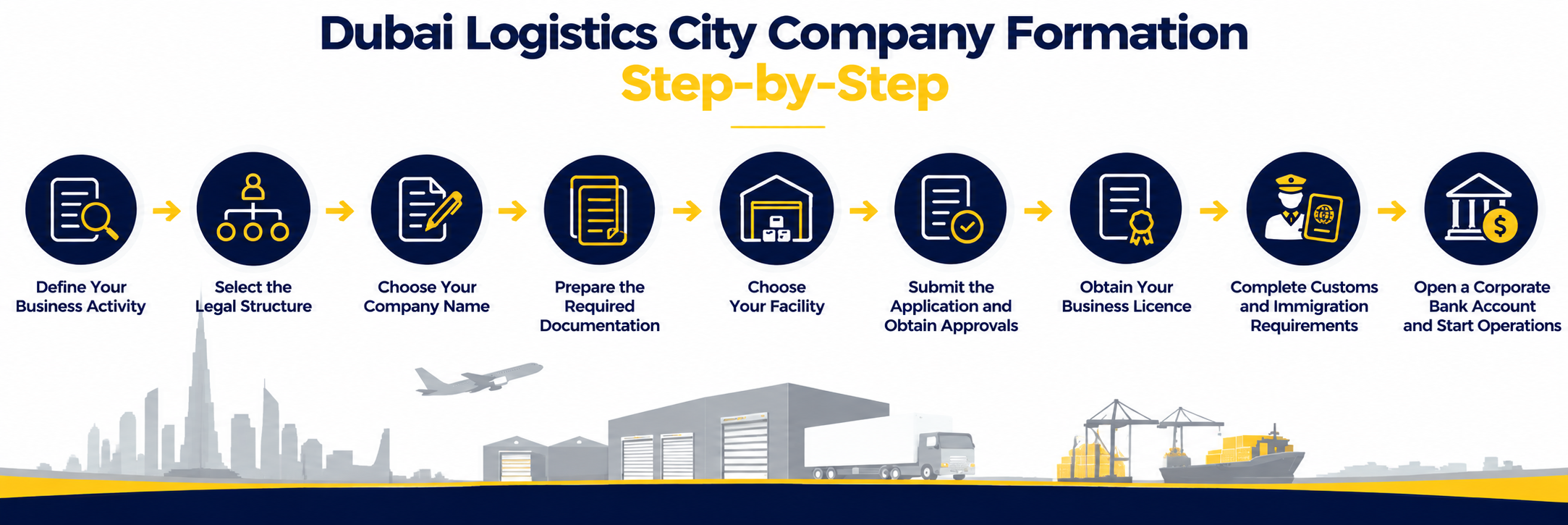
Step 1 – Define Your Business Activity
Start by determining exactly what the company will do.
For example, a freight forwarding operation has different requirements from an e-commerce fulfilment centre or a company primarily involved in trading.
Clearly defining the activity helps determine the appropriate licence and whether external approvals will be necessary.
Step 2 – Select the Appropriate Legal Structure
Choose whether the company will operate as an FZE, FZC or branch, depending on the number of shareholders and whether an existing business is expanding into Dubai.
Step 3 – Choose and Reserve Your Company Name
Select a proposed company name that complies with the applicable UAE and free-zone naming requirements.
It is sensible to prepare alternative names in case the preferred option is unavailable.
Step 4 – Prepare the Required Documentation
Documentation depends on the shareholder structure and proposed activity, but investors may need documents such as
- Passport copies
- Shareholder information
- Application forms
- Proposed business activities
- Corporate documents for company shareholders
- Branch documentation where applicable
- Business plan where requested
- Additional approvals for regulated activities
Foreign corporate documents may also need appropriate legalisation or attestation.
Step 5 – Choose Your Facility
Select an office, warehouse or specialised logistics facility appropriate to your operation.
Do not base this decision purely on the lowest rental cost. Consider cargo volume, storage conditions, loading requirements, staffing, future expansion and proximity to the transport infrastructure your company will use most frequently.
Step 6 – Submit the Application and Obtain Approvals
Once the structure, activity and premises requirements have been established, the company formation application and supporting documentation can be submitted.
Additional regulatory approvals should also be obtained where required for the selected activities.
Step 7 – Obtain Your Business Licence
Following approval and completion of the applicable registration and facility requirements, the relevant licence can be issued.
The licence must accurately reflect the activities the company intends to undertake.
Step 8 – Complete Customs and Immigration Requirements
Companies involved in import, export and cargo operations may need to complete relevant customs registrations.
After incorporation, eligible businesses can also proceed with establishment and immigration requirements and apply for investor, partner or employee visas according to their allocation and circumstances.
Step 9 – Open a Corporate Bank Account and Start Operations
Once the company has been incorporated and its documents issued, the business can proceed with its corporate bank account application.
Banks conduct their own compliance and due-diligence assessments, so account approval should never be treated as automatic.
After the required operational, banking, customs and immigration arrangements are completed, the company can begin trading in accordance with its approved licence.
Documents Required for Dubai Logistics City Company Formation
Requirements vary between companies, but individual shareholders will generally need identification and application documentation.
Corporate shareholders or branches can face additional requirements, including corporate registration documents, board resolutions and supporting ownership information.
Preparing these documents correctly before submitting the application can help prevent avoidable delays.
Customs and Import-Export Considerations
Customs planning is especially important for logistics companies.
Businesses should determine
- Where goods will enter the UAE
- Whether goods will remain within the free zone
- Whether products will enter the UAE mainland
- Whether cargo will be re-exported
- Whether bonded storage is needed
- Which customs registrations are required
- Whether products require additional regulatory approvals
The appropriate customs arrangement depends on the actual movement of goods rather than simply the location of the company.
Dubai Logistics City for E-Commerce Businesses
Dubai South is also increasingly relevant to the e-commerce sector. The Logistics District includes EZDubai, a dedicated e-commerce zone designed to support businesses involved in fulfilment and digital commerce.
An e-commerce company may need facilities for inventory storage, order processing, pick-and-pack operations, returns and regional distribution. Locating these activities within an integrated logistics ecosystem can simplify the physical side of online retail operations.
Also read – Starting a Logistics or E-Commerce Business in Dubai South
Important Factors to Consider Before Setting Up
A Dubai Logistics City company should be structured around its real operational requirements rather than simply obtaining a licence as quickly as possible.
Consider the following before applying
- Exact business activities
- Cargo type
- Expected shipment volumes
- Air versus sea freight requirements
- Warehouse size
- Temperature-control requirements
- Customs arrangements
- Number of employees
- Visa requirements
- Office requirements
- Future expansion
- External regulatory approvals
Businesses dealing with food, pharmaceuticals, chemicals, dangerous goods or other controlled products may face additional requirements depending on the exact activity and products involved.
Benefits of Dubai Logistics City
Dubai Logistics City combines several advantages within one specialised business environment.
Multimodal Connectivity
Access to airport, seaport and road infrastructure can help companies develop more flexible supply chains.
Scalable Infrastructure
Businesses can choose facilities according to their operational requirements and potentially expand as volumes increase.
Specialist Logistics Ecosystem
Operating alongside freight companies, distributors, fulfilment providers and other logistics businesses can support supply-chain efficiency and commercial partnerships.
International Business Environment
Dubai South’s Free Zone supports foreign ownership and provides a dedicated environment for international and UAE-based businesses.
Long-Term Logistics Development
Dubai South continues to attract investment into its Logistics District. Major international operators have established or expanded logistics facilities there, demonstrating the continued development of the area as a specialised logistics destination.
Conclusion
Setting up in Dubai Logistics City gives logistics and trading companies access to one of Dubai’s most strategically positioned supply-chain ecosystems. Proximity to Al Maktoum International Airport, connectivity with Jebel Ali Port, specialised warehousing infrastructure and access to the wider Dubai South development make the location particularly relevant to businesses that depend on efficient international cargo movement.
Successful setup, however, requires more than choosing a location. Investors need to select the correct activity, legal structure, licence, facility and customs arrangements while identifying any additional approvals their operations require. If you are considering establishing a logistics, freight, distribution or e-commerce company in Dubai Logistics City, Contact Us for guidance through the company formation process.