Dubai has developed into a major international centre for logistics, trade and digital commerce, supported by advanced transport infrastructure and its strategic position between Asia, Europe and Africa. For businesses that depend on efficient movement, storage and distribution of goods, location can have a significant effect on operating efficiency and future scalability.
Dubai South has become particularly important for logistics and e-commerce businesses because it combines access to aviation, warehousing, fulfilment and international trade infrastructure within one large business ecosystem. Whether you are planning a freight operation, e-commerce fulfilment centre, distribution business or regional logistics hub, understanding the licensing, facilities and regulatory requirements is essential before setting up.
Why Choose Dubai South for Logistics and E-Commerce?
Dubai South’s Logistics District is designed to support businesses involved in logistics, distribution, freight, e-commerce and international trade. The district provides access to the cargo terminals at Al Maktoum International Airport and connectivity with Jebel Ali Port through a bonded logistics corridor.
This combination is particularly useful for companies that need to coordinate air, sea and road freight. Instead of treating warehousing, customs, transport and distribution as completely separate parts of the supply chain, businesses can establish operations within an ecosystem developed specifically around these requirements.
Businesses considering establishing operations in the area can review the Dubai Logistics City company formation options available through Open a Dubai Company.
Dubai South for E-Commerce Businesses
Dubai South is not limited to traditional freight and logistics companies. Its Logistics District also incorporates EZDubai, a dedicated e-commerce zone developed to support the rapidly expanding digital commerce and fulfilment sector.
This is becoming increasingly significant as online retail expands across the UAE. According to an EZDubai and Euromonitor International report, the UAE e-commerce market reached approximately AED 42.2 billion in 2025, compared with AED 17.6 billion in 2020.
For an e-commerce company, the physical side of online selling can be just as important as the website itself. Businesses may need facilities for
- Inventory storage
- Pick-and-pack operations
- Order processing
- Product handling
- Returns management
- Last-mile distribution
- Cross-border fulfilment
- Regional inventory management
Establishing these functions within a dedicated logistics environment can make Dubai South particularly attractive to e-commerce businesses that expect to scale beyond a small online operation.
Types of Businesses Suitable for Dubai South
Dubai South can accommodate different business models depending on the licence, facility and approvals obtained.
Logistics and Freight Businesses
Freight forwarding, cargo management, distribution and other supply-chain businesses can benefit from the area’s transport connections and logistics infrastructure.
E-Commerce Companies
Online retailers can use Dubai South as a base for managing inventory, order fulfilment and regional distribution while operating their digital sales channels.
Warehousing and Distribution
Companies importing or distributing physical goods may require dedicated storage, handling or distribution facilities rather than a standard office.
Third-Party Logistics Providers
3PL companies can provide storage, inventory management, fulfilment and other logistics services to multiple clients.
Trading Businesses
Companies involved in importing, exporting and distributing goods may combine trading activities with warehousing and logistics operations, subject to the activities permitted under their licence.
Dubai South continues to expand infrastructure serving these sectors, including flexible multiuser facilities specifically designed for SMEs, logistics operators, traders and e-commerce businesses.
For a broader look at online selling requirements
Also read – E-Commerce Business Setup in Dubai
Logistics Business vs E-Commerce Business in Dubai South
Although the two sectors frequently overlap, their operational requirements can be different.
| Factor | Logistics Business | E-Commerce Business |
|---|---|---|
| Main activity | Freight, storage and distribution | Online sale of products |
| Space | Often warehouse-focused | Office, fulfilment or warehouse |
| Key requirement | Transport and cargo connectivity | Inventory and fulfilment efficiency |
| Customers | Businesses and traders | Consumers or businesses |
| Scaling focus | Freight and storage capacity | Orders, inventory and delivery |
A company combining online retail with its own fulfilment operation may require elements from both models.
Business Structures Available in Dubai South
The appropriate legal structure depends on the ownership arrangement and whether the applicant is creating a new business or expanding an existing company.
Depending on the applicable Dubai South framework, structures can include a free zone establishment or company and branches of existing UAE or foreign companies.
For example, an entrepreneur establishing a standalone logistics operation may require a different structure from an international logistics company opening a UAE branch.
Before incorporation, investors should determine
- Number of shareholders
- Proposed business activities
- Ownership structure
- Required visas
- Facility requirements
- Expected UAE and international transactions
- Future expansion plans
Making these decisions early can help prevent restructuring costs later.
Step-by-Step Process to Start a Logistics or E-Commerce Business in Dubai South
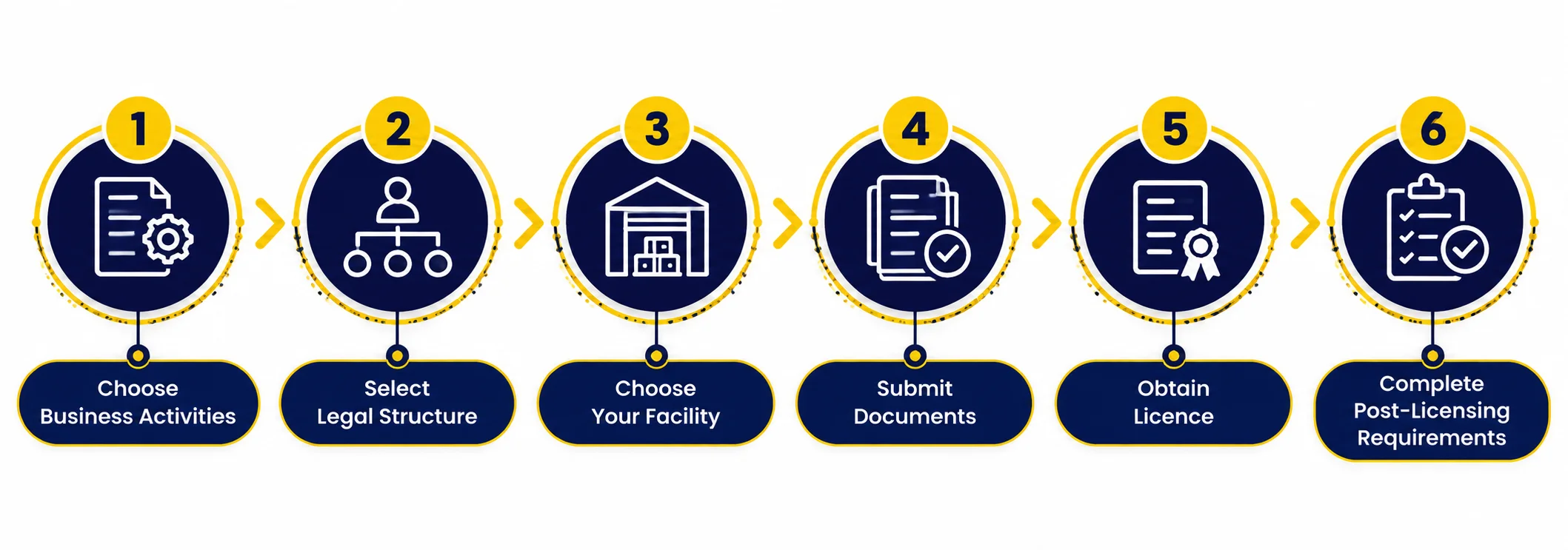
1. Define Your Business Activities
Begin by identifying exactly what the company will do. Logistics, freight forwarding, e-commerce, trading, fulfilment and warehousing are related activities, but they are not necessarily covered by the same licence.
2. Select the Legal Structure
Choose the company structure that reflects the number and type of shareholders and whether you are forming a new entity or registering a branch.
3. Choose Your Facility
Select an office, warehouse or other operational facility according to the company’s actual requirements. Businesses handling physical inventory should consider storage capacity, loading access and future expansion.
4. Submit the Company Formation Documents
Prepare the required shareholder, corporate and application documentation. Requirements can differ for individuals, corporate shareholders and branches.
5. Obtain Approvals and Licence
Once the relevant applications, documentation and facility requirements are satisfied, the licensing process can be completed. Certain regulated activities may require additional approvals.
6. Complete Post-Licensing Requirements
After licensing, the company may need to arrange immigration establishment requirements, visas, banking, customs registration and applicable tax registrations before becoming fully operational.
Choosing the Right Warehouse or Facility
Warehouse selection deserves particular attention because choosing too much or too little space can significantly affect operating costs.
Dubai South’s Logistics District includes a range of logistics infrastructure. Its newer multiuser facilities, for example, include temperature-controlled units with flexible configurations intended for SMEs, traders, logistics providers and e-commerce companies.
When assessing space, consider
- Expected inventory volume
- Product dimensions
- Temperature requirements
- Loading and unloading needs
- Number of employees
- Office requirements
- Order volumes
- Customs arrangements
- Future expansion
An early-stage e-commerce company may not require the same warehouse configuration as a large freight or regional distribution operation.
Customs and International Trade Considerations
Dubai South’s proximity to major transport infrastructure is one of its main advantages for businesses involved in international trade.
The Logistics District has direct access to cargo facilities at Al Maktoum International Airport and connectivity to Jebel Ali Port through its bonded logistics corridor. Dubai South also incorporates dedicated e-commerce and contract logistics areas.
However, companies should not assume that establishing a free zone company automatically resolves every customs issue. Import, export, customs clearance and movement of goods into other parts of the UAE can involve separate procedures depending on the goods, transaction and destination.
Businesses should therefore establish their customs model at the same time as their licensing and warehouse strategy.
Corporate Tax for Dubai South Free Zone Companies
Tax treatment should be assessed carefully when establishing a free zone business.
Under the UAE Corporate Tax framework, a Qualifying Free Zone Person can benefit from a 0% Corporate Tax rate on Qualifying Income, while taxable income that does not qualify is generally subject to the 9% rate. The 0% treatment is therefore not an automatic exemption simply because a company holds a free zone licence.
Conditions for Qualifying Free Zone Person status include requirements relating to Qualifying Income, adequate substance, transfer pricing and other compliance obligations. The Federal Tax Authority also requires taxable persons to comply with applicable Corporate Tax registration requirements.
Logistics and e-commerce companies should obtain professional tax advice based on their actual transactions rather than selecting their company structure solely on an assumed tax benefit.
Important Factors Before Setting Up
Before submitting an application, investors should map their business model against their operational requirements.
Licence Scope
Ensure that every significant activity the company intends to perform is properly covered. E-commerce, trading, freight forwarding and logistics services should not automatically be treated as interchangeable activities.
Warehouse Requirements
Estimate storage needs realistically and account for future growth rather than focusing only on the company’s first few months.
Customs Structure
Determine whether goods will be imported, exported, re-exported or supplied into the UAE market.
Technology
E-commerce and logistics businesses increasingly depend on warehouse management systems, inventory platforms, shipment tracking and integrations between sales and fulfilment channels.
Banking and Compliance
Prepare ownership information, business plans, expected transaction details and supporting documentation early. These can be important during corporate bank account onboarding and ongoing compliance.
Dubai South vs Other Dubai Free Zones
Dubai has several free zones suitable for trading and logistics companies, but their strengths differ.
A business focused heavily on air freight may also consider Dubai Airport Freezone, while companies dependent on maritime cargo and large-scale port logistics may assess JAFZA. Dubai South is particularly relevant when a company wants access to the developing Al Maktoum International Airport ecosystem alongside logistics, warehousing and e-commerce infrastructure.
The best location should therefore be selected according to the company’s cargo routes, customers, facility requirements and long-term operational strategy rather than the licence price alone.
You can review the wider range of Dubai free zone company formation options before deciding which jurisdiction best matches your operation.
Is Dubai South Suitable for Startups?
Dubai South can work for both established operators and growing businesses, but startups should avoid taking unnecessary operational space too early.
A new e-commerce business, for example, may initially need relatively modest inventory and fulfilment capacity. As order volumes increase, it can move towards a larger warehouse or more sophisticated logistics model.
Dubai South’s development of flexible multiuser facilities reflects this need for scalable space, with facilities intended for SMEs as well as logistics and e-commerce operators.
The objective should be to create a structure capable of expanding without burdening the company with unnecessary fixed costs from the beginning.
Conclusion
Starting a logistics or e-commerce company requires more than obtaining a trade licence. Investors should consider how the licence, legal structure, warehouse, customs arrangements, visas, banking and tax position work together.
For businesses dependent on international distribution, Dubai South provides an ecosystem built around logistics infrastructure, Al Maktoum International Airport, e-commerce operations and connectivity with Jebel Ali Port. Its combination of specialised facilities and transport links makes it a significant location for companies building UAE and regional supply chains.
Open a Dubai Company can help investors assess their proposed activities, company structure, facility requirements and incorporation process through our business setup services.