The UAE e-commerce market is worth USD 12.30 billion in 2026 and is on track to reach USD 21 billion by 2031, growing at a CAGR of 11.29% (Mordor Intelligence). With smartphone penetration above 95%, digital wallets mainstream, and government backing through the D33 Agenda, there has never been a better time to start an e-commerce business in Dubai.
But many entrepreneurs hit the same wall early on: Which license do I need? Can I sell on Noon with a free zone license? What’s the difference between dropshipping and FBA? When does VAT kick in?
This guide answers all of it in plain language, with real costs and timelines for 2026.
Why Start an E-Commerce Business in Dubai in 2026?
The numbers tell a clear story. The UAE e-commerce market is worth USD 12.30 billion in 2026, growing at a CAGR of 11.29%, and is expected to reach USD 21.01 billion by 2031. Smartphones processed nearly 79% of all orders and are projected to expand at over 16% CAGR, the fastest growth rate among all devices.
What makes 2026 particularly compelling for new entrants:
- Domestic consumption is strong. According to the Dubai Department of Economic Development, e-commerce transactions in Dubai alone increased by 23% compared to pre-pandemic levels, reaching AED 29 billion (approximately $7.9 billion). That behavioral shift has become permanent (Dubai DED).
- Digital payments are mainstream. Digital wallets achieved 53% usage in 2024, while 67% of consumers prefer using credit or debit cards for online payments. The Central Bank’s 2026 biometric authentication upgrade has made mobile checkout 30–40% faster.
- Mobile-first shopping is the norm. More than one-third of consumers in the UAE make weekly purchases online using their smartphones higher than the global average. UAE carriers Etisalat and du count 22 million combined subscribers, and both offer zero-rate data for partner shopping apps.
- Government support is real and funded. The Dubai Chamber of Commerce reports the digital economy accounts for around 4.3% of the UAE’s GDP, with forecasts of this increasing to 20% by 2031 under the D33 Agenda.
- Cross-border opportunity is built in. Cross-border e-commerce has grown sharply, with 58% of online purchases in the UAE coming from overseas vendors, meaning local sellers compete with international brands, but also have export opportunities.
- Infrastructure is mature. 5G coverage touches 95% of UAE residents, lowering latency and enabling high-definition product video and AR try-ons. Same-day and next-day delivery is now standard in Dubai and Abu Dhabi.
Lower startup costs than physical retail, scalable logistics infrastructure, and zero corporate tax below AED 375,000 profit round out the case. The question is not whether Dubai e-commerce is a good opportunity. The question is which model and structure fits your budget and goals.
E-Commerce Business Models Compared
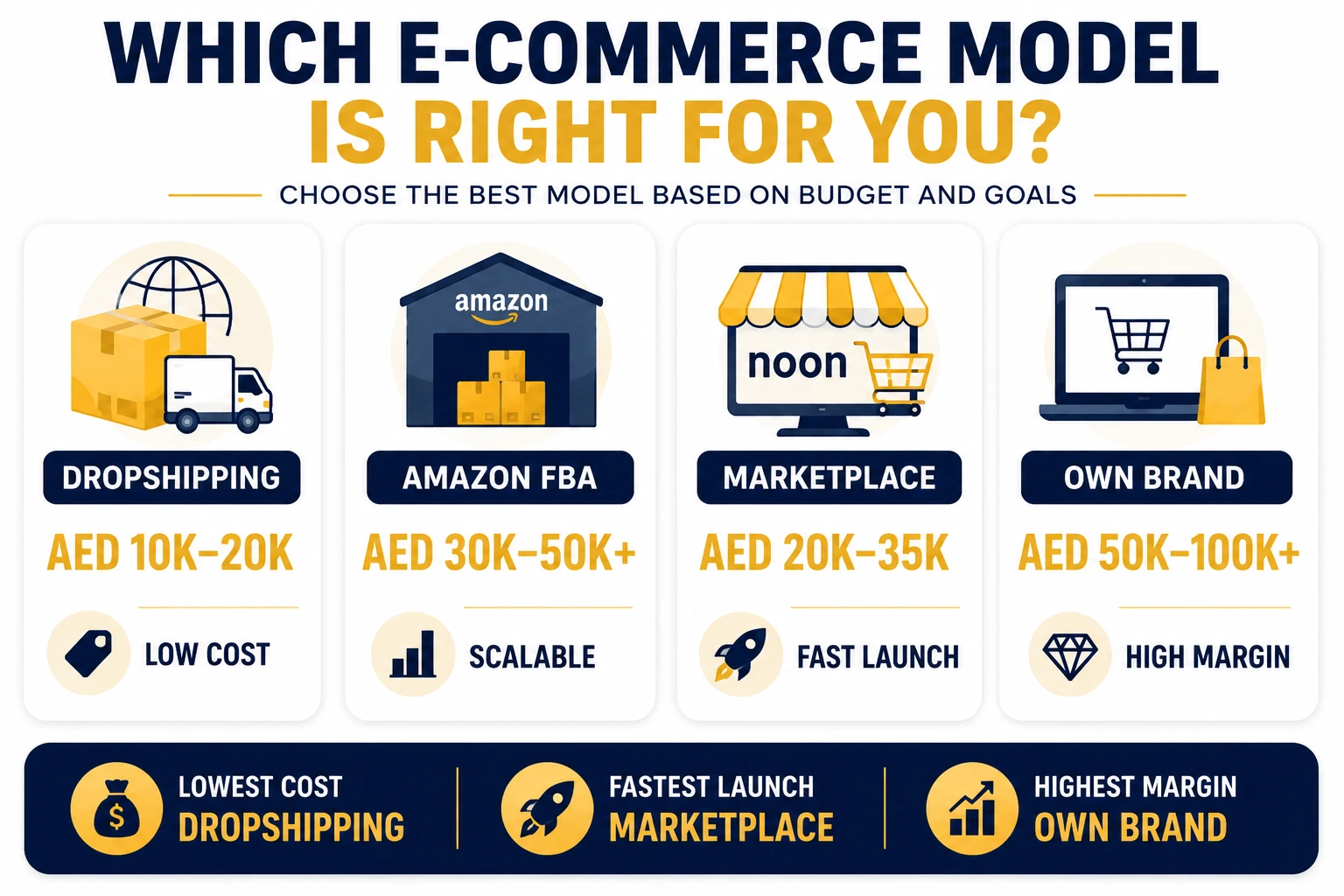
Before you pick a license, you need to decide on your model. Each has a different capital requirement, margin profile, and timeline. Choosing the wrong model early, especially one that requires a license structure you haven’t set up, wastes months and money.
Model 1: Dropshipping
You partner with a supplier, market their products, and when an order comes in, the supplier ships directly to your customer. You profit on the margin between the price you charge and what the supplier charges you. You never touch the product.
Best for
Solo entrepreneurs, budget-limited founders, market testing, and non-residents who want to start lean.
How to source suppliers
Alibaba and AliExpress are common starting points, but UAE-based suppliers through platforms like Tradeling or Dubai-based wholesale directories give faster delivery times and lower shipping costs a significant competitive advantage when competing against Noon and Amazon sellers offering 1–2 day delivery.
Pros
- Lowest capital investment (AED 10,000–20,000 to start)
- No inventory risk, you only buy when a customer pays
- Can test multiple niches before committing capital
- Run entirely remotely
Cons
- Profit margins are thin (15–30% gross; 5–15% net after marketing and fees)
- You depend entirely on supplier quality and shipping reliability
- Customer service challenges when the supplier makes mistakes
- Difficult to differentiate when competing on the same products
Timeline to first revenue: 2–4 months
License needed: Freelance permit or FZ-LLC
Realistic monthly revenue ceiling: AED 50,000–150,000 (solo operation)
Model 2: Fulfillment by Amazon (FBA)
You source or manufacture products, send inventory to Amazon’s UAE warehouses, and Amazon handles storage, packing, shipping, and customer service. You manage pricing, listings, and marketing.
Best for
Private label brands, entrepreneurs targeting volume growth, sellers who want to build a scalable asset.
How it works in practice
You identify a product with strong demand and manageable competition using tools like Jungle Scout or Helium 10. You source it from a manufacturer (often in China, India, or increasingly UAE and Turkey for faster restocking). You ship inventory to Amazon’s fulfillment center. Amazon lists it as Prime-eligible. You run sponsored ads to generate initial velocity. Reviews and ranking build over time.
Pros
- Prime badge materially increases conversion rates
- Amazon handles all logistics, returns, and customer service
- Easier to scale to AED 100,000+/month than most other models
- Business is more sellable as an asset
Cons
- FBA fees eat 20–40% of your sale price depending on category and size
- Inventory risk if products don’t move or get stuck in the warehouse
- Heavy Amazon algorithm dependency ranking changes can crater revenue overnight
- Amazon can suspend accounts with limited recourse
Timeline to profitability: 3–6 months
License needed: Commercial LLC (mainland strongly preferred for UAE marketplace)
Realistic monthly revenue potential: AED 100,000–1,000,000+ at scale
Model 3: Marketplace Seller (Noon / Amazon.ae)
You list existing products on Noon or Amazon.ae. The platform handles payments and offers logistics support. You manage inventory and optimise your listings. Unlike FBA, you handle your own storage and fulfillment (or use a 3PL partner).
Best for:
Businesses with existing product inventory, wholesalers moving online, importers seeking a direct-to-consumer channel.
Pros
- Access to millions of active UAE shoppers immediately
- Fastest route to first sale (4–8 weeks from license to first order)
- The platform handles payment processing and fraud protection
- Lower barrier to entry than building your own store
Cons
- The platform takes 5–15% commission on every sale
- Account suspension risk platforms have strict policies
- Limited branding control, you are one of many sellers
- You are building on rented land; the platform can change terms
Timeline to first sale: 4–8 weeks
License needed: Commercial LLC
Realistic monthly revenue: AED 50,000–500,000+, depending on category and marketing
Model 4: Own E-Commerce Brand (Shopify / Own Website)
You build your own website, own the customer relationship, and control every element of the experience from product discovery to post-purchase emails. No platform taking commissions. No algorithm you don’t control.
Best for
Premium products, long-term brand builders, and founders with sufficient capital and patience.
What the build looks like
Shopify handles the store infrastructure. You need a UAE payment gateway (Telr, PayTabs, Stripe, or 2Checkout), a logistics partner for fulfillment, and a marketing strategy that does not rely on organic marketplace traffic because you have none at launch.
Pros
- Highest margins (60–80%) no platform fees
- Full customer data ownership: email lists, purchase history, behavioural data
- Brand asset that compounds in value over time
- Not subject to marketplace policy changes or account suspensions
Cons
- Highest initial investment (AED 40,000–100,000+)
- Marketing costs are entirely your responsibility
- Takes 6–12 months to reach meaningful revenue
- Requires more operational complexity, payments, logistics, and customer service, all managed by you
Timeline to meaningful revenue: 6–12 months
License needed: Commercial LLC or Free Zone
Realistic monthly revenue ceiling: Unlimited but requires proportional marketing investment
Model Comparison Table
| Factor | Dropshipping | FBA | Marketplace | Own Brand |
|---|---|---|---|---|
| Initial Capital | AED 10k–20k | AED 30k–50k+ | AED 20k–35k | AED 50k–100k+ |
| Gross Margin | 15–30% | 20–40% | 30–50% | 60–80% |
| Time to First Sale | 2–4 months | 3–6 months | 4–8 weeks | 6–12 months |
| Inventory Risk | None | High | Medium | High |
| Customer Control | Limited | Limited | Limited | Full |
| Marketing Dependency | High (paid ads) | Medium (Amazon ads) | Medium | High (own channels) |
| Best Platform | Shopify | Amazon FBA | Noon / Amazon.ae | Shopify / own site |
License Types: Free Zone, Mainland, or Freelance?
This is where many founders make costly mistakes. The license you choose determines where you can sell, how many visas you can sponsor, and what your tax position looks like. Getting this wrong means either overpaying or discovering months later that your license doesn’t allow what you thought it did.
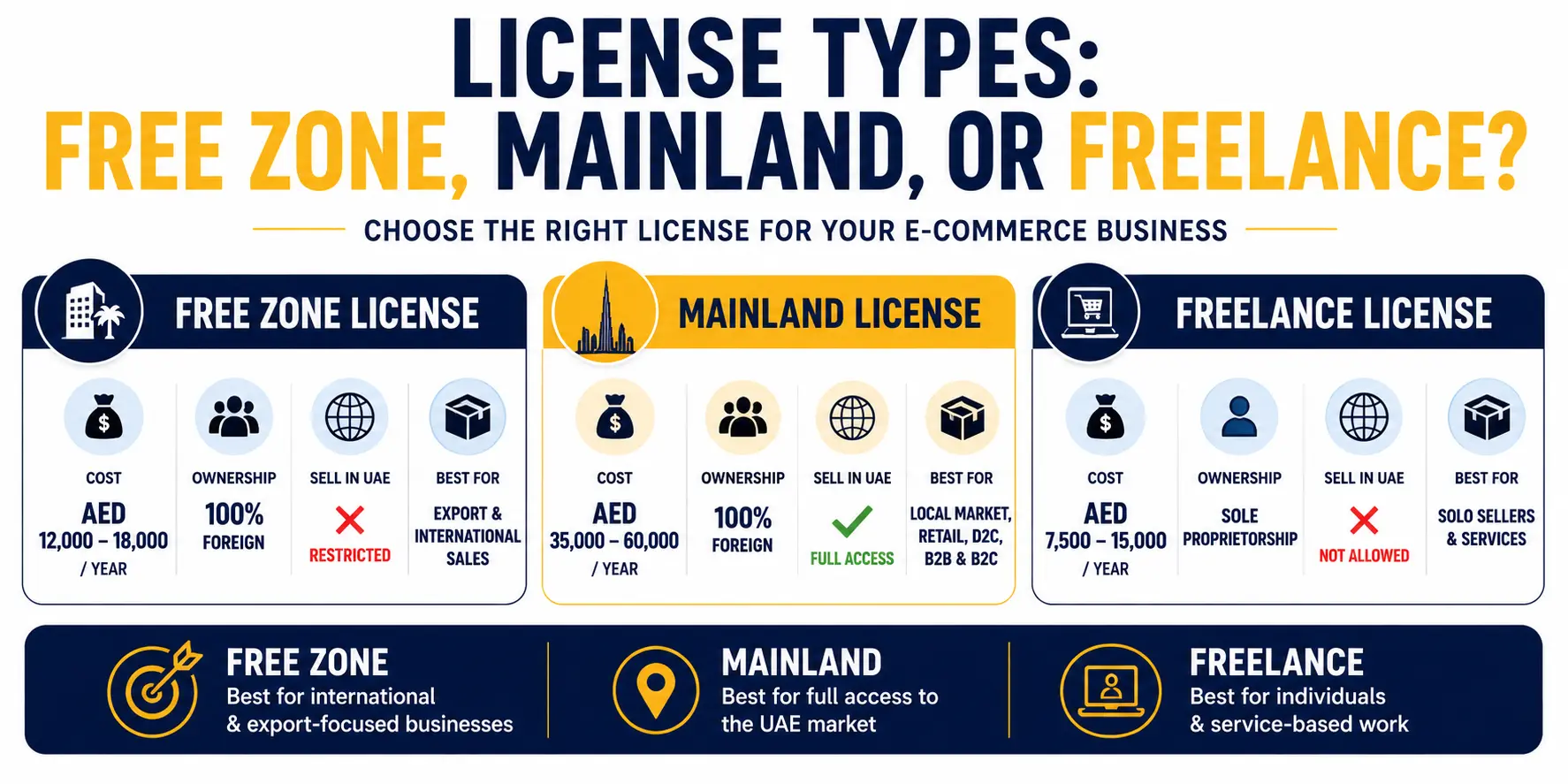
Option A: Free Zone E-Commerce License
Where
Dubai South, DMCC, Meydan Free Zone, IFZA, Dubai Internet City, Shams, RAKEZ
You set up a Free Zone Limited Liability Company (FZ-LLC). The free zone authority issues your license and acts as your regulatory body, not the mainland DET.
Cost breakdown
- License fee: AED 10,000–15,000/year
- Flexi-desk / virtual office: AED 5,000–15,000/year
- Visa (per person): AED 2,500
- Total first year: AED 15,000–30,000
Key advantage
0% corporate tax if your business qualifies as a Qualifying Free Zone Person (QFZP) under UAE corporate tax rules. 100% foreign ownership. Renewal is straightforward. No mandatory physical office a flexi-desk in the free zone is sufficient.
Key limitation
You cannot sell directly to UAE mainland customers without a mainland distributor or a separate branch office. This matters enormously if your target customers are UAE residents shopping on Noon, Amazon.ae, or your own UAE-facing Shopify store. Many free zone founders discover this restriction only after they’ve already set up.
The practical workaround used by many free zone e-commerce businesses: appoint a mainland-registered distributor who handles the “last step” of domestic sales. It adds cost and complexity but preserves the free zone tax benefits.
Best for
International e-commerce, export-focused businesses, dropshipping to customers outside UAE, entrepreneurs wanting the lowest-cost legal setup.
Setup timeline: 4–6 weeks
Option B: Mainland E-Commerce License
Where
Dubai mainland, issued by the Department of Economy & Tourism (DET)
You set up a Limited Liability Company (LLC) with full trading rights across the UAE no distributor required, no geographic restrictions on customers.
Cost breakdown
- License fee: AED 15,000–25,000/year
- Physical office space (required): AED 20,000–40,000/year
- Visa (per person): AED 2,500–3,500
- Total first year: AED 35,000–60,000
Key advantage
Full access to the UAE mainland market. Required if you want to sell directly to UAE consumers through Noon, Amazon.ae, or your own store without a distributor. Also required for any government contracts or tenders. Unlimited visa quota based on office size.
Key limitation
Significantly higher upfront cost due to mandatory physical office space. More regulatory documentation at setup. Annual compliance requirements are higher.
Best for
Marketplace sellers on Noon and Amazon.ae targeting UAE domestic consumers, businesses planning to hire a local team, any founder whose primary customer base is within UAE.
Setup timeline: 6–8 weeks
Option C: Freelance E-Commerce Permit
Where
Select free zones IFZA, Meydan, Dubai Internet City, Shams
A freelance permit is for solo operators only. It is a personal permit tied to you as an individual, not a company structure. You cannot have shareholders or hire employees under this permit.
Cost breakdown
- License/permit fee: AED 1,050–5,900/year (varies significantly by free zone Meydan is on the lower end, DIFC significantly higher)
- Office: Not required
- Visa: AED 2,500 (typically limited to 1–2 visas, including your own)
- Total first year: AED 12,000–18,000
Key advantage
The cheapest legitimate UAE trade license available. No office requirement means no lease costs. Fast to set up some free zones process freelance permits in under two weeks. Ideal for testing whether your e-commerce concept works before investing in a full company structure.
Key limitation
You cannot hire employees. You cannot bring in co-founders under the same permit. Growth is structurally capped. Not appropriate once you need a team or want to raise investment.
Best for
Solo dropshippers, initial market testing, non-residents wanting to validate a concept, founders bootstrapping before upgrading to FZ-LLC or mainland.
Setup timeline: 2–4 weeks
Free Zone vs. Mainland: Quick Decision Guide
| Your Situation | Recommended License |
|---|---|
| Most customers are outside UAE | Free Zone |
| Selling primarily on Noon/Amazon.ae to UAE shoppers | Mainland |
| Solo founder, budget under AED 20,000 | Freelance Permit |
| Need to hire a UAE-based team | Mainland |
| Focused on international dropshipping | Free Zone |
| Want to bid for government contracts | Mainland |
| Building a premium brand with UAE as home market | Mainland |
| Non-resident, remote operation | Free Zone or Freelance |
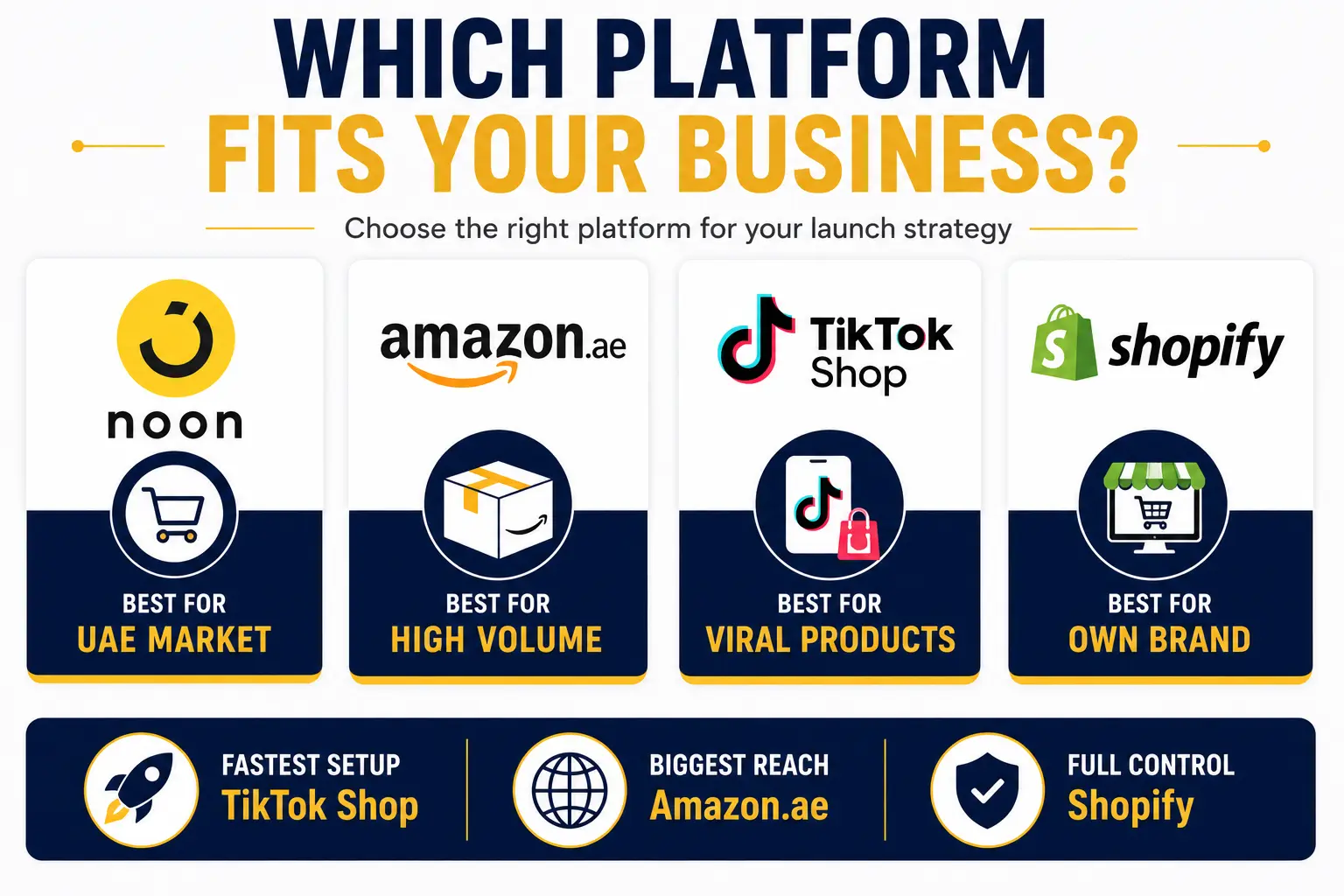
4. Platform Requirements: Noon, Amazon, TikTok Shop, Shopify
Every platform has its own onboarding requirements, fee structure, and quirks. Here is what you actually need for each.
Noon.com
Noon is the UAE’s largest homegrown marketplace, and the first platform most UAE-focused sellers should test. Onboarding is more straightforward than Amazon, local seller support is more responsive, and the platform actively prioritises UAE-based merchants.
What you need to register
- Valid UAE trade license (the business name on your license must match your Noon seller account)
- UAE business bank account (personal accounts are not accepted)
- Emirates ID or UAE residence visa
- Business address
- VAT registration certificate (only if your annual revenue exceeds AED 375,000)
Fee structure
- Seller account setup: Free
- Commission: 5–15% depending on product category (electronics lower, fashion and beauty higher)
- Payment processing: 1.5–2%
- Noon Fulfillment (NowNow): fees vary by category and size similar structure to Amazon FBA
Tips for new Noon sellers
- Start with categories where Noon is dominant: electronics, fashion, home, grocery
- Use Noon’s Fulfilled by Noon (FBN) service if you want faster delivery badges and priority listing
- Product titles and descriptions in both English and Arabic significantly improve search visibility
Timeline to first sale: 1–2 weeks after account approval
Monthly volume potential: AED 50,000–500,000+, depending on category, marketing, and whether you use FBN
Amazon.ae
Amazon.ae has higher traffic volume than Noon for certain categories and is the stronger platform for international brands, electronics, books, and anything targeting the expat demographic. Competition is fiercer, fees are higher, but the ceiling is higher too.
What you need
- UAE trade license
- UAE business bank account
- Valid Emirates ID or residence visa
- Professional product photos (white background, multiple angles, lifestyle shots)
- Optimised product descriptions with keywords
- VAT registration certificate (at the AED 375,000 threshold)
Fee structure
- Seller account: Free (Professional plan is free for the first month, then AED 180/month)
- FBA fees: 20–40% of sale price (includes inbound processing, storage, picking, packing, shipping, returns handling)
- Referral commission: 5–45% depending on category
- Sponsored Products ads: pay-per-click, minimum AED 1/day budget
Tips for the new Amazon.ae sellers
- Research keyword demand before selecting products using tools like Jungle Scout or Helium 10
- Launch with at least 10–15 reviews (use the Early Reviewer Program)
- Price competitively in the first 90 days to build sales velocity and ranking
- Avoid long-tail, slow-moving products. Amazon storage fees accumulate fast on stagnant inventory
Timeline to first sale: 1–3 weeks after listing approval
Monthly volume potential: AED 100,000–1,000,000+, significantly higher ceiling than Noon for the right categories
TikTok Shop
TikTok Shop is the fastest-growing e-commerce channel in the UAE for certain product categories. Its livestream selling feature is unlike any other platform sellers broadcast live, demonstrate products in real time, respond to viewer questions, and take orders during the stream. Conversion rates during well-produced livestreams regularly exceed 5–10%.
What you need
- TikTok account (more followers increases reach, but you can start with a small following)
- UAE business license
- UAE business bank account
- Clear product inventory and fulfillment plan
Fee structure
- Shop setup: Free
- Commission: 2–5% per order (lower than Noon or Amazon)
- Payment processing: 3–4%
- TikTok ads (optional but effective for new accounts): cost varies
Best product categories on TikTok Shop UAE
Beauty and skincare, fitness and wellness products, kitchen gadgets, fashion accessories, tech accessories, and anything that benefits from visual demonstration.
Tips for TikTok Shop
- Post 3–5 organic TikTok videos per week featuring your products before launching the shop
- Affiliate program recruit UAE TikTok creators to promote your products on commission (5–15%)
- Livestream at least 2–3 times per week once you launch; consistent streaming drives the algorithm
Timeline to first sale: ~1 week
Monthly potential: AED 50,000–300,000+ (highly dependent on your TikTok content strategy and following)
Shopify (Own Store)
Shopify gives you 100% control: your brand, your customer data, your experience. No platform taking 15% commission. No risk of account suspension. You own the asset.
The trade-off is that you start with zero traffic. Every visitor must be earned or bought. This is why most founders who choose Shopify also run simultaneous paid social campaigns on Meta and TikTok from day one.
What you need before launch
- UAE trade license
- Custom domain (buy through Namecheap, GoDaddy, or Shopify directly)
- UAE-compatible payment gateway: Telr, PayTabs, Stripe (now available in UAE), or 2Checkout
- Logistics partner for fulfillment (see Section 6)
- VAT registration when applicable
Monthly operational costs
- Shopify plan: AED 300–1,000/month (Basic to Advanced)
- Theme and apps: AED 100–500/month
- Domain: ~AED 150/year
- Payment processing: ~2.9% + AED 0.50 per transaction
- Email marketing (Klaviyo or Mailchimp): AED 150–500/month
Essential Shopify apps for UAE e-commerce
- Loox or Judge.me (reviews)
- Klaviyo (email and SMS marketing)
- Aftership (shipment tracking)
- Sufio (VAT-compliant invoicing)
- ReConvert (post-purchase upsell)
Best for
Brand builders who want to own the customer relationship long-term and are willing to invest in marketing to build their own audience.
Timeline to launch: 2–4 weeks
Timeline to meaningful revenue: 3–6 months minimum, requires consistent marketing investment
Full Cost Breakdown by Model {#cost-breakdown}
Dropshipping Setup
| Cost Item | Range (AED) |
|---|---|
| Freelance license (free zone) | 12,000–18,000 |
| Shopify store setup | 2,000–5,000 |
| Domain + SSL | 500 |
| Branding (logo, basic design) | 1,000 |
| Marketing first 3 months | 3,000–10,000 |
| Total first year | 18,500–34,500 |
Monthly recurring: AED 1,400–3,800 (Shopify + apps + marketing)
Break-even: 3–6 months (requires 3–5 profitable sales per day at AED 300 average profit)
FBA / Marketplace Seller Setup
| Cost Item | Range (AED) |
|---|---|
| Mainland LLC license | 35,000–45,000 |
| Initial inventory | 20,000–50,000 |
| Product photography | 2,000–5,000 |
| Listing optimisation | 1,000–3,000 |
| Marketing first 3 months | 5,000–15,000 |
| Total first year | 63,000–118,000 |
Monthly recurring: FBA fees (20–40% of revenue) + platform commission (5–15%) + marketing (AED 2,000–5,000) + office/operations (AED 3,000–5,000)
Break-even: 4–8 months at AED 20,000/month revenue
Own E-Commerce Brand Setup
| Cost Item | Range (AED) |
|---|---|
| Mainland LLC license | 35,000–45,000 |
| Shopify / custom website | 5,000–15,000 |
| Branding (full identity) | 2,000–5,000 |
| Initial inventory | 30,000–100,000 |
| Product photography | 3,000–8,000 |
| Fulfillment setup | 5,000–10,000 |
| Marketing first 6 months | 20,000–50,000 |
| Total first year | 100,000–233,000 |
Monthly recurring: Website (AED 300–1,000) + fulfillment (AED 10–50/order) + marketing (AED 5,000–20,000) + compliance (AED 1,000–2,000)
Break-even: 6–12 months at AED 50,000/month revenue
Last-Mile Delivery & Logistics
Getting the product to your customer quickly and reliably is where many e-commerce businesses quietly lose margin. In the UAE in 2026, the last-mile delivery market is growing 15–20% annually, and competition between providers is keeping prices reasonable.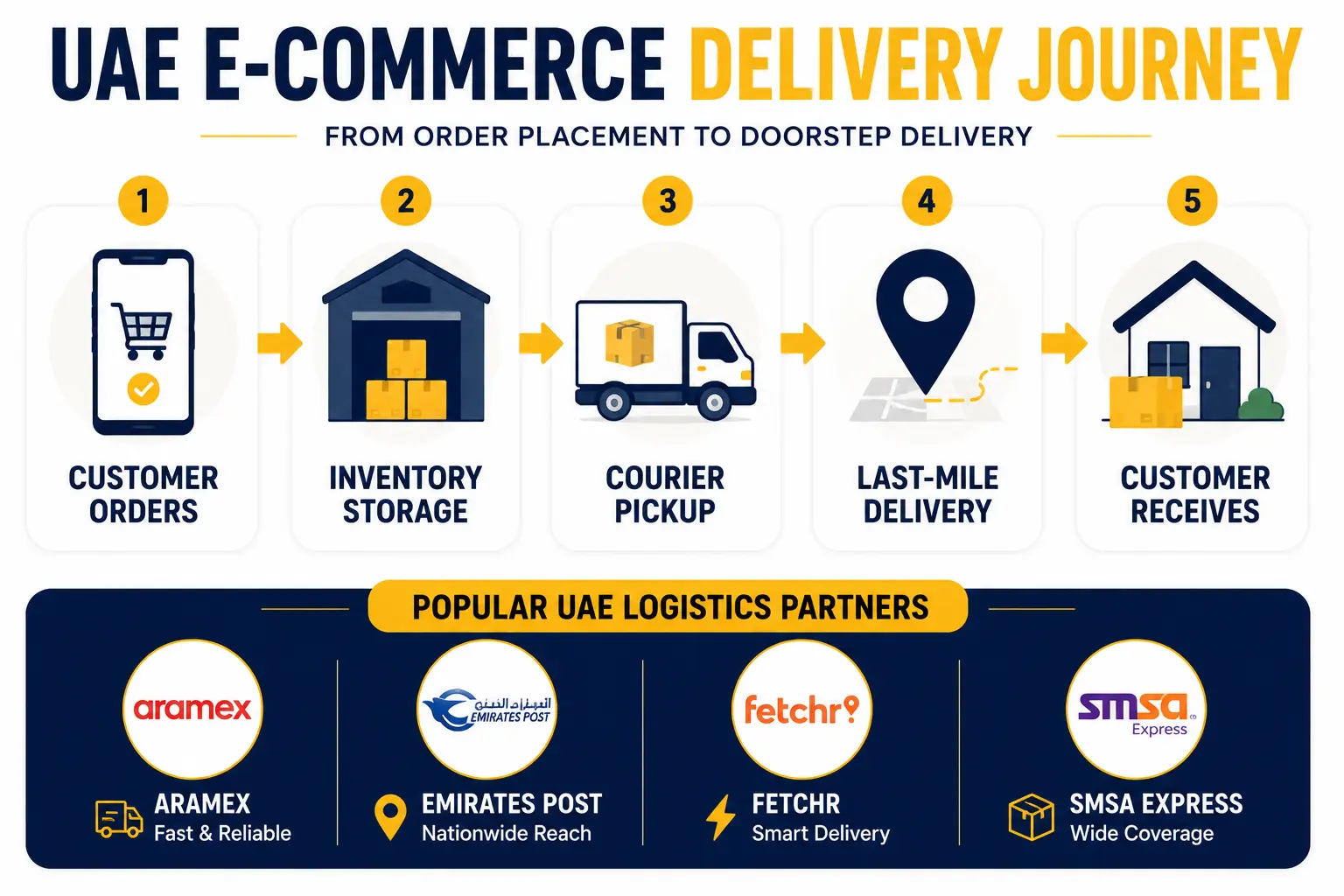
Key last-mile delivery players in the UAE:
- Emirates Post: widest coverage, including remote Emirates, competitive for standard parcels
- Aramex: strong regional and international network, well-suited for cross-border
- Smsa Express: growing fast in the UAE with competitive rates for mid-volume sellers
- Fetchr: tech-forward platform, good API integration for Shopify stores
- Local couriers: lower cost within single emirates, especially useful for same-day Dubai delivery
Cost range: AED 15–60 per package depending on size, weight, distance, and courier.
Delivery Strategy by Model
- Dropshipping: The supplier ships directly to your customer. Your job is to communicate tracking proactively, manage exceptions when shipments are delayed, and handle returns. The shipping cost is built into the supplier’s wholesale price, so negotiate it explicitly. Suppliers who ship from UAE or GCC warehouses give you a significant edge on delivery time over suppliers shipping from China.
- FBA: Amazon handles everything from the warehouse to the doorstep. Customers receive Prime-eligible 1–2 day delivery. You pay through FBA fees (20–40% of sale), but your logistics headaches are largely eliminated. The trade-off: Amazon’s fulfillment fees include a markup a 3PL could be cheaper at high volume.
- Marketplace seller (self-fulfilled): You store inventory yourself or with a 3PL and dispatch to courier on order. Noon and Amazon both have seller fulfillment options. Same-day or next-day delivery is strongly recommended platform algorithms favour faster shipping, and UAE consumers in 2026 expect it.
Own Shopify brand three sub-options
- Partner with a courier directly: Negotiate a rate card with Aramex, Emirates Post, or Smsa. Expect AED 15–40/package for standard parcels. Volume discounts kick in around 200+ shipments/month. This is the most flexible option you control packaging and branding.
- Use a 3PL fulfillment center: Storage costs AED 2–5 per unit per month, plus AED 10–20 per outbound shipment. Best suited for businesses shipping 1,000+ units/month. The 3PL handles picking, packing, and courier handoff you focus on marketing and growth.
- Self-warehouse: Rent a small warehouse or storage unit (AED 500–2,000/month in Dubai industrial areas) and handle all fulfillment yourself. Only makes financial sense for local-only operations with high-value, non-fragile items and low volume.
Returns and Reverse Logistics
Returns will happen. In UAE e-commerce, expect 10–20% return rates depending on category fashion and electronics are the highest, grocery and consumables the lowest.
Plan for this from day one:
- Publish a clear 30-day return policy on your store or listings
- Decide whether customers pay return shipping or you absorb it (most competitive stores absorb it)
- Partner with a reverse logistics provider or handle returns in-house
- Cost per return: AED 10–30 plus any restocking or disposal cost
Poor returns handling is one of the fastest ways to accumulate negative reviews on both Noon and Amazon. One bad review can suppress a listing for weeks.
VAT and Corporate Tax Obligations
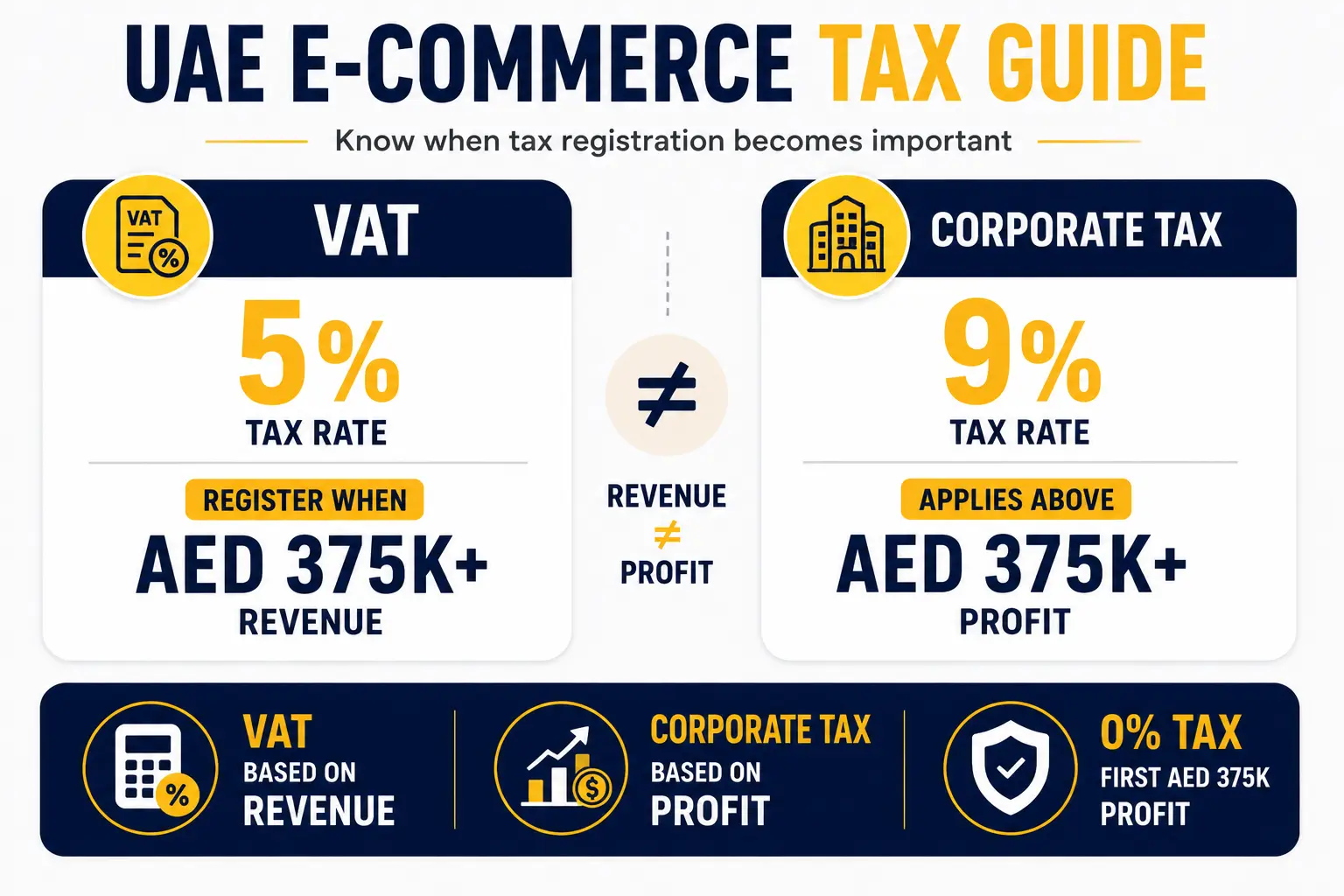
VAT
VAT registration in the UAE is mandatory once your taxable supplies exceed AED 375,000 in any 12-month rolling period. The standard rate is 5% on most goods and services.
What this means for your e-commerce business:
- Track cumulative revenue from month one the AED 375,000 threshold sneaks up on growing businesses
- Once registered, charge 5% VAT on every sale and file quarterly returns with the FTA
- You can reclaim input VAT on legitimate business expenses: stock purchases, courier fees, marketing costs, software subscriptions
- VAT invoices are required for B2B transactions above AED 500
- Compliance costs: approximately AED 2,000–5,000/year (accountant fees for quarterly filings)
Voluntary registration is available once supplies exceed AED 187,500/year. This can be beneficial early if your business expenses are high it lets you reclaim input VAT before you are required to charge output VAT.
Corporate Tax (CIT)
The UAE introduced a 9% corporate tax in June 2023. The structure for 2026:
- 0% on the first AED 375,000 of net profit per year
- 9% on net profit above AED 375,000
In practice:
- Most dropshipping operations and early-stage marketplace sellers will comfortably stay below the threshold effectively zero corporate tax in year one or two
- FBA sellers scaling past AED 2–3 million annual revenue should factor 9% CIT into their financial model
- Own-brand businesses with high margins and growing revenue need proper tax planning from around month 9–12 onward
Free zone note
Free zone businesses can qualify for 0% CIT if they meet the Qualifying Free Zone Person (QFZP) criteria this means deriving income from qualifying activities and meeting substance requirements. This is not automatic; it requires verification by a tax advisor.
Top E-Commerce Niches in UAE for 2026
Not all niches perform equally in the UAE market. Winning e-commerce businesses in Dubai in 2026 share one trait: they are specific. Trying to sell everything to everyone is the most common reason new stores stall at AED 5,000–10,000/month and never break through.
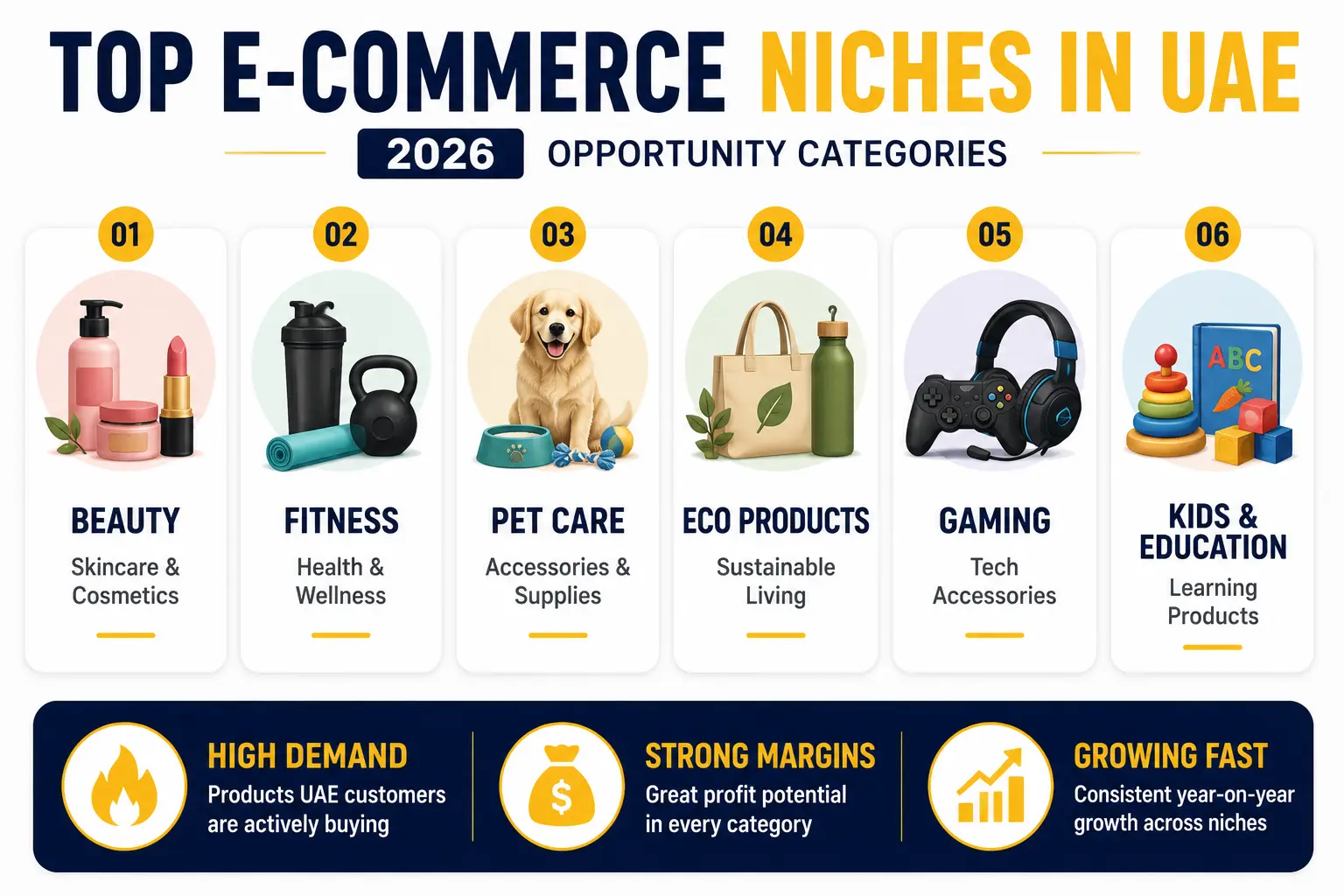
Here are the categories with strong demand signals, healthy margins, and manageable competition:
- Beauty and Skincare One of the highest-revenue categories on both Noon and Amazon.ae. UAE consumers, particularly women aged 25–44, spend significantly above the global average on skincare. Clean beauty, halal-certified skincare, and K-beauty products are growing fast. Margins are excellent, many skincare products have a 4:1–6:1 cost-to-price ratio. The challenge: brand trust takes time to build. Start with marketplaces before investing in your own store.
- Health, Wellness, and Fitness Gym memberships, fitness equipment, supplements, and recovery tools are in sustained demand across Dubai and Abu Dhabi. Resistance bands, yoga equipment, protein supplements, and massage guns are high-performing subcategories. This niche benefits from TikTok content, as demonstration-driven products perform well on video.
- Pet Accessories and Supplies Pet ownership has risen sharply in the UAE over the past three years. Premium pet food, accessories, grooming products, and enrichment toys command strong margins (3:1–5:1 on many products) and generate repeat purchases, the most valuable dynamic in e-commerce. Repeat buyers drive LTV and reduce dependence on paid acquisition.
- Eco-Friendly Home Products Government sustainability initiatives and an increasingly environmentally-conscious consumer base have created real demand for sustainable home products: bamboo kitchenware, reusable packaging alternatives, energy-saving devices, and natural cleaning products. This is a differentiation niche prices can be higher because the product story justifies it.
- Gaming Peripherals and Tech Accessories The UAE has one of the highest gaming penetration rates in the MENA region. Headsets, controllers, desk accessories, and LED lighting gear for gaming setups are consistent performers on Amazon.ae and among tech-focused TikTok audiences. Margins are moderate (2:1–3:1) but volume potential is high.
- Children’s Educational Products and Toys The UAE’s young demographic and high disposable income per household make children’s products a reliable category. Montessori-style educational toys, STEM kits, Arabic-language learning materials, and premium arts-and-crafts supplies have low competition relative to demand.
Choosing your niche the three-question test:
- Is there documented demand? (Check Noon bestsellers, Amazon.ae search suggestions, Google Trends UAE data)
- Can you achieve at least a 2.5:1 cost-to-selling price ratio after shipping and platform fees?
- Is there a clear audience you can reach on TikTok or Instagram for under AED 100 CAC?
If the answer to all three is yes, the niche is worth testing with a small initial inventory before committing fully.
Challenges and How to Solve Them
Every e-commerce model in Dubai comes with predictable challenges. Knowing them in advance is the difference between a fixable setback and a business-ending surprise.
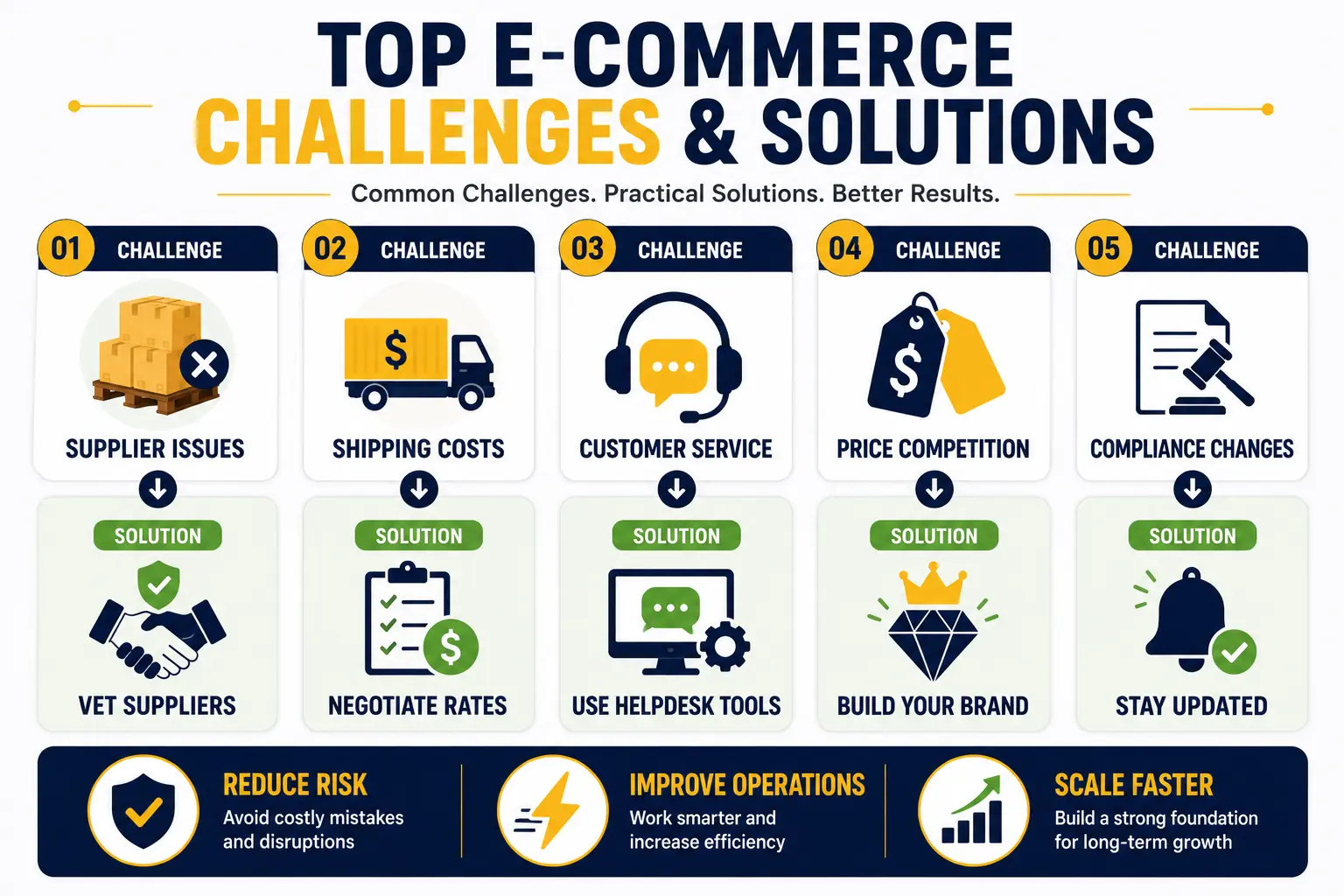
Challenge 1: Supplier Quality and Reliability
The reality with dropshipping and FBA is that suppliers, especially overseas ones, sometimes fail. Late shipments, wrong products shipped, poor packaging, and inconsistent quality. Any of these translates directly into negative reviews, returns, and potential account warnings on Noon or Amazon.
Solutions
- Always order samples before committing to a supplier or listing products publicly
- Visit the supplier’s facility if the order volume justifies it (feasible for high-volume FBA sourcing from UAE, Turkey, or India)
- Establish written quality standards in your purchase order terms
- Maintain two backup suppliers for any product generating more than AED 20,000/month revenue
- For dropshipping, use UAE-based or GCC-based suppliers where possible to reduce lead times and quality risk
Challenge 2: Shipping Cost Volatility
Courier rates fluctuate with fuel costs, route changes, and seasonal demand spikes. A cost increase of AED 5 per package can wipe out your margin on low-AOV products.
Solutions
- Negotiate quarterly or annual rate cards with your logistics partners, and commit to a minimum monthly volume in exchange for a fixed rate
- Use shipping rate comparison tools (ShipBob, Shippit) to maintain competition between couriers
- Build shipping cost into your product pricing model from day one do not treat it as a margin item
- Increase average order value (AOV) through bundling to dilute per-order shipping costs
Challenge 3: Customer Service at Scale
Managing customer queries across WhatsApp, email, Noon seller messaging, and Amazon’s buyer-seller messaging simultaneously is chaotic without systems. As volume grows past AED 50,000/month, customer service becomes a full-time role.
Solutions
- Implement a helpdesk tool from day one, Freshdesk (free tier available) or Zendesk
- Build a detailed FAQ page on your store that pre-answers the 10 most common questions
- Set auto-responses for common queries on WhatsApp Business
- Once revenue justifies it, hire a part-time customer service agent (AED 3,000–5,000/month for a remote role)
- Use marketplace-provided customer service (Noon and Amazon handle returns and most disputes) as long as possible before scaling to your own store
Challenge 4: Competition and Margin Pressure
UAE e-commerce marketplaces are competitive. Price wars on Noon and Amazon.ae can compress margins to unsustainable levels, particularly in electronics and commodity categories.
Solutions
- Differentiation is the only sustainable protection. Own a niche, build a brand story, and compete on value rather than price
- Invest in product photography, and copy the sellers with the best visuals to win more conversions at the same price
- Build off-marketplace channels: email lists, Instagram, TikTok. A customer who follows you on social is far harder to lose to a competitor undercutting on price
- Focus on repeat purchase rate, target 30%+ second-order rate by building post-purchase email sequences
Challenge 5: Regulatory and Compliance Changes
UAE VAT rules, licensing requirements, platform policies, and corporate tax regulations evolve. What is true today may be different in 12 months.
Solutions
- Hire an accountant familiar with UAE e-commerce compliance budget AED 2,000–5,000/year
- Subscribe to FTA announcements at tax.gov.ae
- Join UAE e-commerce communities (Dubai e-commerce Facebook groups, LinkedIn forums, founder Slack channels) where regulatory changes surface quickly
- Budget for compliance costs upfront in your financial model treat them as a fixed operating expense, not a surprise
Funding and Growth Strategy
Bootstrapping Path (Recommended for Most Beginners)
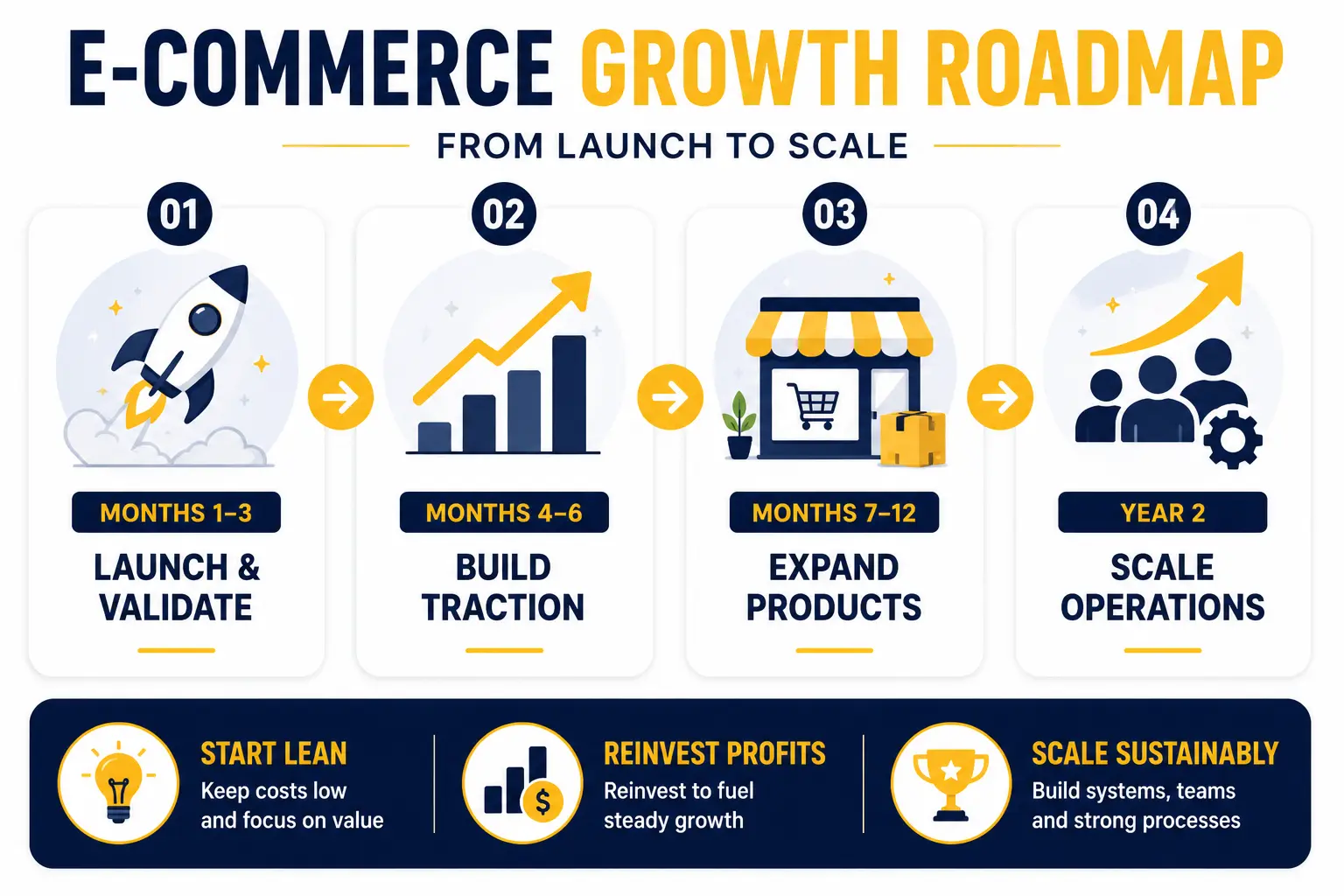
This is the most realistic path for founders starting with under AED 50,000. The key is sequencing: start lean, validate demand, then reinvest profits rather than raising capital before you have proof.
- Months 1–3: Launch with dropshipping or a small marketplace listing. Target AED 10,000–20,000/month revenue. The goal is validation, not profit. Learn what sells, what doesn’t, what your real CAC is.
- Months 4–6: Grow to AED 30,000–50,000/month. Launch on Noon or Amazon.ae alongside your Shopify store. Build an email list targeting 1,000+ subscribers. Email marketing has the highest ROI of any channel at this stage.
- Months 7–12: Aim for AED 50,000–100,000/month. Add private-label products if the category justifies it. Make your first hire part-time customer service or part-time marketing. Start thinking about the shift from dropshipping to owned inventory for your best-selling products.
- Year 2: AED 100,000–300,000/month. Full-time team. Owned brand with repeat customer base. Consider angel funding to accelerate rather than to survive.
Angel Investment Path
If you are launching FBA or an own brand and need faster scale particularly if you are going after a category that requires significant inventory investment:
- Seed round: AED 100,000–500,000 use for inventory, marketing, and first two hires
- Dilution: Typically 10–20% for pre-revenue; 5–15% with demonstrated traction
- Timeline to raise: 2–3 months if you have a tested concept and some revenue
- Where to find UAE angel investors: Dubai Angel Investors network, DIFC FinTech Hive alumni, 1Dyas accelerator, LinkedIn direct outreach to UAE-based e-commerce operators
What angels look for
Demonstrated unit economics (CAC, LTV, repeat purchase rate), a defensible niche, a founder who understands operations, and a clear path to AED 500,000+/month revenue.
Government Grants and Support
The D33 Economic Agenda specifically prioritises e-commerce as a growth sector. Available support in 2026:
- Government grants up to AED 100,000 for qualifying digital economy businesses
- DIEDC accelerator programs with mentoring and investor access
- 1Dyas incubator focused on e-commerce and digital businesses
- Zero corporate tax under AED 375,000 profit is itself an implicit subsidy worth up to AED 33,750/year
- SME lending programs through Emirates Development Bank for inventory financing
5 Key Success Factors
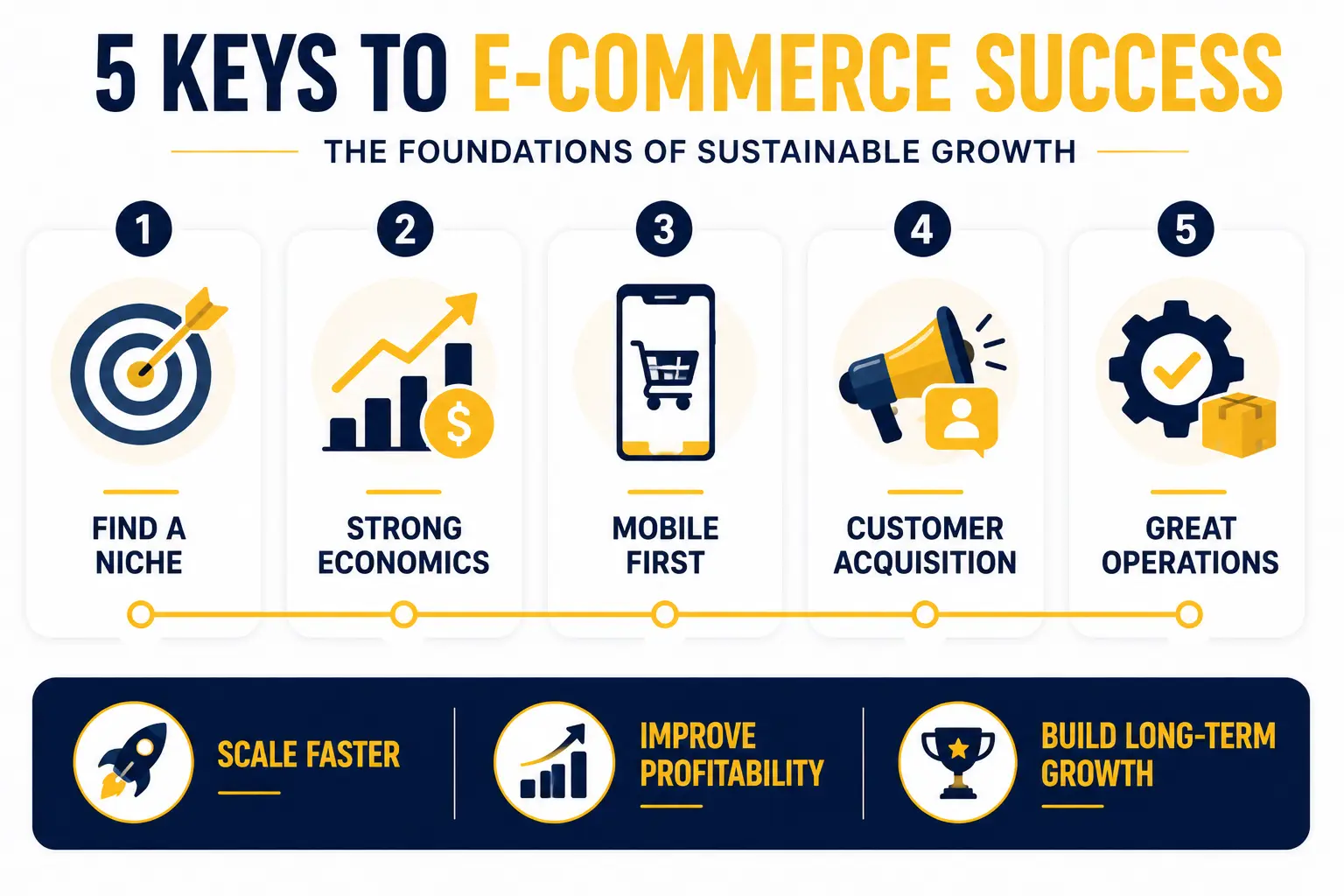
1. Niche First, Always
The most consistent predictor of e-commerce success in Dubai is niche specificity. Businesses that try to sell across too many categories early on spread their marketing budget too thin and build no authority in any segment. Pick one niche, own it, expand later.
The best niches have three characteristics: you can source the product at a 2.5:1+ margin, there is a clear audience you can target on TikTok or Instagram for under AED 100 CAC, and the product generates repeat purchases or natural word-of-mouth.
2. Unit Economics That Actually Work
Before you spend a single dirham on marketing, validate these numbers on paper:
- Product cost to selling price ratio: minimum 2:1 after all fees
- Customer acquisition cost (CAC): AED 50–150 is the realistic range in the UAE
- CAC payback period: must be within 3–6 months
- Average order value (AOV): AED 100+ minimum; anything below makes the economics very hard
- Target a 30%+ second-order rate. This is what separates sustainable businesses from treadmills
If the unit economics do not work on paper, they will not work with real marketing spend.
3. Mobile-First Without Compromise
Smartphones drive 79% of all e-commerce transactions in the UAE. Your store, checkout, product images, page load speed, and post-purchase emails must all be fully optimised for mobile. This is not a nice-to-have. Shopify themes are generally mobile-responsive by default, but test your checkout on an actual iPhone and Android device before launching. One extra tap at checkout can reduce conversion by 10–15%.
4. Customer Acquisition Strategy
The channels that consistently deliver ROI for UAE e-commerce in 2026:
- TikTok and Instagram Reels: Most cost-effective reach, especially for products that benefit from demonstration or storytelling. Aim for 3–5 posts per week.
- Email marketing: Highest long-term value per customer. Build your list aggressively from day one with a lead magnet or first-order discount.
- Micro-influencer partnerships: UAE nano and micro influencers (10,000–100,000 followers) deliver better ROI than celebrity accounts their audiences are more engaged, and their rates are far lower.
- Retargeting ads: Once you have traffic data (1,000+ website visitors), Meta retargeting campaigns consistently outperform cold prospecting on ROAS.
Typical CAC in the UAE: AED 50–150 per customer, depending on category. If you are paying more than AED 200 to acquire a customer who spends AED 150, the model does not work.
5. Operations as a Competitive Advantage
Fast shipping, accurate product descriptions, professional photography, an easy return process, and responsive customer service are not nice-to-haves in the UAE market in 2026; they are table stakes. The platforms enforce them through review systems, and those reviews directly determine your search ranking on Noon and Amazon.
The sellers who build a reputation for reliability, fast delivery, as-described products, and easy returns earn repeat business without additional CAC. Operations is your most durable moat in e-commerce.
Conclusion
Starting an e-commerce business in Dubai in 2026 is genuinely accessible but only if you make the right structural decisions early. Choose the wrong license and you will either overpay for permissions you do not need, or find yourself unable to sell to your actual customers. Choose the wrong model and your margins will not survive your costs.
The clearest path for most founders:
- Tight budget, solo operation: Freelance permit + dropshipping. Start with AED 18,500. Test your niche. Upgrade when you have revenue.
- Ready to commit to UAE domestic market: Mainland LLC + Noon or Amazon.ae marketplace. AED 60,000–120,000 total. First sale within weeks.
- Building for the long term: Mainland LLC or free zone + Shopify + owned brand. AED 100,000+. Longer timeline, highest long-term value.
The UAE e-commerce market is worth USD 12.30 billion today and growing. The logistics infrastructure is mature. Digital payments are mainstream. Government support is funded and real. The regulatory framework, while detailed, is clear. What is left is execution and that starts with picking the right model for your budget and goals.