DLC Costs, Dubai Logistics City now part of the wider Dubai South development is a purpose-built location for logistics, freight forwarding, warehousing, distribution, e-commerce and supply-chain businesses. For companies considering DLC, however, the trade licence is only one part of the financial picture. Warehouse rent, land leasing, facility specifications, employee visas, utilities, fit-out, customs requirements and operational approvals can significantly affect the total investment. Understanding these costs before committing to a facility can help businesses choose between a ready-built warehouse, flexible logistics space or a leased plot for a custom-built operation.
What Is Dubai Logistics City?
Dubai Logistics City is located within Dubai South and forms part of a major integrated aviation, logistics and commercial ecosystem. The Logistics District is positioned close to Al Maktoum International Airport while also providing road connectivity towards Jebel Ali Port and other parts of Dubai and the UAE. Dubai South describes the district as connected to air, sea and land transport networks and specifically designed to support warehousing, distribution and logistics operations.
For international companies, regional distributors and logistics operators, this location can help combine warehousing, cargo movement and business operations within one broader logistics environment.
Businesses planning to establish operations in the area can explore Dubai Logistics City company formation to understand available company structures, licensing and setup requirements.
How Much Does It Cost to Set Up in DLC?
There is no single fixed cost for establishing a fully operational logistics company in DLC. A small operation requiring limited storage will have a very different budget from a freight company leasing thousands of square metres or an industrial operator developing its own facility.
The main costs normally fall into several categories.
Company Registration and Licensing
The business must first have the appropriate company registration and licence for its proposed activities.
Dubai South’s current registration portal demonstrates that costs can contain separate elements such as setup fees, establishment-card charges, licence-related fees and taxes. The exact total depends on the selected company and facility package.
Businesses should therefore request an itemised quotation covering:
- Company registration
- Trade or logistics licence
- Establishment card
- Immigration requirements
- Shareholder and employee visas
- Facility lease
- Additional activities
- Regulatory approvals
- Customs-related requirements where applicable
The cheapest licence package should not automatically determine the final location decision. For a logistics company, the facility and operational requirements will often represent a much larger financial commitment than registration alone.
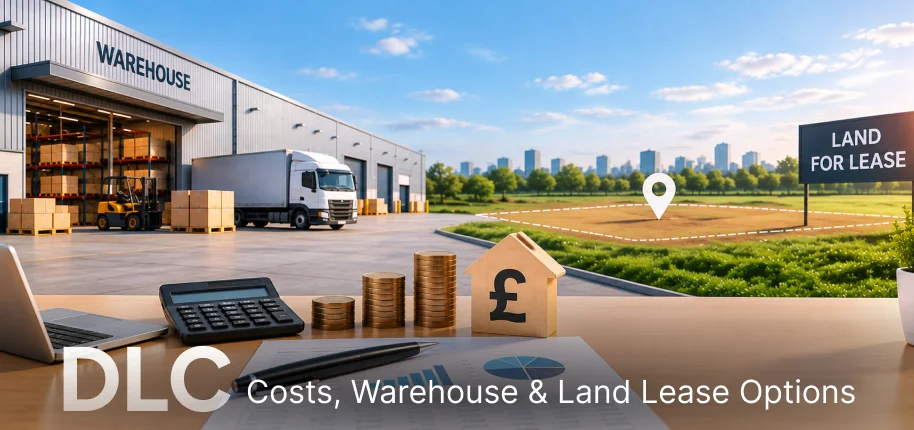
DLC Warehouse Lease Costs
Warehouse rental is usually one of the most significant ongoing expenses for a logistics business.
There is no universal DLC warehouse rate. Rental costs depend on factors including
- Total floor area
- Warehouse age and specification
- Clear height
- Loading bays
- Power capacity
- Cooling requirements
- Office component
- Fire-safety infrastructure
- Temperature control
- Cargo requirements
- Location within the district
- Length and terms of the lease
Current market listings illustrate just how significantly the final rent can vary. For example, a large Grade A facility of approximately 123,785 square feet in Dubai South’s Logistics District was recently marketed at AED 7.475 million annually, while another approximately 55,289-square-foot logistics and manufacturing facility was listed at AED 3.04 million annually. These are individual market listings rather than standard Dubai South tariff rates and should not be treated as quotations for other facilities.
This is why businesses should compare facilities according to their operational specifications rather than simply looking at an advertised price per square metre or square foot.
Also read – DAFZA for Logistics, Pharma, Aviation & Tech Companies.
What Warehouse Options Are Available?
Dubai South provides logistics facilities designed for different types and scales of operation.
Its newer multiuser facilities include flexible warehouse space with units that can be combined as businesses expand. Dubai South states that these facilities have been developed within the freight-forwarding zone and are positioned close to Al Maktoum International Airport, Jebel Ali Port and major road networks.
Current Dubai South Logistics District information indicates warehouse areas starting from approximately 190 square metres, with the ability to combine units.
Multiuser Warehouse Units
These can be particularly suitable for small and medium-sized logistics companies that need professional warehousing without developing a standalone facility.
Businesses can potentially increase their space by combining units as operations expand.
Larger Standalone Warehouses
Established logistics companies, distributors and regional fulfilment operators may require larger dedicated facilities.
These can provide greater control over
- Storage configuration
- Racking
- Loading operations
- Vehicle movement
- Staff areas
- Internal offices
- Inventory systems
- Security
Specialised Warehouse Facilities
Certain industries need more than standard dry storage.
Companies dealing with pharmaceuticals, food products, chemicals, sensitive electronics or other regulated products may require temperature control, enhanced fire protection, specialist power requirements or other approvals.
These additional requirements can materially increase both rental and fit-out costs.
Warehouse Specifications Matter
The headline size of a warehouse does not tell you whether it is operationally suitable.
Dubai South’s current multiuser warehouse specifications include facilities starting at approximately 190 square metres, 8-metre eaves height, provision for upper-level offices, individually metered utilities and cooling, access doors, specialised flooring and integrated fire-safety systems.
Before signing a lease, businesses should evaluate
- Floor loading capacity
- Clear warehouse height
- Loading and unloading configuration
- Number of dock doors
- Truck turning space
- Electrical capacity
- Cooling
- Fire protection
- Office space
- Parking
- Security
- Customs requirements
- Expansion possibilities
Paying slightly more for the correct facility can be more efficient than taking cheaper premises that later require extensive modifications.
DLC Land Lease Options
A ready-built warehouse is not always suitable for a large logistics or industrial project.
Companies requiring a customised distribution centre, manufacturing operation, automated fulfilment centre or specialised storage facility may instead consider leasing land and developing their own premises.
Dubai South’s published Logistics District development guidelines specifically contemplate serviced plots rented to approved developers for the construction of industrial or warehousing units with ancillary offices. A developer seeking a serviced plot must apply to the authority with details of the intended operation and land requirements.
This option can provide much greater flexibility for large-scale businesses.
Why Lease Land Instead of a Warehouse?
Land leasing can allow a company to design a facility around its exact requirements.
This may include
- Custom warehouse dimensions
- Automated storage systems
- High-bay warehousing
- Dedicated loading docks
- Cold-storage areas
- Manufacturing space
- Administrative offices
- Fleet parking
- Staff facilities
- Specialised power infrastructure
- Future expansion areas
The trade-off is that land-based projects normally require considerably more planning, capital and time than leasing a completed warehouse.
Warehouse vs Land Lease – Which Is Better?
| Factor | Ready-Built Warehouse | Land Lease |
|---|---|---|
| Initial investment | Generally lower | Generally higher |
| Setup speed | Faster | Longer development period |
| Facility design | Existing specification | Highly customisable |
| Construction required | Usually limited | Yes |
| Fit-out | Usually required | Full development required |
| Expansion flexibility | Depends on availability | Potentially greater |
| Suitable for | SMEs, distributors, 3PL and e-commerce | Large logistics and industrial operators |
| Operational control | Moderate to high | Very high |
| Long-term planning | Good | Particularly suitable |
| Complexity | Lower | Higher |
For businesses entering Dubai for the first time, a ready-built warehouse may reduce the initial operational burden. Large companies with highly specific infrastructure requirements may gain more value from a land-based development.
Costs Beyond Warehouse Rent
A common budgeting mistake is calculating only the annual lease.
The actual first-year cost can include considerably more.
Security Deposit
A landlord or authority may require a security deposit under the lease terms.
Warehouse Fit-Out
Depending on the facility and business, fit-out could include
- Pallet racking
- Shelving
- Partitioning
- Offices
- Cold rooms
- Lighting
- CCTV
- Access control
- IT infrastructure
- Additional fire-safety equipment
Utilities
Businesses should determine whether electricity, water, cooling and other utility costs are included or separately metered.
Dubai South’s multiuser facility specifications state that water, electricity and district cooling can be individually metered.
Employee and Immigration Costs
Logistics companies should also account for establishment-card requirements, visas, medical examinations, Emirates ID processes and other employee-related costs.
Insurance
Depending on the operation, insurance requirements may include property, public liability, cargo, vehicle, employer and other commercial coverage.
Customs and Import Requirements
Businesses importing, exporting or re-exporting physical goods may need customs registration and additional procedures depending on their activities and cargo.
Regulatory Approvals
Specialised industries may require approvals beyond the standard business licence.
This can be particularly relevant to
- Pharmaceuticals
- Food
- Chemicals
- Dangerous goods
- Medical products
- Manufacturing
- Aviation-related cargo
Understanding these expenses at the planning stage provides a much more accurate picture of the actual cost of operating from DLC.
For businesses comparing different logistics locations before committing to a facility
How to Choose the Right DLC Facility
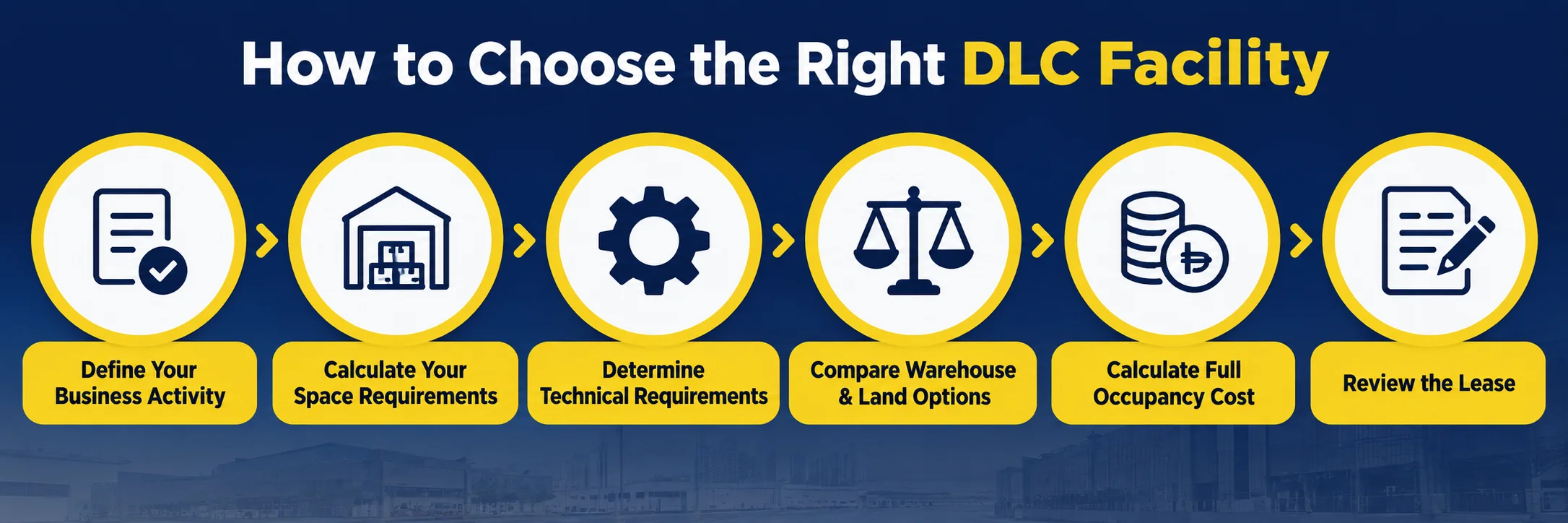
Step 1 – Define Your Business Activity
Determine exactly what the company will do – freight forwarding, storage, fulfilment, distribution, trading, manufacturing or another activity.
Step 2 – Calculate Your Space Requirements
Estimate the warehouse, office, loading and vehicle space required for both current operations and realistic future growth.
Step 3 – Determine Technical Requirements
Identify requirements for power, temperature control, clear height, loading docks, floor loading, fire protection and specialist storage.
Step 4 – Compare Warehouse and Land Options
Determine whether a completed warehouse can support the operation or whether a custom-built facility is commercially justified.
Step 5 – Calculate the Full Occupancy Cost
Compare rent together with deposits, utilities, service charges where applicable, fit-out, licensing, visas, insurance and approvals.
Step 6 – Review the Lease Before Committing
Check lease duration, renewal terms, permitted use, modification rules, expansion possibilities and exit conditions before signing.
Why DLC Can Work for Logistics Businesses
DLC’s main attraction is the broader logistics ecosystem surrounding the business.
Dubai South’s Logistics District provides access to Al Maktoum International Airport, road networks and connections towards Jebel Ali Port. Its facilities are specifically designed around logistics, warehousing and trade requirements.
This can make the location particularly relevant to
- Freight forwarders
- Third-party logistics providers
- Importers and exporters
- E-commerce fulfilment companies
- Regional distributors
- Cargo operators
- Supply-chain companies
- Warehousing businesses
- Retail distribution operations
Businesses can learn more about UAE company formation options through Open a Dubai Company.
Conclusion
DLC provides several routes for logistics businesses – from flexible warehouse units to substantial dedicated facilities and serviced plots for custom development. The best option depends on the scale of the operation, cargo type, technical requirements, workforce, expansion plans and available budget.
Rather than evaluating a facility only by its advertised annual rent, businesses should calculate the complete first-year and ongoing occupancy costs. Licensing, deposits, fit-out, utilities, visas, regulatory approvals and operational infrastructure can materially change the final budget.
If you are considering establishing a logistics, warehousing, freight or distribution operation in Dubai Logistics City, Contact Us to discuss your proposed activity and setup requirements.