Dubai has developed into one of the world’s most important logistics and distribution centres, connecting businesses with markets across the Middle East, Asia, Europe and Africa. Its combination of major airports, Jebel Ali Port, modern road networks, customs infrastructure and specialist free zones gives logistics companies several options for establishing regional operations.
Among these options, Dubai Logistics City – DLC, Jebel Ali Free Zone – JAFZA and Dubai Airport Freezone – DAFZA stand out for businesses involved in logistics, warehousing, freight forwarding, distribution and international trade. However, each zone serves a different operational model. DLC is closely connected to the growing logistics ecosystem around Al Maktoum International Airport, JAFZA has a major advantage for sea freight and large-scale distribution, while DAFZA is particularly attractive for companies dependent on Dubai International Airport and time-sensitive air cargo.
Why Free Zone Location Matters for Logistics Companies
A logistics business is more dependent on location than many service-based businesses. Distance from an airport, seaport, customs facility or major road can affect cargo handling times, transportation costs, inventory management and delivery performance.
The right Dubai free zone should therefore be selected according to the company’s actual supply chain. A freight forwarder focused on air cargo may have completely different requirements from a regional distributor importing containers through Jebel Ali Port.
Other factors that should influence the decision include warehouse size, customs arrangements, cargo type, customer locations, employee requirements, future expansion and whether the company expects to operate primarily through air, sea or multimodal transport.
DLC – Purpose-Built for Modern Logistics Operations
Dubai Logistics City forms part of the wider Dubai South logistics ecosystem around Al Maktoum International Airport. The location has been developed specifically around aviation, logistics, e-commerce, freight and supply-chain operations.
Dubai South states that its Logistics District provides direct access to the cargo terminals at Al Maktoum International Airport and uninterrupted access to Jebel Ali Port through a bonded logistics corridor. The district also includes specialised areas such as EZDubai for e-commerce and a Contract Logistics Zone.
This positioning makes Dubai Logistics City company formation particularly relevant to companies that want access to both aviation and port infrastructure rather than depending exclusively on one transport mode.
DLC Can Be Suitable For
- Freight forwarding companies
- Third-party logistics providers
- E-commerce fulfilment businesses
- Warehousing and distribution companies
- Import and re-export operations
- Contract logistics providers
- Regional distribution centres
- Supply-chain management companies
Another advantage is scalability. Dubai South continues to accommodate major international logistics operations alongside flexible facilities designed for SMEs, traders and e-commerce businesses. Its newer multi-user facilities, for example, provide combinable temperature-controlled spaces intended for logistics and international trade operations.
Also read – DLC Costs, Warehouse & Land Lease Options
JAFZA – Strongest for Port-Based Logistics and Large Distribution
Jebel Ali Free Zone has developed around one of Dubai’s greatest logistics assets – Jebel Ali Port. For companies moving large volumes of containerised cargo, operating regional distribution centres or requiring substantial warehousing, this creates a major operational advantage.
JAFZA reports that its logistics industry includes 3.85 million square metres of combined facilities and more than 650 logistics companies from over 60 countries. Its logistics ecosystem combines sea, land and air connections within a customs-bonded environment.
Companies can establish various structures and activities through JAFZA company formation, depending on their ownership, activity and operational requirements.
JAFZA Can Be Suitable For
- Sea freight businesses
- 3PL providers
- Container-based importers
- Large distribution centres
- Manufacturing and industrial logistics
- Automotive supply chains
- FMCG distribution
- Machinery and equipment businesses
- Import and re-export companies
JAFZA becomes particularly compelling when warehousing and port connectivity form the centre of the business model. A company importing high container volumes through Jebel Ali Port may reduce unnecessary cargo movements by locating storage, distribution and supporting operations close to the port.
DAFZA – Strong Choice for Air Freight and Time-Sensitive Cargo
Dubai Airport Freezone offers a different logistics proposition. Rather than being built primarily around maritime cargo, DAFZA’s major advantage is its proximity to Dubai International Airport.
DAFZ Industrial Park is approximately 5 km from Dubai International Airport and includes bonded warehouses, individual loading and unloading areas and cold-storage-enabled facilities. DAFZ specifically highlights rapid movement of imported and exported goods as an advantage of the location.
This makes DAFZA particularly attractive when delivery speed, airport access and cargo handling time matter more than proximity to a seaport.
DAFZA Can Be Suitable For
- Air-freight operations
- Express cargo businesses
- Pharmaceutical logistics
- Electronics distribution
- High-value goods
- Aviation supply chains
- Time-sensitive spare parts
- Import and re-export businesses
Companies dealing with pharmaceuticals, technology products, valuable components or urgent spare parts may place greater value on airport proximity than on access to extensive port-side warehousing.
Businesses considering this model should assess their exact activities, facility needs and approvals before proceeding with their DAFZA company setup.
DLC vs JAFZA vs DAFZA – Quick Comparison
| Factor | DLC | JAFZA | DAFZA |
|---|---|---|---|
| Best suited for | Multimodal logistics | Sea freight and distribution | Air freight |
| Key transport advantage | Air, road and port access | Jebel Ali Port | Dubai International Airport |
| Warehousing model | Flexible and scalable | Large-scale logistics | Airport-oriented |
| Strong use case | 3PL and e-commerce | Regional distribution | Urgent cargo |
| Expansion potential | Strong | Strong | Strong for specialised operations |
The comparison shows why there is no single best free zone for every logistics company. The appropriate choice depends primarily on how goods enter Dubai, where they are stored and where they need to go next.
Which Zone Is Best for Warehousing?
For large-scale warehouse requirements connected to containerised imports, JAFZA is often the strongest starting point because of its proximity to Jebel Ali Port and established logistics infrastructure.
DLC is particularly competitive when businesses require scalable facilities while maintaining access to both Al Maktoum International Airport and Jebel Ali Port. It can therefore suit regional fulfilment, e-commerce, 3PL and multimodal distribution operations.
DAFZA is more specialised. Its warehouse proposition becomes especially attractive when airport proximity, bonded facilities, cold storage or fast-moving air cargo are important to the business.
The correct comparison should consequently consider warehouse specifications rather than floor area alone. Power capacity, loading access, temperature control, ceiling height, customs status and expansion possibilities can materially affect operations.
Which Zone Is Best for Freight Forwarding?
The answer depends heavily on the freight mode.
An air-freight forwarder handling cargo through Dubai International Airport may find DAFZA strategically advantageous. A freight company built primarily around ocean cargo and containers will normally have stronger operational reasons to consider JAFZA.
DLC becomes particularly interesting for companies managing multiple transport modes. Access to Al Maktoum International Airport combined with the bonded logistics connection towards Jebel Ali creates opportunities for businesses coordinating air, road and sea movements. Dubai South describes its Logistics District as providing direct cargo-terminal access alongside uninterrupted access to Jebel Ali Port through the bonded corridor.
Customs and Import-Re-Export Considerations
Customs procedures should be examined before choosing any logistics free zone. A business may need customs registration, appropriate import or export documentation and procedures for moving goods between a free zone, mainland UAE and international markets.
The precise requirements depend on the transaction, cargo, destination and business activity. Companies dealing with regulated products may also need additional approvals from the relevant UAE authorities.
This is particularly important for logistics businesses because goods may regularly move between customs-controlled facilities, ports, airports, free zones and mainland customers.
A company should therefore map its expected cargo flow before incorporation rather than dealing with customs arrangements after securing a licence and warehouse.
Corporate Tax Considerations for Logistics Companies
Free zone incorporation should not be interpreted as an automatic guarantee that every type of income will be subject to 0% UAE Corporate Tax.
The Federal Tax Authority states that a Qualifying Free Zone Person can benefit from a 0% Corporate Tax rate on Qualifying Income when the applicable requirements are satisfied. Taxable income that does not qualify can be subject to the 9% rate.
The FTA’s guidance also specifically addresses logistics services as a Qualifying Activity and provides examples covering activities such as shipping and receiving, warehousing, inventory management, order fulfilment and certain transportation arrangements. However, the actual tax treatment depends on the company’s circumstances and compliance with the relevant conditions.
Businesses should therefore assess their actual transactions, customers, activities and substance requirements rather than selecting DLC, JAFZA or DAFZA solely because of expected tax treatment.
How to Choose Between DLC, JAFZA and DAFZA
The best way to compare the three zones is to start with the company’s operational requirements rather than the headline licence fee.
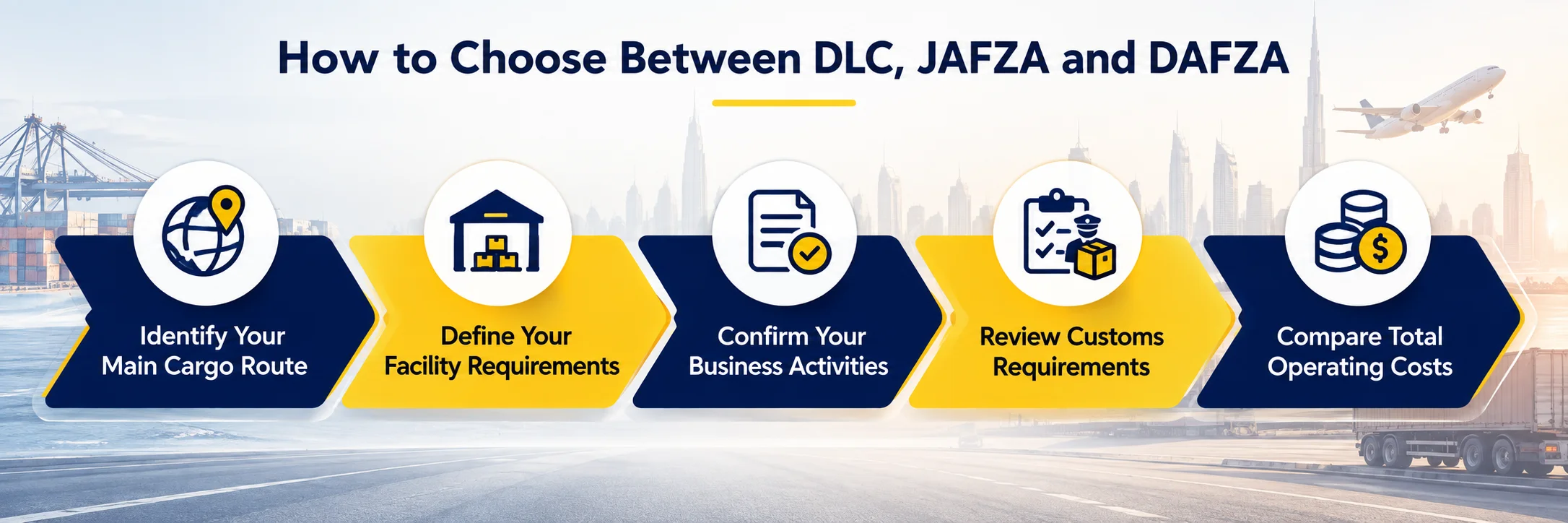
Identify Your Main Cargo Route
Determine whether most goods will arrive or leave by air, sea, road or a combination of transport modes.
Define Your Facility Requirements
Establish whether the business needs an office, standard warehouse, cold storage, fulfilment centre, industrial facility or land for a purpose-built operation.
Confirm Your Business Activities
Freight forwarding, logistics services, trading, warehousing and industrial operations can involve different licensing and approval requirements. The licence should accurately reflect the activities the company will actually perform.
Review Customs and Regulatory Requirements
Identify customs registrations, product-specific approvals and other regulatory requirements before beginning operations.
Compare the Total Operating Model
Calculate the cost of the licence together with warehouse rent, utilities, fit-out, visas, transportation, customs handling, insurance, staffing, compliance and renewal expenses.
This approach produces a more meaningful comparison than simply selecting whichever zone advertises the lowest initial formation cost.
DLC vs JAFZA vs DAFZA – Which Is Best for Your Business?
Choose DLC when the company requires multimodal connectivity, modern logistics infrastructure, e-commerce or fulfilment capabilities and access to the expanding logistics ecosystem surrounding Al Maktoum International Airport.
Choose JAFZA when sea freight, Jebel Ali Port, containerised cargo, substantial warehousing or regional distribution forms the core of the operation.
Choose DAFZA when the business depends heavily on Dubai International Airport, air freight, urgent cargo, high-value goods or time-sensitive distribution.
For companies with more complex supply chains, the decision may not be this straightforward. Cargo volumes, customer locations, warehouse specifications, customs movements and future expansion should all be evaluated before selecting the jurisdiction.
Why Dubai Remains a Strategic Logistics Base
Dubai’s advantage extends beyond any individual free zone. Businesses can access major aviation infrastructure, Jebel Ali Port, extensive road connections, specialist warehousing and an established ecosystem of freight forwarders, distributors, customs specialists and international trading companies.
DLC, JAFZA and DAFZA each provide access to different parts of this ecosystem. Rather than asking which free zone has the strongest name, investors should determine which location removes the most friction from their specific supply chain.
For logistics businesses, even relatively small differences in cargo routes, warehousing and transportation requirements can become significant as transaction volumes increase.
Conclusion
DLC, JAFZA and DAFZA are all strong options for establishing a logistics company in Dubai, but their advantages serve different operating models. DLC is particularly suitable for multimodal logistics, e-commerce, fulfilment and businesses planning around Al Maktoum International Airport. JAFZA stands out for port-oriented logistics, large-scale warehousing and regional distribution, while DAFZA is particularly attractive for air freight and time-sensitive cargo operations.
Choosing between them requires a detailed assessment of business activities, cargo routes, facilities, customs requirements, compliance obligations and long-term expansion plans. For professional assistance comparing these jurisdictions and selecting the structure that fits your logistics operation, Contact Us to discuss your Dubai company setup.