Trade free zones are designated economic areas created to encourage international trade, investment, manufacturing, logistics, and business activity. These zones typically provide businesses with simplified registration procedures, customs advantages, modern infrastructure, and ownership structures designed to attract international entrepreneurs.
Dubai and the wider UAE have developed a strong network of free zones serving industries ranging from commodities and logistics to technology, media, e-commerce, and professional services. For entrepreneurs planning to establish a business in the UAE, understanding how trade free zones work can help determine whether a free zone or mainland company is the better structure.
If you are considering starting a business in Dubai, Open A Dubai Company can help you understand the available business structures and select an option suited to your commercial objectives.
What Is a Trade Free Zone?
A trade free zone is a designated geographical area where businesses can operate under specific regulations and incentives established by the relevant free zone authority. These areas are particularly attractive to companies involved in importing, exporting, distribution, re-exporting, logistics, and international trade.
Free zones may offer different licences, office solutions, warehouses, customs facilities, and company structures depending on the authority and business activity.
In Dubai, examples include DMCC, JAFZA, Dubai Airport Free Zone, IFZA, Meydan Free Zone, and Dubai World Trade Centre Free Zone. Each has its own permitted activities and setup requirements.
Why Were Trade Free Zones Created?
Trade free zones are designed to make international business easier and more competitive. Governments establish these zones to attract foreign investment, create employment, develop specific industries, and strengthen international trade networks.
For businesses, the advantages can include
- Simplified company formation
- 100% foreign ownership in many free zones
- Access to international markets
- Customs and logistics advantages
- Flexible office solutions
- Industry-specific business ecosystems
- Modern infrastructure
- Repatriation of capital and profits, subject to applicable rules
The exact benefits depend on the selected free zone, licence type, business activity, and applicable UAE regulations.
How Do Trade Free Zones Work?
When a company establishes itself in a free zone, it is generally registered with the relevant free zone authority rather than the mainland licensing authority.
The business selects an approved activity and legal structure, applies for the appropriate licence, provides the required documentation, and obtains its incorporation and licensing approvals.
Depending on the free zone and business model, entrepreneurs may choose structures such as
Free Zone Establishment (FZE)
An FZE is generally suitable for a company with a single shareholder, subject to the rules of the relevant free zone.
Free Zone Company (FZC/FZCO)
This structure can accommodate multiple shareholders, depending on the authority’s regulations.
Branch of a Foreign Company
An overseas company can establish a branch to extend its existing business activities into the free zone.
Branch of a Local Company
Some free zones also permit UAE companies to establish branches within the zone.
Key Benefits of Trade Free Zones
1. 100% Foreign Ownership
One of the major attractions of UAE free zones is the ability for foreign investors to own their companies fully, subject to the rules of the relevant jurisdiction.
This allows international entrepreneurs to maintain greater control over their business without requiring a UAE national shareholder in the free zone entity.
2. Strategic Location
The UAE is positioned between major markets in Asia, Europe, Africa, and the Middle East. Dubai’s airports, seaports, highways, and logistics infrastructure make it particularly attractive for companies involved in international commerce.
Free zones such as JAFZA are closely connected to major logistics infrastructure, while DAFZA provides proximity to Dubai International Airport.
3. Import and Export Advantages
Trade-focused businesses can benefit from customs procedures and infrastructure designed to facilitate international movement of goods.
This can be especially useful for companies involved in
- Importing
- Exporting
- Re-exporting
- Wholesale distribution
- Warehousing
- Logistics
- International trading
4. Flexible Office Solutions
Many free zones offer different workspace options, including flexi-desks, shared offices, serviced offices, and dedicated premises.
This flexibility can make free zones attractive to startups and smaller businesses that do not initially require a large physical office.
5. Industry-Specific Ecosystems
Many UAE free zones are designed around particular sectors.
For example, DMCC is well known for commodities and trading businesses, while JAFZA has a strong logistics, manufacturing, and industrial focus. Other zones specialise in media, technology, education, healthcare, or digital businesses.
Popular Trade and Business Free Zones in Dubai
Dubai has several free zones that can accommodate trading and international business activities.
DMCC
DMCC is one of Dubai’s best-known free zones and supports companies operating across commodities, trading, professional services, technology, and other sectors. It offers various company structures and licence categories.
JAFZA
Jebel Ali Free Zone is particularly suited to logistics, manufacturing, shipping, distribution, and international trade because of its connection to Jebel Ali Port and surrounding transport infrastructure.
Dubai Airport Free Zone (DAFZA)
DAFZA is strategically located near Dubai International Airport and is suitable for businesses involved in aviation, logistics, technology, trading, and international commerce.
IFZA
IFZA is popular among startups, SMEs, consultants, service providers, and international entrepreneurs looking for flexible and cost-conscious company formation options.
Meydan Free Zone
Meydan supports activities including trading, e-commerce, consultancy, digital marketing, content creation, and other professional services.
What Businesses Can Operate in Trade Free Zones?
The permitted activities depend on the selected free zone and licence.
Common activities include
- General trading
- Import and export
- Wholesale trading
- Distribution
- E-commerce
- Logistics
- Warehousing
- Manufacturing
- Consultancy
- Technology services
- Professional services
- Media and creative services
Some activities may require additional approvals from government or regulatory authorities.
For businesses that need help selecting a suitable jurisdiction, our Dubai company formation services cover company registration, licensing, office solutions, government approvals, accounting, VAT, and related business setup requirements.
Trade Free Zone vs Mainland Company
One of the most important decisions for an entrepreneur is choosing between a free zone and mainland company.
A free zone can be particularly attractive when the business is focused on international clients, exports, re-exports, digital services, or activities supported by a specific free zone ecosystem.
A mainland company can be more suitable when the business needs direct access to the UAE domestic market, government contracts, or greater flexibility to operate throughout the UAE.
Mainland companies can also have 100% foreign ownership in most activities under the UAE’s current ownership framework, so ownership alone should not be the only reason for choosing a free zone.
Are Trade Free Zones Tax-Free?
This is an important point for anyone considering a UAE free zone.
Free zone companies are not automatically exempt from UAE Corporate Tax. The UAE Corporate Tax regime introduced a 9% standard rate on taxable income above the applicable threshold, while qualifying free zone businesses may benefit from a 0% rate on qualifying income if they meet the requirements for Qualifying Free Zone Person status.
Therefore, entrepreneurs should assess their expected income, activities, customers, substance requirements, and compliance obligations before assuming that a free zone company will receive a 0% tax rate.
Professional tax advice should be obtained where necessary.
Trade Free Zones and International Businesses
Trade free zones can be particularly useful for international businesses that want to use Dubai as a regional base.
For example, a company may establish its headquarters in a Dubai free zone, import products through UAE logistics infrastructure, store goods in a warehouse, and re-export them to customers in other countries.
This model can help businesses take advantage of Dubai’s geographical position and extensive logistics network.
However, companies intending to sell directly to customers in the UAE mainland should carefully assess the applicable distribution, licensing, customs, and regulatory requirements.
How to Choose the Right Trade Free Zone
There is no single free zone that is best for every business. Your choice should be based on several factors.
Business Activity
First, confirm that the free zone permits your exact business activity. Some zones specialise in specific industries.
Target Market
Consider whether your customers are primarily in the UAE, internationally, or both.
Licensing Requirements
Compare commercial, professional, industrial, e-commerce, and other available licences based on your activities.
Office Requirements
Determine whether you need a flexi-desk, serviced office, dedicated office, warehouse, or industrial facility.
Visa Requirements
If you plan to sponsor employees or dependants, check the visa allocation associated with your selected office package and free zone.
Total Cost
Do not compare only the initial licence fee. Consider registration, licence renewal, office space, visas, immigration cards, accounting, tax compliance, and other recurring costs.
What Is the Process for Setting Up a Trade Free Zone Company?
Although the exact procedure differs between authorities, the process generally involves
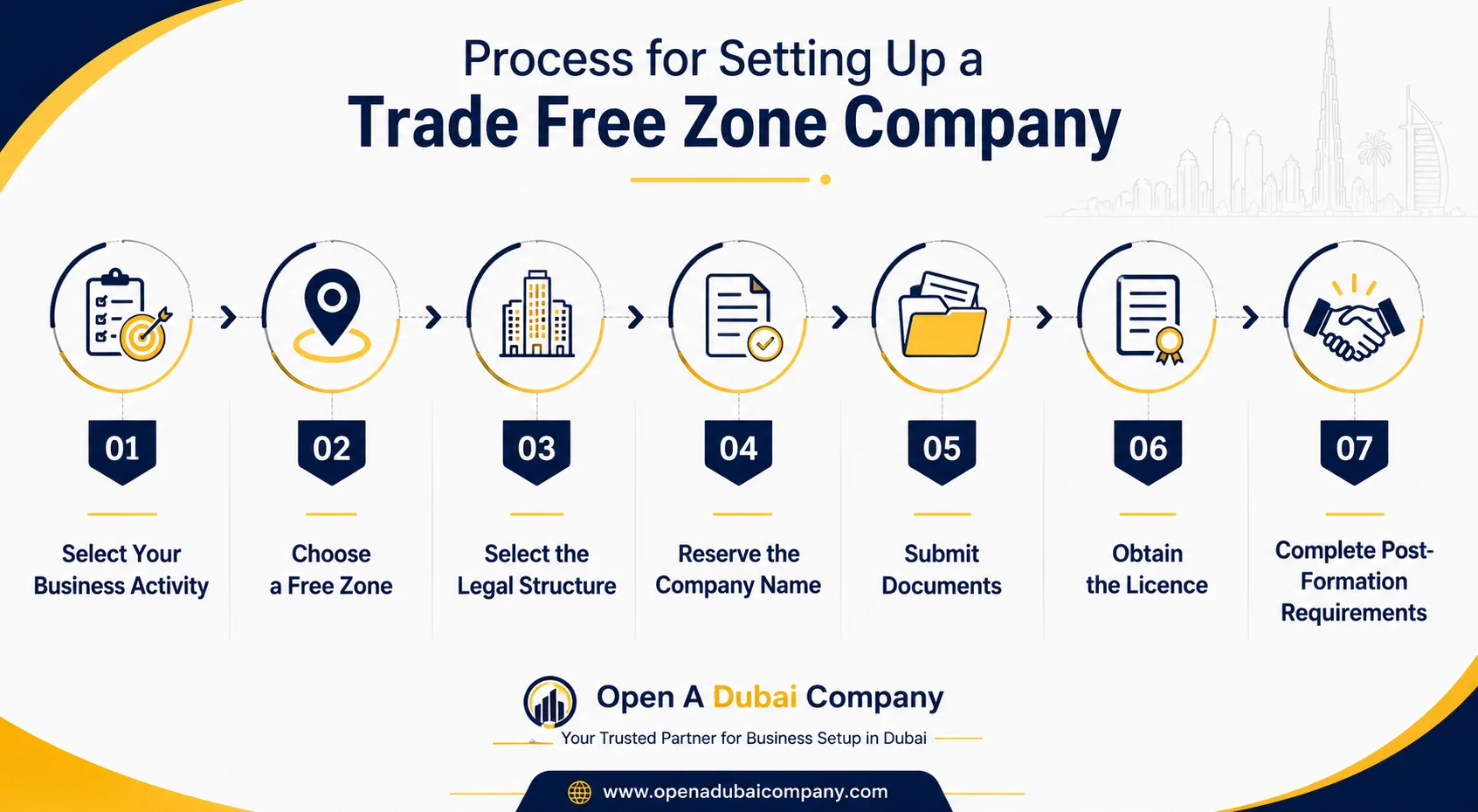
Step 1 – Select Your Business Activity
Determine the activities your company will conduct and confirm that they are permitted by the selected free zone.
Step 2 – Choose a Free Zone
Compare free zones based on location, licensing, infrastructure, costs, facilities, and business requirements.
Step 3 – Select the Legal Structure
Choose an appropriate entity, such as an FZE, FZC/FZCO, or branch, depending on your circumstances.
Step 4 – Reserve the Company Name
Submit the proposed business name for approval in accordance with the relevant authority’s naming requirements.
Step 5 – Submit Documents
Provide the required shareholder, director, passport, corporate, and other supporting documents.
Step 6 – Obtain the Licence
Once the application is approved and required fees are paid, the free zone authority issues the relevant business licence.
Step 7 – Complete Post-Formation Requirements
Depending on your business, you may need to arrange visas, office facilities, corporate banking, accounting, tax registration, and other compliance requirements.
Common Mistakes to Avoid
Entrepreneurs should avoid choosing a free zone based solely on the cheapest package.
Other common mistakes include
- Selecting a zone without checking whether the required activity is permitted
- Assuming every free zone provides the same benefits
- Assuming free zone companies are automatically tax-free
- Ignoring annual renewal and compliance costs
- Choosing insufficient office space for planned visa requirements
- Failing to consider UAE mainland market access
- Selecting a licence that does not accurately cover the intended business activities
A proper assessment before incorporation can prevent unnecessary restructuring and additional costs later.
Is a Trade Free Zone Right for Your Business?
A trade free zone may be suitable if you are involved in international trade, import/export, logistics, e-commerce, professional services, technology, manufacturing, or another activity supported by a free zone.
However, the best structure depends on your business activity, customers, operational requirements, budget, and long-term expansion plans.
For a broader comparison of Dubai’s business structures, read our relevant guide on Mainland vs Free Zone vs Offshore Company in Dubai.
Conclusion
Trade free zones have played an important role in making Dubai a global hub for international business and commerce. They provide entrepreneurs with access to specialised business environments, modern infrastructure, international connectivity, and flexible company formation options.
For trading and export-oriented companies, a free zone can provide an efficient base for managing international operations. However, choosing the right jurisdiction requires more than comparing licence prices.
Business activity, target customers, tax position, office requirements, visa needs, compliance obligations, and future expansion should all be considered before making a decision.
With the right structure and professional guidance, a Dubai trade free zone can provide a strong foundation for building and expanding an international business.