Dubai has long used major investment projects to strengthen its position as a global destination for business, tourism, entertainment, and international investment. One important example came in 2014, when Dubai Parks and Resorts announced an initial public offering as part of the financing strategy behind one of the emirate’s largest leisure developments.
The IPO aimed to raise AED 2.53 billion (US$689 million) by offering 2.53 billion shares at AED 1 each. The offering represented 40% of Dubai Parks and Resorts and demonstrated how Dubai was using both public investment and capital markets to support its expanding tourism economy.
What Was the Dubai Parks and Resorts IPO?
Dubai Parks and Resorts, then part of government-owned Meraas, launched its IPO in November 2014. The offer ran from 17 to 30 November and involved the sale of 2.53 billion shares at AED 1 per share, raising approximately AED 2.53 billion or US$689 million. For entrepreneurs, this wider economic development is another reason why setting up a business in Dubai continues to provide access to a highly diversified commercial environment.
Key details included:
- IPO size – AED 2.53 billion
- Shares offered – 2.53 billion
- Offer price – AED 1 per share
- Equity offered – 40%
- Offer period – 17-30 November 2014
- Purpose – Help finance Dubai Parks and Resorts
- Market – Dubai Financial Market
The offering was part of a broader financing package for a major leisure and entertainment development designed to strengthen Dubai’s appeal to international visitors.
Why Was the IPO Important for Dubai?
The IPO represented more than a fundraising exercise. It arrived as UAE equity markets were recovering from the effects of the global financial crisis and investor interest in Dubai-listed companies was returning. The original plan followed other significant offerings, including Emaar Malls Group’s IPO.
For Dubai, raising capital for tourism infrastructure supported a broader strategy – diversify the economy, attract international visitors, create new entertainment experiences, and stimulate supporting industries. Businesses seeking to participate in this expanding economy.
Also read – company formation options in Dubai
to compare suitable structures for operating in the emirate.
The Vision Behind Dubai Parks and Resorts
The project was conceived as a large integrated entertainment destination covering approximately 16 million square feet. Plans included three major theme parks alongside hotel, retail, dining, and entertainment facilities.
The original development included:
- Motiongate Dubai – Film-inspired attractions
- LEGOLAND Dubai – Family-focused entertainment
- Bollywood Parks Dubai – Bollywood-themed experiences
- Hospitality facilities – Accommodation for visitors
- Retail and dining – Supporting the wider destination
- Entertainment areas – Connecting the individual attractions
The project reflected Dubai’s strategy of expanding beyond traditional shopping and luxury tourism by developing family entertainment and destination experiences. Contemporary reporting said the development was expected to play a role in Dubai’s then-target of reaching 20 million annual visitors by 2020.
How Was the Development Financed?
The estimated development cost was approximately AED 10.5 billion. Rather than depending on one source of funding, the project combined equity, debt, land, and existing expenditure.
| Funding Element | Approximate Amount |
|---|---|
| Debt financing | AED 4.2 billion |
| IPO | AED 2.53 billion |
| Cash from Meraas | AED 2 billion |
| Land and previous expenses | AED 1.78 billion |
| Estimated total project cost | AED 10.5 billion |
Goldman Sachs arranged approximately AED 4.2 billion in debt, while the remaining funding included IPO proceeds and contributions from Meraas. This diversified approach illustrated how large Dubai projects could combine government-backed development with private and institutional capital.
Who Could Participate in the IPO?
The offering was divided between different categories of investors rather than being allocated exclusively to large institutions.
The planned allocation included:
- 10% for retail investors
- 25% for qualifying individual investors
- 60% for institutional investors
- 5% for the Emirates Investment Authority
Demand proved strong. Reports following the offering said the institutional portion was oversubscribed multiple times, providing an indication of investor confidence in Dubai’s tourism and development strategy at the time.
Tourism Development Creates Wider Business Opportunities
Large tourism developments have an impact far beyond hotels and attractions. Increasing visitor numbers can generate demand throughout the wider economy.
Potential beneficiaries include
- Hospitality and accommodation
- Restaurants and catering
- Travel and tourism services
- Retail and e-commerce
- Transportation
- Events and entertainment
- Marketing and media
- Cleaning and maintenance
- Technology
- Professional services
This multiplier effect is one reason tourism investment can support entrepreneurship. Companies considering this sector can also read Starting a Hospitality Business in Dubai for more information about opportunities within Dubai’s hospitality market.
Dubai’s Economic Diversification Strategy
Dubai’s development model has never depended on a single sector. Tourism operates alongside finance, logistics, property, technology, international trade, professional services, and the digital economy.
Major leisure projects contribute to this diversification by attracting visitors while creating demand for supporting companies. They can also encourage international brands and service providers to establish a presence in Dubai rather than serving the UAE remotely.
Entrepreneurs evaluating these opportunities can consider Dubai mainland company formation when their activities require access to the wider UAE market, while specialised businesses may find a free zone more appropriate.
Role of Dubai’s Free Zones
Dubai’s free zones have played an important role in attracting international businesses by providing specialised environments for sectors ranging from commodities and logistics to technology and media.
Depending on the activity, entrepreneurs can
Also read – Dubai free zone company formation
- Permitted business activities
- Target customers
- Office requirements
- Licence costs
- Location
- Visa requirements
- Regulatory approvals
- Expansion plans
Businesses connected to tourism may also operate in supporting fields such as marketing, digital technology, consultancy, logistics, events, or e-commerce, making the correct licence and jurisdiction particularly important.
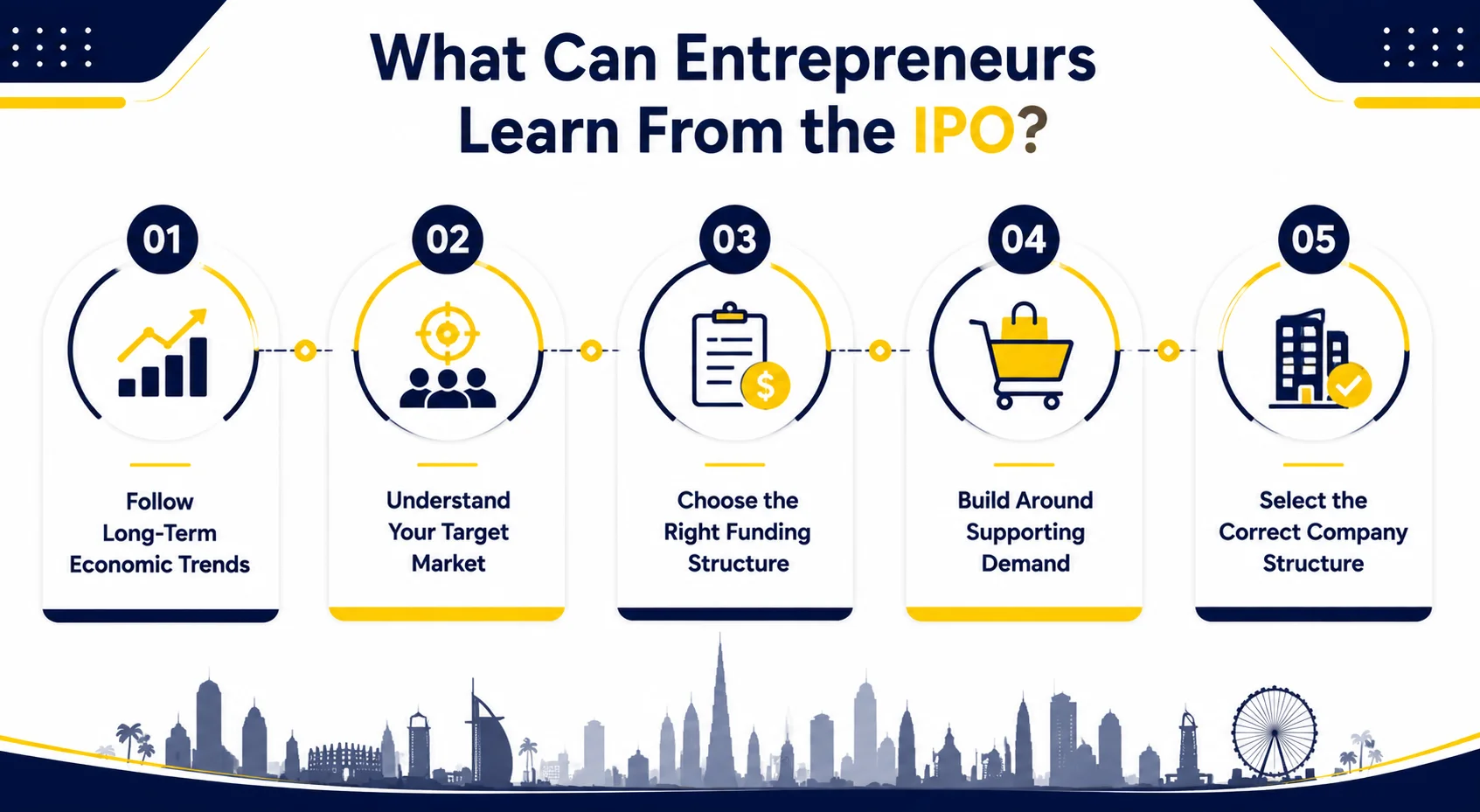
What Can Entrepreneurs Learn From the IPO?
Although the Dubai Parks and Resorts IPO involved a major development, it illustrates several principles relevant to businesses of almost any size.
1. Follow Long-Term Economic Trends
The project targeted tourism growth rather than a short-term commercial opportunity. Entrepreneurs can similarly look at Dubai’s long-term priorities when deciding where to invest.
2. Understand Your Target Market
Dubai Parks and Resorts focused heavily on family entertainment and international tourism, helping diversify Dubai’s leisure offering.
3. Choose the Right Funding Structure
Large businesses may combine debt and equity, while smaller companies can use founder capital, investors, partnerships, or other appropriate financing options.
4. Build Around Supporting Demand
Entrepreneurs do not have to develop theme parks to benefit from tourism growth. Supporting services can create significant opportunities.
5. Select the Correct Company Structure
A company’s licence and jurisdiction should match its intended operations. Choosing correctly at the beginning can reduce unnecessary restructuring later.
What the IPO Demonstrated About Investor Confidence
The IPO came during a period of renewed activity in UAE capital markets. Strong demand suggested that investors were willing to back projects connected to Dubai’s wider economic and tourism strategy.
The Dubai Parks offering also followed the US$1.6 billion Emaar Malls IPO, providing another indication of returning investor appetite in the UAE equity market at the time. The success of these offerings helped demonstrate that Dubai could use its capital markets to support large-scale development.
Why This Matters to Businesses Today
The original IPO belongs to 2014, but its broader lesson remains relevant – Dubai continually invests in infrastructure and industries designed to attract people, capital, companies, and international visitors.
For entrepreneurs, the opportunity is often found in the businesses surrounding these developments. Tourism growth can support hospitality, technology, retail, professional services, transportation, food, media, events, and many other commercial activities.
Also read Thriving Businesses in Dubai
Conclusion
The Dubai Parks and Resorts IPO was an important example of Dubai combining capital-market activity with ambitious tourism development. The AED 2.53 billion offering helped finance a major entertainment destination while demonstrating investor appetite for projects linked to the emirate’s long-term growth strategy.
Dubai’s continued focus on tourism, infrastructure, innovation, and economic diversification creates opportunities not only for major corporations but also for entrepreneurs and SMEs that support these expanding sectors. Contact our Dubai company formation experts to discuss your business idea and identify a suitable company formation route.