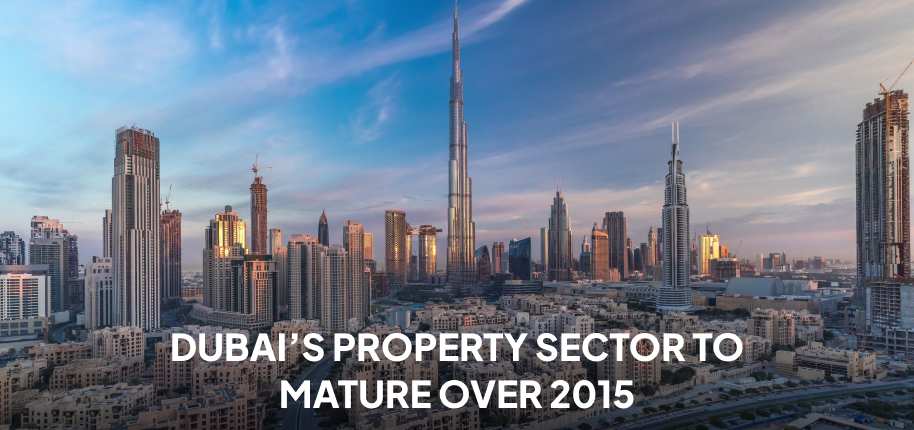
Dubai’s property market is entering a more mature and balanced phase in 2026 after several years of exceptional growth in transactions, prices, development activity, and international investment. Strong population growth, continued investor interest, new residential projects, expanding infrastructure, and Dubai’s appeal to global buyers continue to support the sector, while increasing housing supply and more selective purchasing behaviour are beginning to moderate parts of the residential market. Rather than signalling an end to growth, this shift reflects a market becoming more established, competitive, and driven by long-term fundamentals with property type, location, quality, rental demand, and future supply playing an increasingly important role in investment decisions.
From Rapid Growth to a More Mature Property Market
Dubai entered 2026 from a position of considerable strength. During 2025, the emirate recorded more than 270,000 real estate transactions worth over AED 917 billion, representing a 20% annual increase in transaction value. Dubai’s Public Debt Management Office described this performance as a progression from rapid growth towards sustainable market leadership.
Momentum continued into the beginning of 2026. Dubai Land Department reported 60,303 real estate transactions worth AED 252 billion during Q1, with transaction value rising 31% and transaction volume increasing 6% compared with the same quarter of 2025.
For international entrepreneurs attracted by Dubai’s expanding economy, setting up a business in Dubai can also provide access to opportunities surrounding the property and construction sectors.
What Does Market Maturity Mean?
A mature property market does not necessarily mean that prices continually increase or that every development performs equally well. Instead, maturity can involve stronger regulation, more diverse buyers, greater housing supply, improved transparency, sophisticated financing, and greater differentiation between individual property segments.
For Dubai, this transition is becoming visible through several developments
- More residential supply
- Increasing buyer selectivity
- Greater focus on completed communities
- Stronger regulatory frameworks
- Broader homeownership initiatives
- Increased market transparency
- More sophisticated institutional investment
- Greater differentiation between apartments and villas
This evolution can make market fundamentals increasingly important when buyers and businesses make investment decisions.
Residential Activity Is Beginning to Moderate
One of the clearest signs of maturity appeared during Q2 2026. CBRE reported that Dubai’s residential market moderated as demand softened, transaction activity declined, and new supply helped ease pressure on prices.
July data also points towards a more nuanced market. A residential price index calculated from Dubai Land Department registered sales showed overall residential prices down 2.6% year on year in July 2026. However, villas remained 1.7% higher year on year while apartments were 3.3% lower.
This difference demonstrates why investors increasingly need to assess property type, location, supply, developer quality, and individual community fundamentals rather than relying solely on citywide averages.
Off-Plan Property Remains Important
Off-plan development remains a major part of Dubai’s residential market. In July 2026, off-plan properties accounted for 6,856 of the 9,352 residential sales included in one DLD-derived price index.
Off-plan property can attract buyers through
- New community developments
- Modern amenities
- Payment plans
- New-build specifications
- Potential capital appreciation
- Wider project selection
However, increasing supply also means buyers can become more selective. Developer reputation, construction progress, location, payment terms, expected completion dates, and realistic rental demand are increasingly important considerations.
New Property Supply Is Reshaping the Market
Dubai continues to deliver substantial numbers of new projects. During the first half of 2026, 104 real estate projects valued at more than AED 111 billion were completed, compared with 75 projects worth AED 73 billion during H1 2025. That represents growth of more than 38% in completed projects and 52% in their investment value.
More supply can support Dubai’s long-term population growth while also increasing competition between developers and landlords. This is one reason the next stage of Dubai’s property cycle may be characterised more by differences between communities and property types than broad market-wide increases.
Apartments and Villas Are Following Different Trends
Dubai’s residential market should no longer be viewed as a single uniform asset class.
| Segment | July 2026 YoY Price Trend |
|---|---|
| Overall Residential | -2.6% |
| Apartments | -3.3% |
| Villas | +1.7% |
| Ready Property | +1.9% |
| Off-Plan | +0.6% |
Source – Property Index using Dubai Land Department registered sales.
The figures illustrate how market maturity can create greater differentiation. Buyers looking for villas may face different supply-and-demand conditions from those purchasing apartments, while completed properties can behave differently from off-plan developments.
Dubai’s Rental Market Remains Significant
The rental market is another important indicator of underlying housing demand. Dubai Land Department reported 1.38 million registered tenancy contracts worth AED 126.4 billion during 2025. Contract volume increased 6% while total value rose 17% compared with 2024.
More than 513,000 new tenancy contracts were registered during the year, demonstrating continued demand from residents moving into or within Dubai. This is particularly important because a sustainable property market cannot depend entirely on investors – it also needs genuine demand from people who live and work in the city.
More Residents Are Becoming Homeowners
Dubai is also encouraging residents to move from renting towards ownership.
The First-Time Home Buyer Programme, introduced in July 2025, had helped more than 3,200 residents purchase their first Dubai homes by June 2026, generating property transactions exceeding AED 5 billion. The initiative had also expanded to include 22 participating developers.
Increasing owner-occupier participation can contribute to a more established residential market by broadening demand beyond short-term investment and speculative activity.
What Is Supporting Dubai’s Property Sector?
Several structural factors continue to support the market despite the recent moderation in residential activity.
Population and Talent
Dubai continues attracting professionals, entrepreneurs, investors, and families from international markets, supporting long-term demand for housing.
Economic Diversification
Property benefits from growth across tourism, technology, finance, logistics, professional services, hospitality, and international trade.
International Investment
Dubai remains accessible to international property investors across designated freehold areas.
Infrastructure
Metro expansion, roads, airports, commercial districts, schools, healthcare facilities, and community infrastructure can influence property demand as the city expands.
Government Strategy
The Dubai Real Estate Strategy 2033 aims to increase real estate transactions by 70%, raise the value of real estate portfolios and expand homeownership.
Property Growth Creates Opportunities Beyond Real Estate Investment
Dubai’s expanding built environment also supports a broad network of businesses. Entrepreneurs do not necessarily need to become property developers or investors to participate in this ecosystem.
Potential opportunities include –
- Property management
- Facilities management
- Interior design
- Construction services
- Building materials
- PropTech
- Cleaning and maintenance
- Landscaping
- Furniture
- Relocation services
- Architecture and engineering
- Professional consultancy
Entrepreneurs considering these activities can Dubai company formation services to understand the licensing and structural requirements applying to their proposed operations.
Dubai’s continuing need for residential development also connects property growth with population and community expansion.
Also read – Dubai Needs Homes
for more insight into the relationship between population growth, residential supply, and business opportunities.
What Should Property Businesses Consider in 2026?
A maturing market rewards preparation and differentiation. Businesses entering the sector should avoid assuming that rapid property growth automatically guarantees commercial success.
Important considerations include
- Identify a clear market segment – Understand exactly which customers the business will serve.
- Study individual communities – Property trends can differ considerably by location.
- Understand supply – Future completions can influence prices, rents, and competition.
- Choose the correct business activity – Real estate, property management, construction, and professional services can have different licensing requirements.
- Plan for sustainable demand – Build the business around long-term customer requirements rather than short-term market movements.
What Comes Next for Dubai Property?
The evidence in 2026 points towards transition rather than a simple boom-or-bust narrative. Dubai’s overall real estate sector began the year strongly, while residential activity subsequently showed signs of cooling as additional supply entered the market.
This can be a healthy development. More choice gives buyers greater negotiating power, developers face stronger competition, and investors need to focus more closely on property quality, location, rental demand, and long-term fundamentals.
Conclusion
Dubai’s property sector in 2026 is showing many characteristics of a market moving towards greater maturity. Record activity in 2025 and a strong start to 2026 demonstrate continued investor confidence, while rising supply, more selective demand, differentiated price performance, and growing homeownership are creating a more balanced residential environment.
For businesses, this evolution creates opportunities across the wider property ecosystem rather than property investment alone. If you are considering establishing a real estate-related, construction, consultancy, technology, or property-services company, contact our Dubai company formation experts to discuss the appropriate licence and company structure for your plans.