Dubai’s free zones attract thousands of entrepreneurs every year, and it is easy to see why. Lower setup costs, 100% foreign ownership, and the promise of tax exemption make them a compelling starting point. But many business owners only discover the disadvantages of free zone companies in Dubai after they have already committed.
The core limitations are significant: you cannot sell directly into the UAE mainland market without a local distributor, visa quotas are capped by your office size, and since June 2023, the 0% corporate tax rate is no longer automatic, you must qualify for it. On top of that, free zone companies cannot bid on government tenders and are bound by the rules of a single free zone authority.
Free zones work extremely well for internationally focused businesses. But if your customers are in the UAE, if you need to hire a growing local team, or if government contracts are part of your growth plan, a mainland company will serve you better, and now offers 100% foreign ownership too.
This guide covers all three structures in depth, with real-world case studies, a full cost breakdown, and a head-to-head comparison, so you can make the right decision from the start.
What Is a Free Zone Company in Dubai?
A free zone company is registered with one of Dubai’s 30+ dedicated free zone authorities, such as DMCC, JAFZA, IFZA, or Dubai Internet City, rather than with the mainland Department of Economic Development (DED).
Each free zone is designed for specific industries:
- DMCC: commodities, trading, financial services
- Dubai Internet City: technology and IT companies
- Dubai Media City: media, PR, and publishing
- Jebel Ali Free Zone (JAFZA): logistics, manufacturing, and heavy industry
- IFZA (Dubai Silicon Oasis): startups and SMEs across multiple sectors
Free zones operate under their own regulatory authority, with separate rules for licensing, office requirements, visa quotas, and business activities.
What a free zone offer typically includes
- 100% foreign ownership
- 0% tax exemption (subject to qualifying conditions, more on this below)
- No import/export duties within the zone
- Streamlined company registration
- Flexi desk and virtual office options
These benefits make free zones very attractive on paper. However, the disadvantages of free zone companies in Dubai become apparent once you look beyond the headline incentives.
Disadvantages of Free Zone Companies in Dubai

Disadvantage 1: You cannot Trade Directly with the UAE Mainland Market
This is the single biggest limitation of a free zone company. You are legally prohibited from selling goods or services directly to customers on the UAE mainland without using a licensed local distributor or agent.
What this means in practice
If you run a free zone e-commerce business and a Dubai-based customer wants to buy directly from you, you technically need to route that transaction through a mainland distributor, adding cost and complexity.
According to the Dubai Department of Economy and Tourism (DED), any business activity targeting UAE residents must be conducted through a mainland-licensed entity.
Who this affects most: Retail brands, restaurants, service companies, and B2B companies targeting UAE-based clients.
Disadvantage 2: The Tax Exemption Is No Longer Automatic
This is one of the most misunderstood aspects of free zones in 2025.
Since June 2023, the UAE has introduced a 9% Federal Corporate Tax under Federal Decree-Law No. 47 of 2022. Free zone companies are not automatically exempt.
To retain the 0% tax rate, your company must qualify as a Qualifying Free Zone Person (QFZP). The criteria include:
- Maintaining adequate substance in the free zone (real office, real employees)
- Earning income primarily from qualifying activities as defined by the Federal Tax Authority (FTA)
- Ensuring non-qualifying income does not exceed 5% of total revenue or AED 5 million, whichever is lower
- Keeping audited financial records under IFRS standards
If you fail any of these conditions, your company is taxed at 9% on all income, not just the non-qualifying portion.
Who this affects most: Mixed-income businesses, trading companies with mainland clients, and service companies with diverse revenue streams.
Disadvantage 3: Visa Quotas Are Tied to Office Size
The number of employee visas your free zone company can sponsor is directly linked to the office size you choose.
Here is how it typically works:
| Office Type | Typical Office Size | Approximate Visa Allocation |
|---|---|---|
| Flexi Desk | Shared / Virtual | 2–3 visas |
| Hot Desk | Shared, assigned | 3–5 visas |
| Dedicated Office | 150–200 sq ft | 5–8 visas |
| Larger Office | 300+ sq ft | 10+ visas |
Note: Visa quotas vary by free zone authority. Figures are approximate guides based on standard DMCC, IFZA, and JAFZA policies.
A flexi desk is cost-effective at setup, but it severely limits your ability to grow your team in the UAE. If your business plan requires hiring locally at scale, this constraint can become a serious operational bottleneck.
Disadvantage 4: Restricted Business Activity Scope
Each free zone licence is tied to a specific set of permitted business activities. You cannot simply add a new line of business, you must apply for an amended licence, which takes time and adds to your setup cost.
Additionally, if your business activity requires you to be physically present across the UAE (for example, a construction firm, a retail chain, or a government contractor), a free zone structure simply does not work.
Disadvantage 5: Cannot Bid on Government Tenders
Free zone companies are ineligible to bid on UAE government or semi-government contracts. This is a significant limitation for businesses in sectors such as:
- Construction and infrastructure
- IT and software services
- Healthcare and education
- Consulting and advisory
The UAE government spending represents a major portion of economic activity. Mainland registration is required to access these tenders.
Disadvantage 6: Dependency on a Specific Free Zone Authority
Each free zone has its own renewal fees, compliance requirements, and operating rules. These can change. Businesses that registered expecting fixed long-term conditions have sometimes faced:
- Increased renewal costs
- Changes to flexi desk and office size policies
- Modified visa quota allocations
- Updated compliance requirements following the Corporate Tax Law
Unlike mainland companies, which are all governed by the DED and UAE Commercial Companies Law, free zone companies have less regulatory consistency across the board.
Disadvantage 7: Perceived Credibility Gap with UAE Clients
Some UAE-based clients and financial institutions view free zone companies as less established than mainland businesses. This perception can affect:
- Bank account opening: banks sometimes apply stricter due diligence to free zone companies
- Local supplier and client relationships: Some UAE companies prefer or require mainland-registered partners
- Office leasing: Some landlords outside free zones will not lease to free zone entities
Real-World Examples: Who Gets It Wrong, and Right
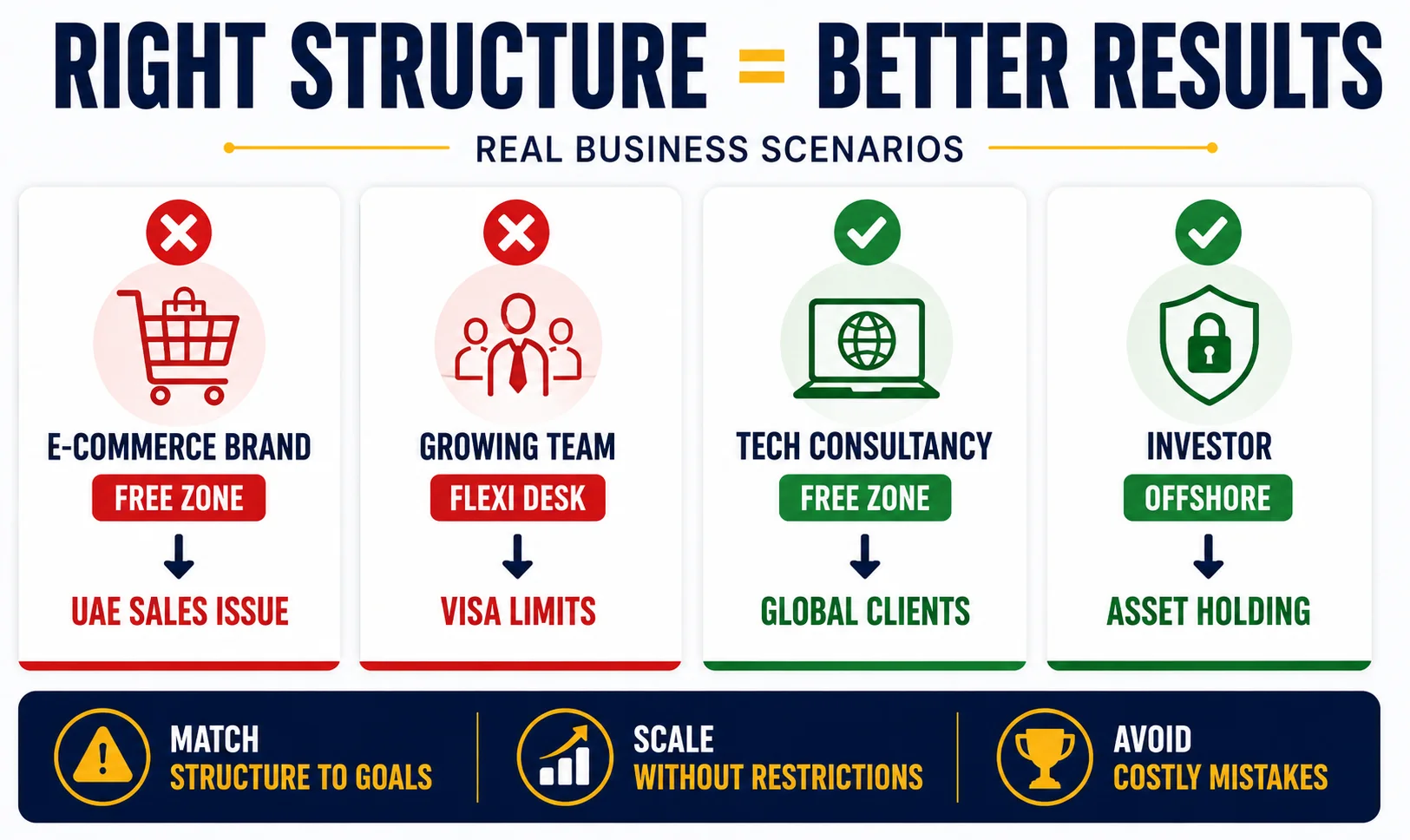
Case Study: The E-Commerce Brand That Outgrew Its Free Zone
A European fashion brand set up in a UAE free zone to tap into the Gulf market. The flexi desk option kept initial costs low and they got 2 investor visas.
Within 18 months, they had customers across Dubai, Abu Dhabi, and Sharjah. But they could not fulfil orders directly, every transaction had to go through a mainland distributor who took a 15% margin. Their team also hit the visa ceiling quickly, making local hiring difficult.
Outcome: They had to set up a parallel mainland company, paying double the setup cost they were trying to avoid in the first place.
Lesson: If your target market is UAE residents, factor mainland costs into your plan from day one.
Case Study: The Tech Consultancy That Got It Right
A UK-based software consultancy set up in DMCC with a dedicated office (200 sq ft) for their 4-person team. Their clients were entirely international, US and European corporates. Their income was 100% qualifying under QFZP conditions.
They benefited from 0% corporate tax, full foreign ownership, and a straightforward annual renewal. No mainland distributor needed because they had no UAE-based clients.
Outcome: After two years, their setup cost had been recovered through tax savings alone.
Lesson: Free zones work exceptionally well for internationally focused businesses with no UAE mainland sales requirements.
Use Case: Offshore for Asset Holding
A Gulf-based investor used an RAK ICC offshore company to hold shares in three separate operating businesses across the GCC. The offshore structure provided:
- Clean ownership separation
- No annual audit requirement
- Privacy of beneficial ownership
- Multi-currency banking
Lesson: Offshore companies are not for operating businesses in the UAE, they are for holding, investment, and international trade structures.
Dubai Mainland Company
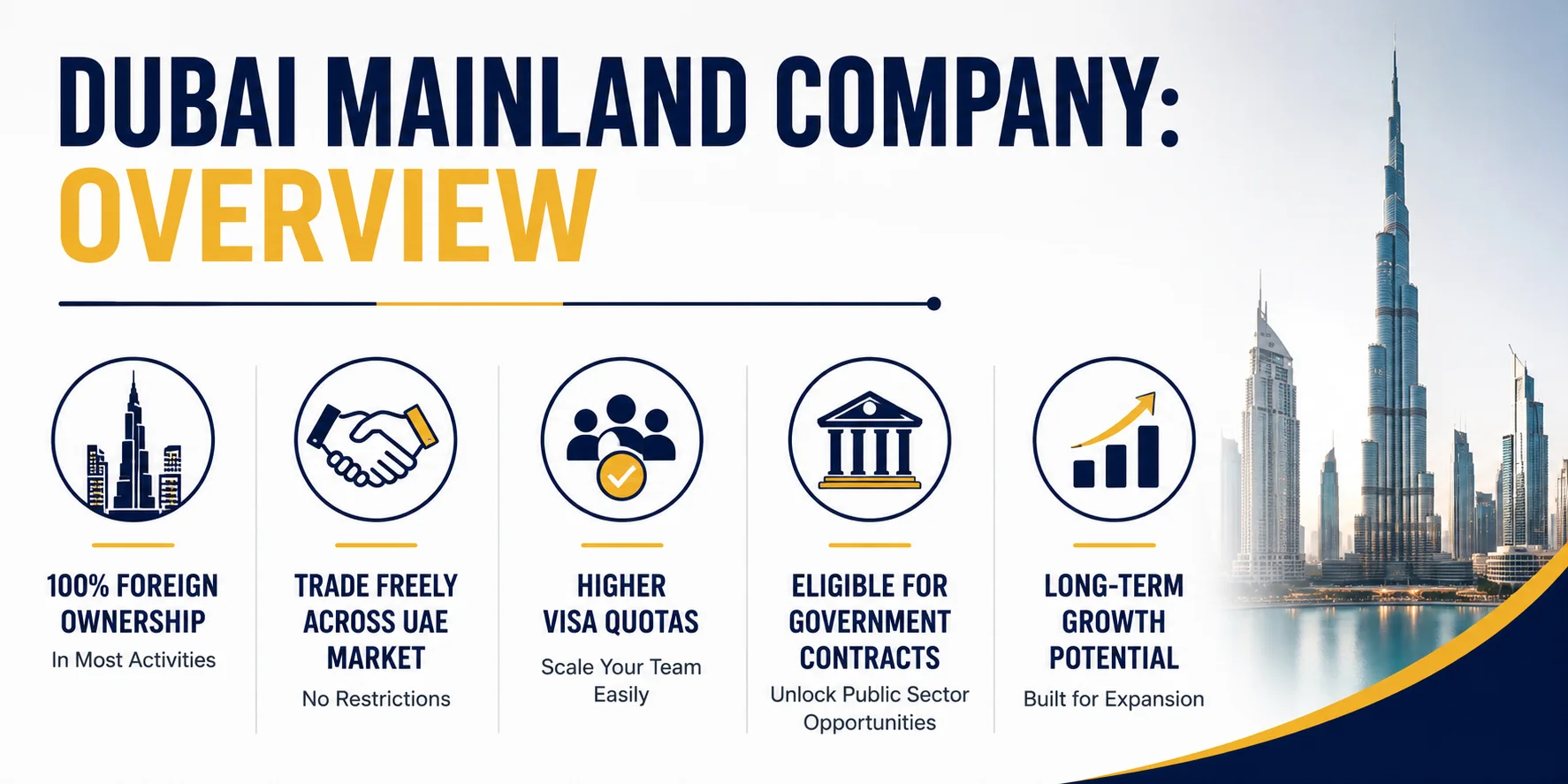
A mainland company is registered with the Department of Economic Development (DED) and can operate anywhere in the UAE and internationally.
Key Features
- Unrestricted access to UAE markets and government tenders
- Ability to open branches across all Emirates
- Mandatory office space (minimum office size requirement applies)
- Greater visibility and credibility with local clients
Ownership, The 2021 Reform
As of 2021, the UAE amended the Commercial Companies Law to allow 100% foreign ownership in most sectors on the mainland, eliminating the need for a UAE national sponsor in the majority of business activities.
This was a landmark change. One of the historically cited advantages of a free zone was 100% foreign ownership. That advantage is now largely neutralised for mainland companies.
Mainland Advantages
- Full access to UAE markets and government tenders
- Open branches in any Emirate without restrictions
- Greater reputation and trust with UAE-based clients
- More flexibility in office location
- Corporate tax applies (9% on income above AED 375,000), same as non-qualifying free zone companies
Mainland Disadvantages
- Higher setup cost than most free zones
- Mandatory office space, no flexi desk option
- More regulatory paperwork and compliance
Offshore Company Dubai
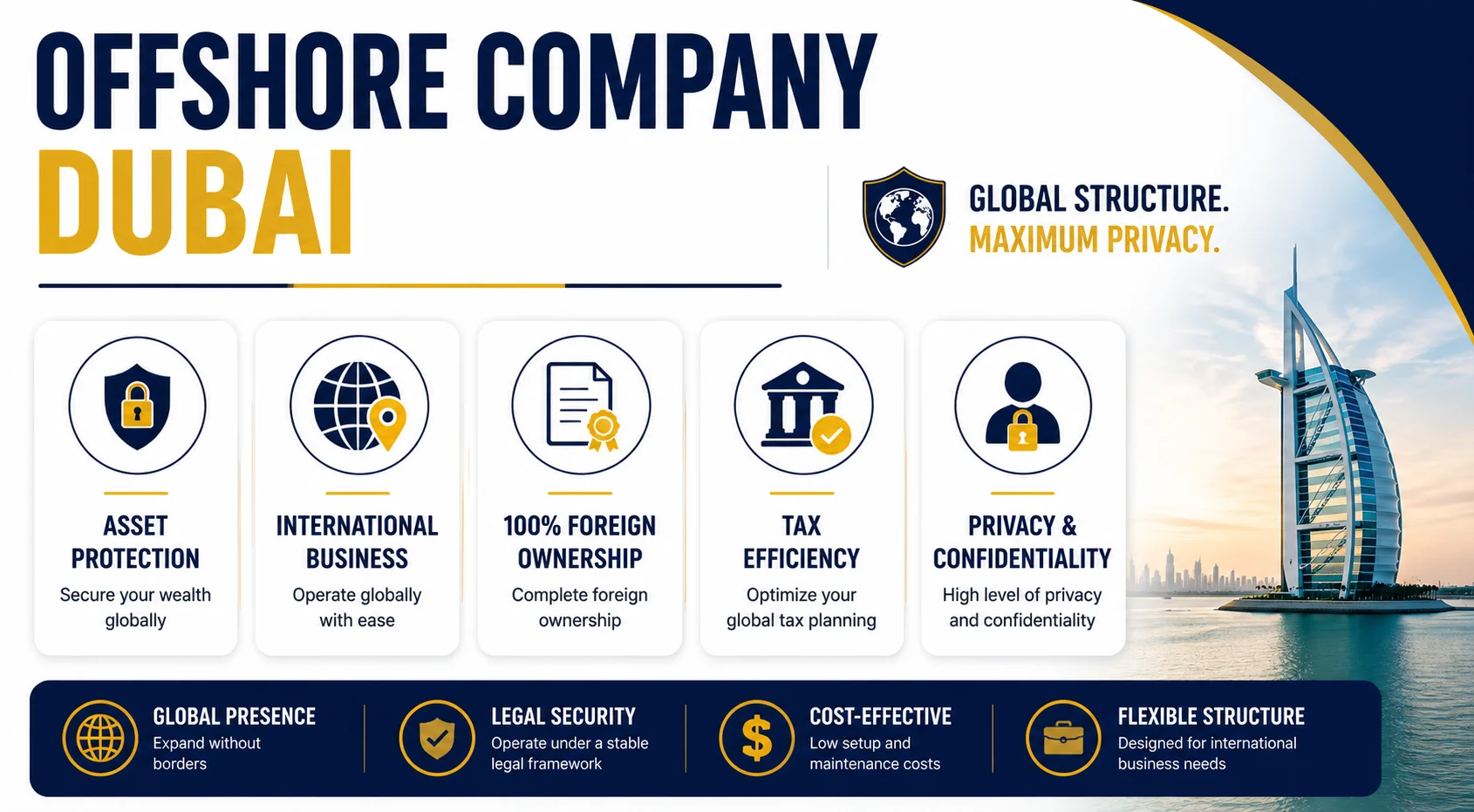
Offshore companies in Dubai are typically registered under JAFZA or RAK ICC. They are legal entities with no physical presence requirement in the UAE.
What Offshore Companies Can and Cannot Do
| Can Do | Cannot Do |
|---|---|
| Hold international assets and shares | Conduct business within the UAE |
| Open multi-currency bank accounts | Hire employees in the UAE |
| Trade internationally | Obtain UAE residency visas |
| Hold UAE property (JAFZA offshore only) | Invoice UAE-based clients directly |
Offshore Advantages
- 0% tax, no corporate or personal income tax
- Full privacy, minimal public disclosure
- No physical office required
- Lowest setup cost of the three structures
- Ideal for international holding, asset protection, and wealth management
Offshore Disadvantages
- Cannot operate within the UAE
- No UAE residency visas
- Bank account opening is increasingly difficult due to global compliance requirements
- Not suitable for businesses with UAE operations or clients
Full Comparison: Mainland vs Free Zone vs Offshore
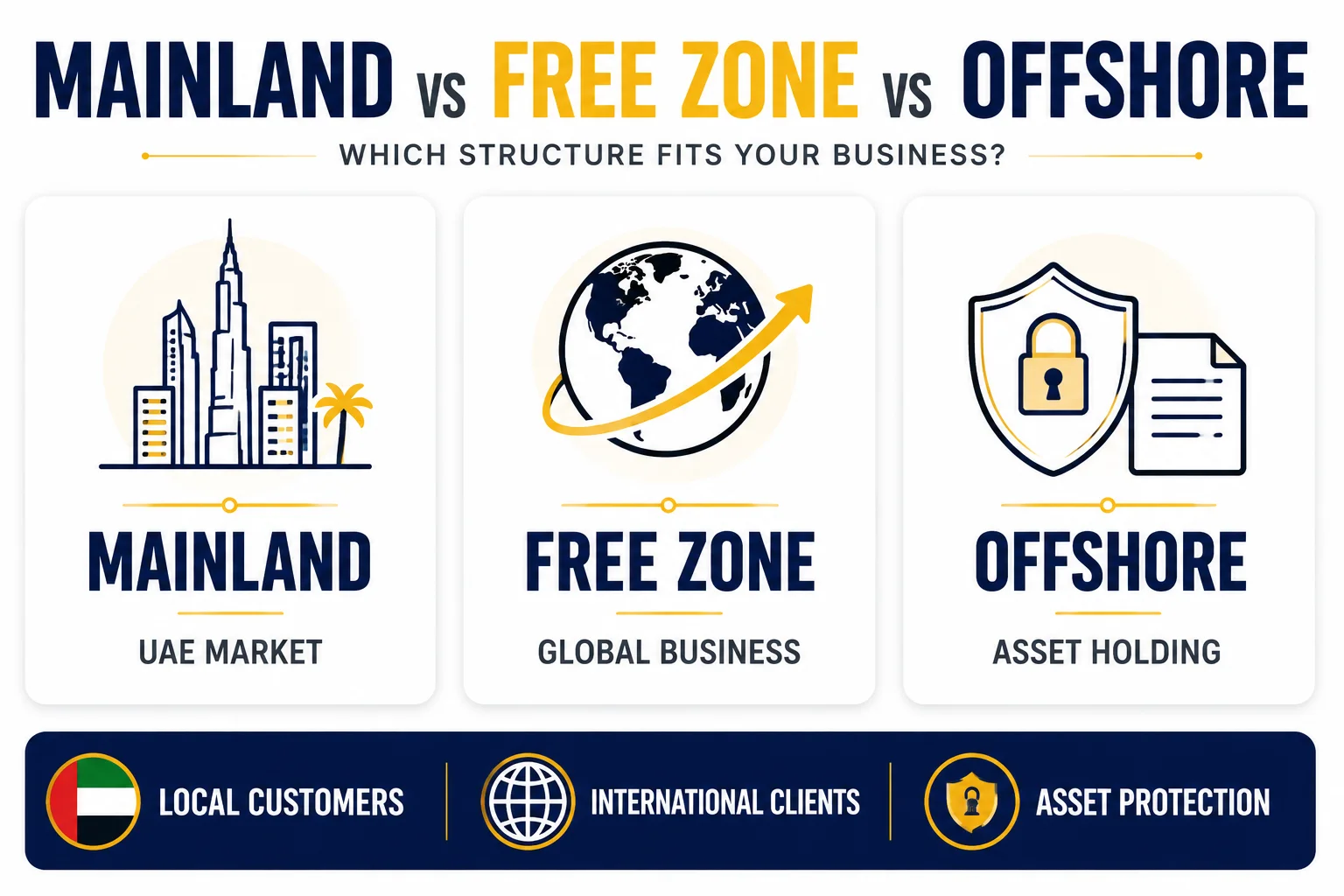
| Feature | Mainland | Free Zone | Offshore |
|---|---|---|---|
| Foreign Ownership | 100% (most sectors) | 100% | 100% |
| Trade in UAE Markets | Yes, direct | Via distributor only | Not permitted |
| Government Tenders | Eligible | Not eligible | Not eligible |
| Office Size Requirement | Mandatory minimum | Flexi desk available | Not required |
| Tax Exemption | 9% on income >AED 375k | 0% if QFZP qualified | 0% |
| Visa Allocation | Based on office size | Based on office size / zone | None available |
| Setup Cost (Est.) | AED 15,000–50,000+ | AED 7,500–30,000+ | AED 5,000–15,000 |
| Bank Account Opening | Straightforward | Generally straightforward | More complex |
| Suitable For | UAE market, government | Export, international | Holding, asset management |
Setup cost estimates are indicative ranges for 2025 and vary by business activity, free zone authority, and office size chosen. Contact us for a precise quote.
How to Choose the Right Structure

Ask yourself these five questions before deciding:
- 1. Who are my primary customers? UAE-based customers → Mainland. International clients only → Free Zone or Offshore.
- 2. Do I need UAE residency visas for my team? Yes, and more than 3 → Mainland or a Free Zone with a dedicated office. Just 1–2 visas needed → Free Zone flexi desk may work.
- 3. Am I planning to bid on government contracts? Yes → Mainland only.
- 4. Is my business activity purely international holding or asset management? Yes → Offshore is the most efficient and cost-effective option.
- 5. What is my setup cost budget? Tight budget, international-only focus → Free Zone. Willing to invest for full UAE market access → Mainland.
Setup Cost Comparison
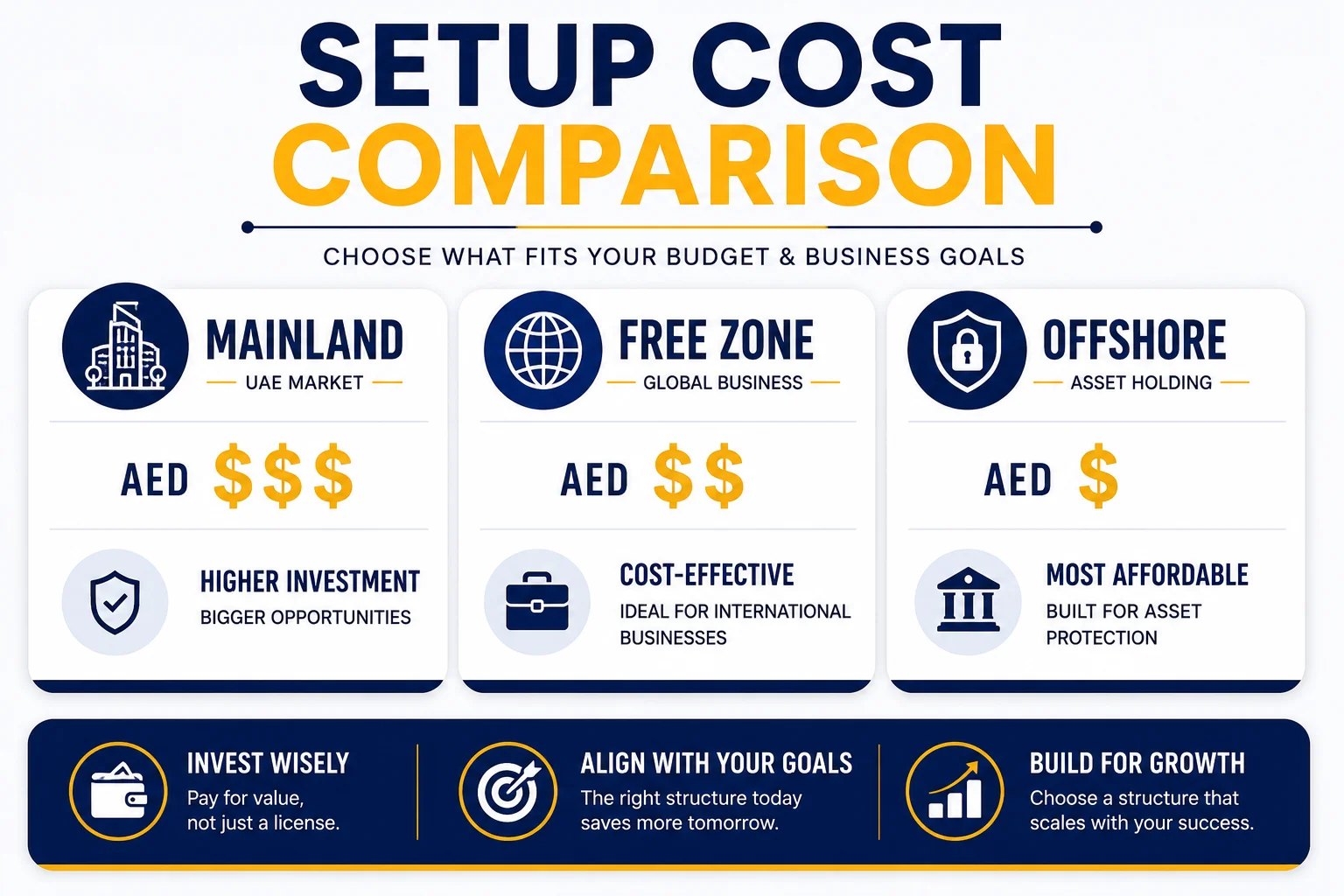
Costs vary significantly based on business activity, office size, visa requirements, and the specific free zone authority. Below is a realistic 2025 guide:
| Cost Component | Mainland | Free Zone (Mid-Range) | Offshore |
|---|---|---|---|
| Trade Licence | AED 10,000–20,000 | AED 5,000–15,000 | AED 3,000–8,000 |
| Office Space (Annual) | AED 15,000–60,000+ | AED 5,000–25,000 (flexi desk to office) | Not required |
| Visa (per person) | AED 3,000–5,000 | AED 2,500–5,000 | N/A |
| Government Fees | AED 2,000–5,000 | AED 1,000–3,000 | AED 500–2,000 |
| Estimated Year 1 Total | AED 30,000–80,000+ | AED 15,000–45,000 | AED 5,000–15,000 |
The mainland’s higher setup cost is often justified by the revenue potential of direct UAE market access and government tender eligibility.
Common Misconceptions About Free Zones in Dubai
Despite being widely discussed, several myths about free zone companies continue to mislead entrepreneurs. Here are the most common ones, and the reality behind each.
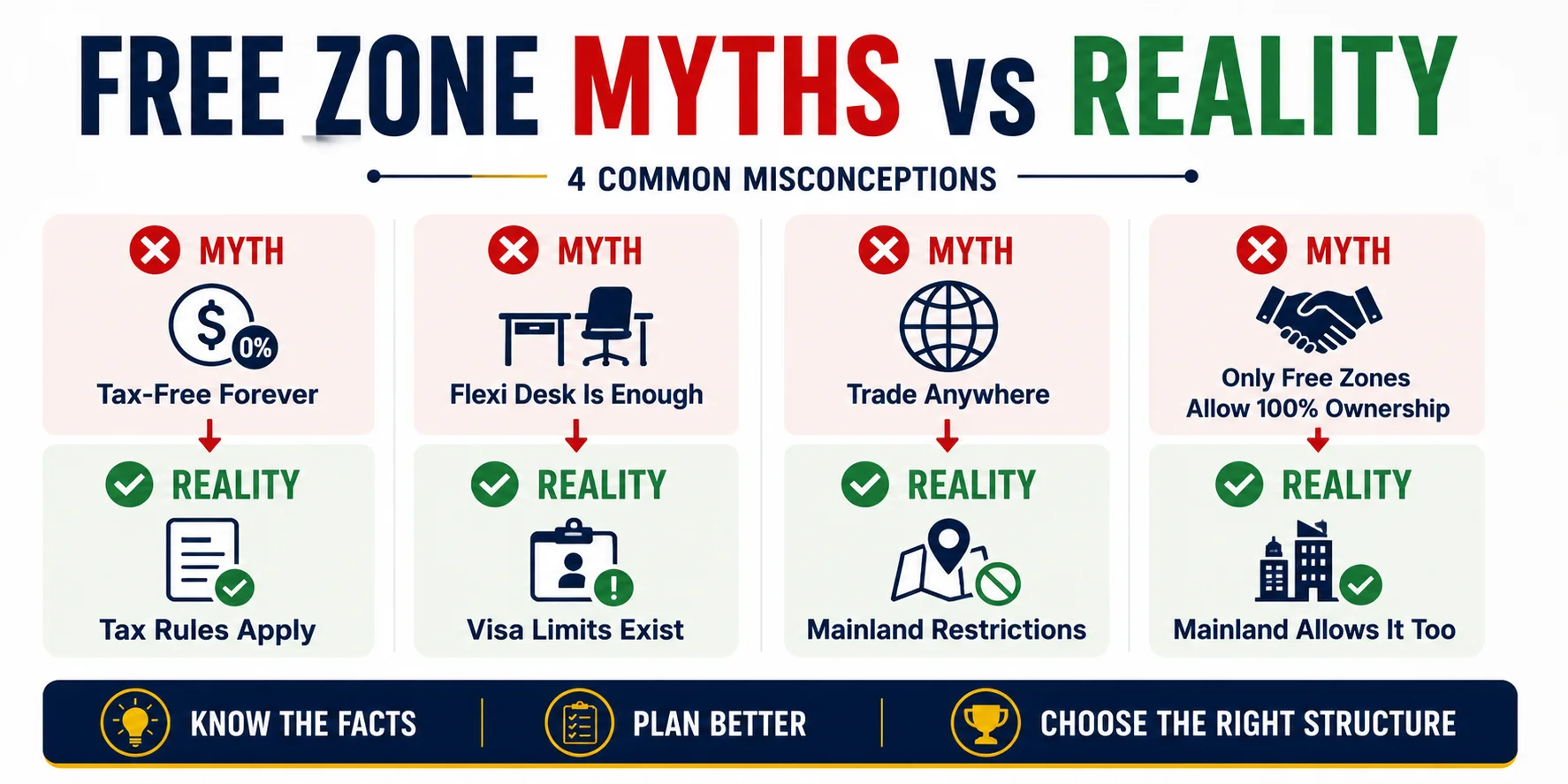
Myth #1: “Free zone means completely tax-free”
Reality: This was broadly true before June 2023. Today, tax exemption in a free zone depends on your company qualifying as a QFZP. If your business has any mainland income, mixed revenue streams, or fails to maintain adequate substance (real staff, real office), you may be liable for the standard 9% corporate tax. Planning your revenue structure before setup is essential.
Myth #2: “A flexi desk is enough to run a real business”
Reality: A flexi desk satisfies the legal address requirement, but it limits your visa quota to 2–3 visas in most free zones. It also signals lower substance to banks, which matters for bank account opening. Some free zone authorities have also tightened their flexi desk policies following the Corporate Tax Law’s emphasis on “adequate substance.” If you are building a team in Dubai, plan for a dedicated office from the start.
Myth #3: “Free zone setup is always cheaper than mainland”
Reality: Initial setup cost for a free zone is often lower, but the total cost picture changes quickly. If you need more than 3 visas, your free zone costs rise with each office upgrade. Add in the cost of a mainland distributor if you want UAE market access, and the “savings” often disappear within the first year.
Myth #4: “I can do business anywhere in the UAE with a free zone licence”
Reality: Your free zone licence authorises you to operate within the geographic boundaries of that free zone and internationally. It does not authorise you to set up a retail outlet in a Dubai mall, open a branch office in Abu Dhabi, or deliver professional services to UAE government clients. Each of those activities requires a mainland or additional licence.
Myth #5: “100% foreign ownership is only available in free zones”
Reality: Since the 2021 Commercial Companies Law amendment, 100% foreign ownership is available on the Dubai mainland for most business activities. The UAE government has removed the mandatory local sponsor requirement across the majority of sectors. This is a significant development that narrows one of the traditional advantages of free zone registration.
Industry-Specific Guidance: Which Structure Fits Your Sector?
Not all business activities are treated equally across the three structures. Here is a sector-by-sector breakdown to help you narrow down your options.
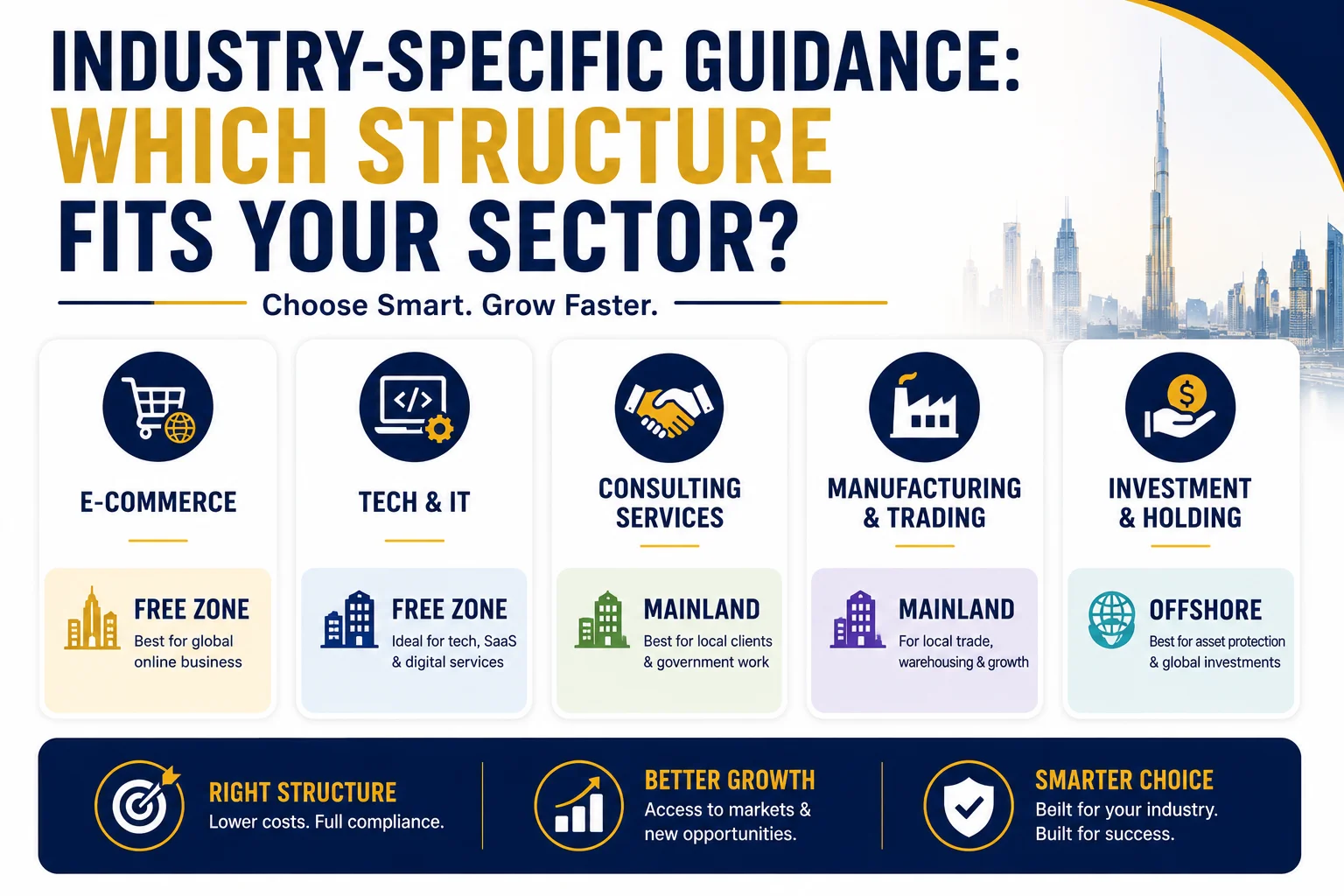
Technology and IT Companies
Best fit: Free Zone (DMCC, Dubai Internet City, IFZA)
Tech companies that service global clients, SaaS platforms, software development agencies, cybersecurity firms, are ideal candidates for a free zone. Their income is primarily from international clients, making QFZP qualification straightforward. Dubai Internet City in particular offers sector-specific networking, events, and regulatory support tailored to the tech industry.
If the tech company also has UAE government or enterprise clients, a mainland entity, or a dual structure, becomes necessary.
Retail and Consumer Brands
Best fit: Mainland
Any brand with physical retail presence in UAE malls, supermarkets, or direct-to-consumer online sales in the UAE needs a mainland licence. The free zone restriction on direct UAE trading is particularly costly for retail businesses, where eliminating distributor margins directly impacts profitability.
Trading and Import/Export
Best fit: Depends on the market
For companies that import goods into the UAE for resale locally, a mainland trading licence is required. For companies that use the UAE as a re-export hub, bringing goods in and sending them to other markets, a free zone (particularly Jebel Ali Free Zone / JAFZA) is well-suited, benefiting from customs exemptions and world-class logistics infrastructure.
According to the Jebel Ali Free Zone Authority (JAFZA), over 9,000 companies use JAFZA for trade and logistics, making it the largest free zone in the world by area and one of the most strategically important in global supply chains.
Professional Services (Consulting, Legal, Finance)
Best fit: Mainland or DIFC/ADGM for regulated activities
Consultants, accountants, and legal professionals who plan to advise UAE-based companies should register on the mainland or within the DIFC (Dubai International Financial Centre) or ADGM (Abu Dhabi Global Market) for regulated financial services. Free zones can work for internationally-focused advisory firms, but if your pipeline is UAE clients, mainland is the practical choice.
Media, Publishing, and Creative Agencies
Best fit: Dubai Media City or Dubai Design District (free zone)
Creative agencies, PR firms, content studios, and publishers often find that Dubai Media City or Dubai Design District provides exactly the right ecosystem, sector-specific networking, streamlined licensing for creative business activities, and a community of like-minded businesses. These zones are specifically designed to support their industry.
Manufacturing and Industrial Businesses
Best fit: JAFZA or Sharjah/Ajman free zones with industrial units
For manufacturing companies, the free zone vs mainland decision revolves around where you plan to sell. Export-only manufacturers benefit significantly from free zone customs exemptions. Manufacturers selling into the UAE market need either a mainland licence or a local distributor arrangement.
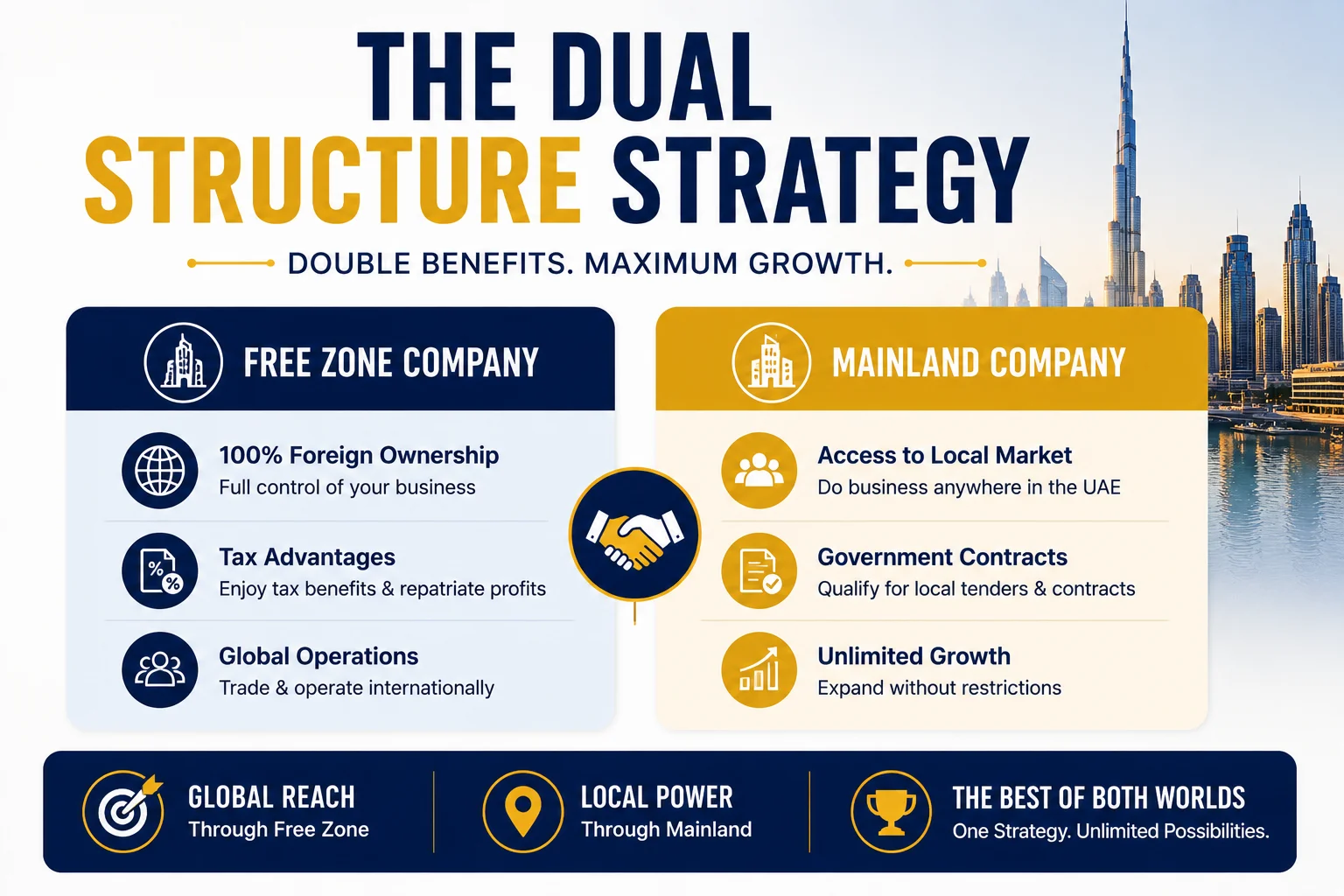
The Dual Structure Strategy
Many growing businesses in Dubai choose to run two parallel entities: a free zone company and a mainland company. This approach is more common than most people realise, and it can be genuinely cost-effective when used deliberately.
How it works
- The free zone entity handles international operations, invoicing overseas clients, and benefiting from the QFZP tax rate
- The mainland entity handles all UAE-based sales, government tenders, and local contracts
When it makes sense
- Your business has both international and UAE domestic revenue streams
- You want to maintain the tax efficiency of a free zone for international income
- You need mainland credibility for certain clients while keeping international operations lean
When it does not make sense
- You are a startup with limited capital, running two entities doubles compliance costs
- Your revenue is entirely from one market (all UAE or all international), and there is no benefit to the complexity
The dual structure requires careful accounting to ensure income is correctly allocated between entities, particularly in light of the UAE Corporate Tax Law’s transfer pricing and related party transaction rules.
Final Thoughts
Free zone companies remain one of the most popular business structures in the UAE, and for good reason. The combination of 100% foreign ownership, streamlined setup, and potential tax advantages makes them ideal for internationally focused businesses.
But the disadvantages of free zone companies in Dubai are real, and they catch many entrepreneurs off guard. The three you most need to plan for:
- No direct UAE market access: your mainland revenue potential is zero without a distributor
- Tax exemption requires qualification: the 2023 Corporate Tax Law ended the era of automatic 0% for all free zone companies
- Office size caps your team size: if you need to hire in the UAE, a flexi desk will not scale with you
The good news: with 100% foreign ownership now available on the mainland too, the choice between structures is clearer than ever. If you are targeting UAE customers or government clients, start with the mainland. If you are purely internationally focused, a free zone delivers excellent value. If you need a holding or asset structure, offshore is the most efficient route.
The right structure depends entirely on your specific business activity, target market, and long-term goals. Getting this decision right from the start saves significant time and costs down the line.